
.jpg) 2 hours ago
4
2 hours ago
4
Article content
74% of Canadians Say Rising Food and Gas Prices are Straining Their Finances, and 61% Report ‘Financial Whiplash’ as 43% Remain Within $200 of Not Being Able to Meet Their Financial Obligations

THIS CONTENT IS RESERVED FOR SUBSCRIBERS ONLY
Subscribe now to read the latest news in your city and across Canada.
- Exclusive articles from Barbara Shecter, Joe O'Connor, Gabriel Friedman, and others.
- Daily content from Financial Times, the world's leading global business publication.
- Unlimited online access to read articles from Financial Post, National Post and 15 news sites across Canada with one account.
- National Post ePaper, an electronic replica of the print edition to view on any device, share and comment on.
- Daily puzzles, including the New York Times Crossword.
SUBSCRIBE TO UNLOCK MORE ARTICLES
Subscribe now to read the latest news in your city and across Canada.
- Exclusive articles from Barbara Shecter, Joe O'Connor, Gabriel Friedman and others.
- Daily content from Financial Times, the world's leading global business publication.
- Unlimited online access to read articles from Financial Post, National Post and 15 news sites across Canada with one account.
- National Post ePaper, an electronic replica of the print edition to view on any device, share and comment on.
- Daily puzzles, including the New York Times Crossword.
REGISTER / SIGN IN TO UNLOCK MORE ARTICLES
Create an account or sign in to continue with your reading experience.
- Access articles from across Canada with one account.
- Share your thoughts and join the conversation in the comments.
- Enjoy additional articles per month.
- Get email updates from your favourite authors.
THIS ARTICLE IS FREE TO READ REGISTER TO UNLOCK.
Create an account or sign in to continue with your reading experience.
- Access articles from across Canada with one account
- Share your thoughts and join the conversation in the comments
- Enjoy additional articles per month
- Get email updates from your favourite authors
Sign In or Create an Account
or
Article content
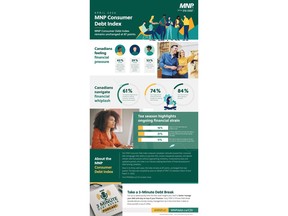
CALGARY, Alberta, April 13, 2026 (GLOBE NEWSWIRE) — Many Canadians are feeling the effects of ongoing economic uncertainty as conditions continue to evolve, reshaping household behaviours. According to the latest MNP Consumer Debt Index conducted quarterly by Ipsos, three in five (61%) say they are experiencing ‘financial whiplash’ as shifting conditions repeatedly disrupt their financial plans, while nearly three-quarters (74%) say rising prices for essentials like food and gas are straining their finances. Against this backdrop, nearly three-quarters (73%) say they are cutting back on spending, and more than four in five (84%) are more cautious about taking on new debt, as ongoing cost pressures and uncertainty drive conservative financial decision-making.
Article content
Article content
Article content
These pressures are also shaping how Canadians view their financial progress and future plans. Three in five (64%) say they feel they are working harder financially but not getting ahead, while seven in 10 (69%) say they are delaying major financial decisions because conditions feel unpredictable.
Article content
By signing up you consent to receive the above newsletter from Postmedia Network Inc.
Article content
“Many Canadians are not just feeling financial pressure, they are navigating an environment that continues to shift, increasing uncertainty and making it more difficult to plan, budget, and stay ahead financially,” explains Grant Bazian, president of MNP LTD, the country’s largest insolvency firm. “Rising everyday costs and broader global uncertainty are outside of an individual’s control, creating a sense of ‘financial whiplash’. When conditions feel unpredictable, it becomes harder to absorb unexpected expenses or make confident financial decisions, whether that’s taking on new debt, making a large purchase, or planning for the future.”
Article content
While the overall Index remains unchanged at 87 points, holding steady over the past year and reflecting a continued ‘wait and see’ approach, this apparent stability may be masking underlying financial pressures for many households, as Canadians continue to navigate an endurance economy where financial challenges persist without a clear endpoint. Canadians’ net personal debt rating edged up slightly from the previous quarter to 18 points (+1 pt) but still represents the lowest first-quarter debt rating in the Index’s history, underscoring ongoing financial strain as concerns about job security, inflation, and broader economic conditions continue to weigh on consumer sentiment.
Article content
Article content
Compared to a year ago, nearly one-quarter of Canadians (24%) say their debt situation has improved, while one in five (19%) say it has worsened, both unchanged from last quarter. This lack of movement highlights how many Canadians feel stuck with little progress in improving their financial position, as financial pressures persist and concerns about job security continue to rise, with nearly four in 10 (39%, +2 pts) fearing job loss in their household.
Article content
Financial pressures remain uneven as many households still face limited flexibility
Article content
The average amount Canadians have left at month-end has risen to an all-time high of $1,000, up from $907 last quarter, suggesting some improvement in overall financial flexibility. However, these gains are not being felt equally across all households. More than four in 10 (43%) say they are within $200 or less of not being able to meet their monthly financial obligations, up two points from last quarter, while nearly one-third (29%, +4 pts) say they already do not earn enough to cover their bills and debt payments.
Article content
While the Bank of Canada’s recent decision to hold its key rate at 2.25% may ease distress for some Canadians, three in five (61%, -3 pts) still say they need interest rates to come down. With the future direction of rates remaining uncertain, more than half (53%, -1 pt) fear financial trouble if rates rise, and four in 10 (42%, -2pts) are concerned rising rates could move them toward bankruptcy. Nearly half (45%, -3pts) say that even if rates decline, they remain concerned about their ability to repay their debts. Even small increases in interest rates could have an impact, as just one in five (20%) say they could absorb an additional $130 in monthly interest payments, while nearly one-third (32%) say they could not.
 English (US)