 Image via Paramount Pictures

Published Oct 31, 2026, 11:49 PM EDT
Charlie Ridgely is a writer from Maryland, currently residing in Nashville, Tennessee. He may be new to Collider, but he's been writing, editing, conducting interviews, and podcasting around the industry for 10 years. From 2016 to the start of 2026, Charlie was a full time writer and critic at ComicBook.com. A lifelong movie fan, avid reader, and renowned (fictional) dungeon explorer/dragonslayer, Charlie is a jack-of-all-trades throughout the fandom multiverse and has covered everything under the sun.
Sign in to your Collider account
Very few remakes are able to stand up to the quality of their predecessors. Even fewer wind up better than the original. When you get filmmakers like Joel and Ethan Coen involved, however, miracles feel a lot more attainable. Given their track record together, it should've come as no surprise that they were able to instantly conquer the modern Western back in 2010, crafting a much better version of a John Wayne classic in the process.
True Grit, starring Jeff Bridges (in a role that should have given him back-to-back Oscars), Matt Damon, and Hailee Steinfeld (in her film debut), was an instant Western masterpiece upon its release nearly 16 years ago. From the phenomenal performances turned in by the all-star cast, to the stunning cinematography from Roger Deakins, to the kind of darkly hilarious and simultaneously gut-wrenching dialogue only the Coen Brothers could write, True Grit is an absolute all-timer. It stands easily as the best Western movie of the last 15 years, and could arguably be counted amongst the greatest in the history of the genre.
This 'True Grit' Is Better Than the Original
Based on the novel by Charles Portis, the original True Grit first hit theaters back in 1969 and was another hit for John Wayne. In fact, this is the film that won Wayne his only Academy Award for acting, though many have argued that it was one of those victories that was more about a full body of work rather than just one performance. While Wayne's turn as Rooster Cogburn might be looked at as one of his better performances, True Grit is ultimately very forgettable in the grand scheme of his career, as well as in the landscape of the Western genre. The performances surrounding Wayne are tough to watch — Glen Campbell is especially disappointing — and the film doesn't have the effective pacing of Stagecoach or The Searchers. It's an average film at best, made memorable because of Wayne's involvement and the story itself, which can be attributed to the source material.
More than 40 years later, the Coen Brothers found a way to breathe new life into the tale of Rooster Cogburn, finally giving the character the quality film he always deserved but never got. Bridges is remarkable as the drunken Marshal, and he is able to play off a pair of absolutely brilliant actors in Damon and Steinfeld. Their electrifying dynamic paints the tale in an entirely different light, focusing on the melancholy of the West, rather than the rough-and-tumble adventure depicted in the original.
Of course, a lot of that melancholic tone can be attributed to the Coen Brothers, the filmmakers behind Fargo and No Country for Old Men. They have a specific way of viewing the world that really lends itself to the Western genre, capturing the sadness and hopelessness that operate in juxtaposition to joy and humor. There's a reason they've explored the genre in a few different ways over the years, though it's honestly a little surprising they haven't made even more Westerns. Hopefully, The Ballad of Buster Scruggs won't be their last.
Collider Exclusive · 8 Questions · 2 Minutes Which Western Icon Are You Most Like? No Name · Doc Holliday · Wyatt Earp · Mattie Ross
Pick your name, your gun, your horse and how you spend a night in town, and we will tell you which legend of the Old West you would have been. Four icons are waiting at the end of this: the stranger who never gives his name, the gambler who would die for a friend, the lawman who never wanted the badge, and the girl nobody has ever talked out of anything.
🚬No Name(Dollars Trilogy)
🃏Doc Holliday(Tombstone)
⭐Wyatt Earp(Tombstone)
🐎Mattie Ross(True Grit)
FIND YOUR ICON →
01
The town is about to learn your name. What do they call you? In a Western, what people call you is already half the character.
AThey never do find it out, so the stranger will have to do. BA nickname I picked up at a card table and never shook off. CMarshal, and most people say it with a bit of respect. DMy full name, and I will correct anybody who tries to shorten it.
NEXT QUESTION →
02
What are you carrying? Everything out here is character, right down to what is sitting on your hip.
AOne revolver I have had for years and have never once talked about. BA pistol, a knife and a deck of cards, and the cards do most of the damage. CA shotgun, because it tends to end arguments rather than start them. DMy father's gun, which is far too big for me, and I am carrying it anyway.
NEXT QUESTION →
03
What are you riding? A hero and their horse is one of the oldest relationships in cinema.
ASomething plain that nobody in town would look at twice. BWhatever I won last night, which may not be strictly mine yet. CA big steady horse that will not spook when things get loud. DA pony I overpaid for and named myself, and I will hear nothing against him.
NEXT QUESTION →
04
You have got one evening in town. How does it go? The saloon is where these films quietly tell you who somebody really is.
AOne drink at the far end of the bar with my back to the wall. BAt the card table, holding court, up forty dollars and climbing. CA quick drink, then a walk round town to see that everything is quiet. DUpstairs with the ledger, working out exactly what tomorrow is going to cost.
NEXT QUESTION →
05
A stranger offers you money for a job that sounds like trouble. Somebody always turns up with a full purse and a bad idea.
AI ask how much, and then I ask for a good deal more than that. BI say yes before he has finished, mostly because it sounds like a story. CI ask him who gets hurt if I turn him down. DI ask for the terms in writing before anybody shakes on anything.
NEXT QUESTION →
06
Somebody is waiting for you in the street. What does the town see? Two people, an empty road, and everybody else watching from behind the shutters.
ASomebody walking out very slowly who has not said a single word. BSomebody grinning, which everyone watching finds deeply unnerving. CSomebody making one last attempt to talk the other man down. DSomebody far too young to be out there, walking out regardless.
NEXT QUESTION →
07
What is the one thing you will not do out here? The code is about the only thing west of the river that actually holds.
AExplain myself to somebody who has not earned an explanation. BRide off and leave a friend standing out there on his own. CLet a whole town pay for a fight it had nothing to do with. DLet a grown man tell me I am too young to be standing here.
NEXT QUESTION →
08
The job is finished. Where does the story leave you? Eight questions in, this is the one that decides your icon.
AOn a ridge somewhere, riding away, without saying goodbye to anybody. BSomewhere warm and worn out, having enjoyed very nearly all of it. CHome, with the badge on the table and the whole thing behind me. DOlder, changed by it, and telling this story for the rest of my life.
REVEAL MY ICON →
The Dust Has Settled Your Western Icon Is…
Four icons and four completely different ways of walking into trouble. This is the one you would have been out there, why it fits, and what it would have cost you.
The Man With No Name
You have never explained yourself and you have never needed to, because people work out fairly quickly that you are the most capable person in the room without you ever having to mention it.
- Eastwood built the character out of everything he refused to do, stripping away the backstory, the speeches and every bit of reassurance until only the competence was left.
- You keep your own counsel, and while other people occasionally find that unnerving, you have never felt any real need to fix it for them.
- The Dollars films work because he genuinely is in it for himself right up until the moment he is not, and he never explains that part either.
- You would be gone before anybody got a chance to thank you.
Doc Holliday
You are the funniest person in most rooms and the most loyal person in all of them, and you would be genuinely insulted if somebody suggested those two things were in any tension.
- Doc has no real reason to be in this fight beyond the fact that his friend is in it, which is the only reason he has ever needed for anything.
- You lead with wit, and it does a very effective job of hiding how seriously you take the handful of people you actually care about.
- Val Kilmer's performance is the most quoted in the entire genre because the jokes keep getting sharper as the situation gets worse.
- You would spend everything you had on this and still describe it as a good week.
Wyatt Earp
You never wanted this job, and you took it anyway because the alternative was standing there watching somebody less careful do it badly, which is the most Western reason there has ever been.
- Earp is the reluctant authority figure, a man who came to town specifically to be left alone and somehow ended up answerable for all of it.
- You are protective by instinct, so when something goes wrong your first thought is who is exposed rather than who is to blame.
- These films understand that keeping order costs far more than breaking it, and that the person holding the line almost never gets thanked.
- You would do the whole thing again, and you would complain about it the entire time.
Mattie Ross
Nobody has ever successfully talked you out of something you had already decided was right, and a long line of grown adults has found that out the hard way.
- Mattie is the most relentless character in the Western canon and she manages it through argument, paperwork and flat refusal rather than a fast draw.
- You have no patience for being managed, so you negotiate, you check the details and you turn up exactly when you said you would.
- True Grit is the rare Western where the moral centre is the youngest person on screen and every adult around her has to catch up.
- You would get what you came for, and the film is honest about what that takes out of you.
↻ RETAKE THE QUIZ
One Big Choice Sets the 'True Grit' Remake Apart
Of all the great choices made by the Coen Brothers when adapting True Grit, none were more impactful than the decision to not make the movie about Rooster Cogburn. He's the big character in the story, and he is the person you'll see the most of throughout any iteration of the film, but the tale has never been his to tell. True Grit belongs to Mattie Ross (Steinfeld), and the remake never once lost sight of that.
Now, putting this kind of heavy exploration of grief and the fragility of life into the hands of an unknown 13-year-old is certainly a choice, but the Coens knew exactly what they had in Hailee Steinfeld. She was more than up to the challenge, delivering one of the best young performances of the 21st century. She was nominated for an Oscar at just 14 for her turn as Mattie Ross, and she easily could've walked away as a winner. When it comes to Western movies made after the turn of the millennium, they don't get much better than True Grit. Even if you weren't a fan of the original, there's a great chance you'll find a lot more to love in this phenomenal adaptation.
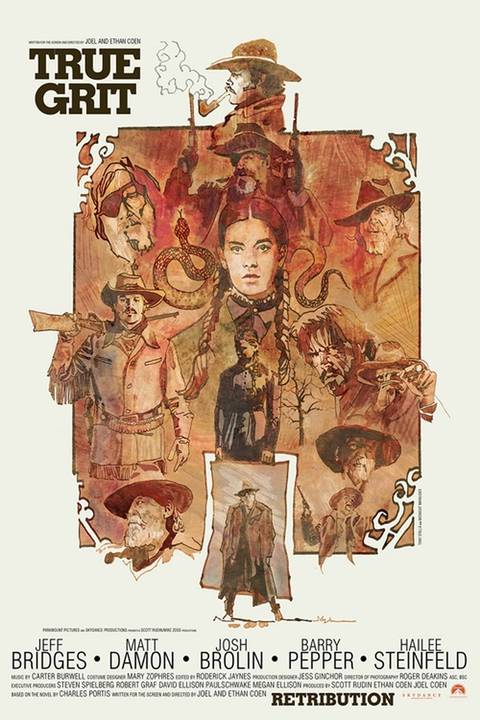
True Grit
Release Date December 22, 2010
Runtime 110 minutes