
.jpg) 2 hours ago
2
2 hours ago
2
Some killer whales don’t get along with others, and in extreme cases, they may stoop to cannibalizing members of their own species. The notion of cannibal killer whales, however, is more complicated than it appears on the surface. The clear-cut differences between separate killer whale groups have led researchers to consider whether there’s truly just one species of killer whale, or multiple subspecies.
A new study published in Marine Mammal Science has confronted the question of killer whale cannibalism at a marine crime scene on Bering Island off Russia’s Pacific coast, where severed killer whale fins marked with the teeth of another whale were discovered on two separate occasions in 2022 and 2024.
This evidence provides a glimpse into two killer whale groups that are unlike in many ways, from their diets to their social structures.
“They almost certainly do not perceive themselves as belonging to the same species. For the transient groups, the resident killer whales are simply prey,” said study author Olga Filatova, a whale researcher and associate professor at the University of Southern Denmark, in a statement.
Questioning Killer Whale Cannibalism
Although there is technically only one species of killer whale — Orcinus orca — multiple whale groups display their own specialized behaviors. These groups are acknowledged as ecotypes, populations of a species that exhibit distinct features in response to ecological conditions; such features are generally considered too subtle to warrant the classification of an ecotype into a new subspecies.
In the North Pacific, there are three recognized killer whale ecotypes: residents, transients, and offshores. Each ecotype leads different lives, best seen in the contrast between residents and transients. While residents primarily feed on fish and live within large families that stick close together, transients (also called Bigg’s killer whales) hunt marine mammals and travel in smaller, looser social units, often leaving their families at a young age.
When the torn-off whale fins were found on Bering Island, researchers suspected that one killer whale had likely eaten another. Genetic analysis of the remains confirmed that they belonged to resident whales. All signs pointed to predation of resident whales by the mammal-eating transient whales.
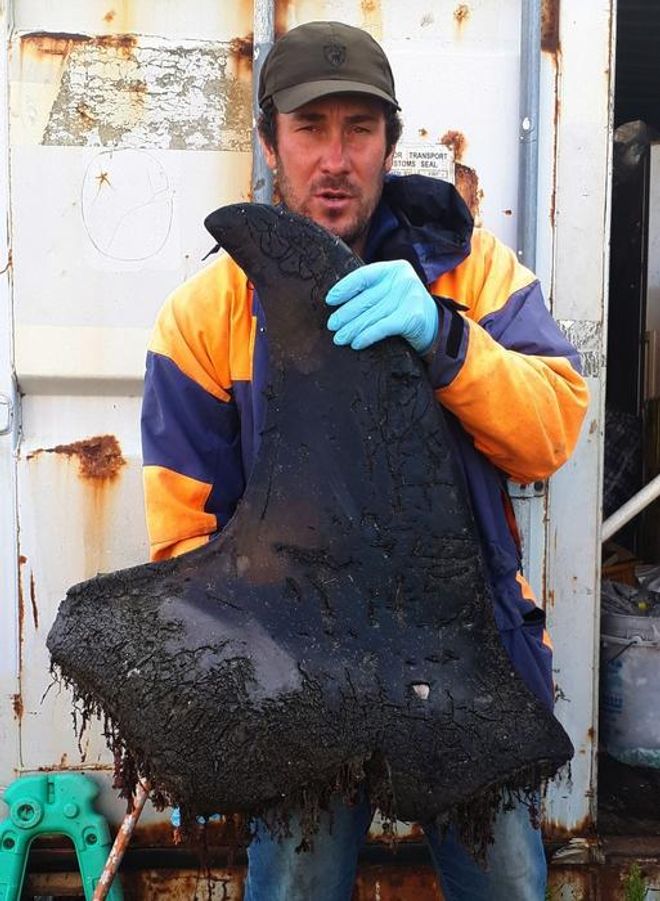
Torn-off killer whale fin, found on Bering Island.
(Image Credit: Sergey Fomin/SDU)
But the researchers think of this less as cannibalism and more as interspecific predation. Because despite living in the same waters, the two groups don’t socialize or interbreed.
Read More: Those Orcas Wearing Salmon Hats? It Might Not Be as Cute as You Think
Incompatible in the North Pacific
Resident and transient whales are both long-time residents of the North Pacific, and may have ties going back hundreds of thousands of years. Transient whales showed up first once the waters became ice-free, moving from the Atlantic. Residents later arrived in the area, needing to develop such a tight-knit family structure to protect against potential predation by transient whales.
“We are witnessing an evolutionary process: these two groups, which never mix, are becoming increasingly distinct. At some point, they will be so different that they will become separate species,” said Filatova in the release.
Residents and transients that call the North Pacific home aren’t the only groups to have such distinct traits. There are all kinds of other whale groups around the world that eat different prey and prefer different habitats.
A Fateful Gathering
As for resident whales near Bering Island, some family members leave their immediate group for an hour or two to seek out other resident families. Multiple families even have large gatherings to give young females and males a chance to find mates outside of their own family.
However, residents are spread far apart during these gatherings, leaving themselves open to predation from transient whales (although the researchers note that reports of cannibalism from transients are exceptionally rare). Only days before one of the severed fins was discovered, it turns out, multiple residents had a gathering that would end in the death of one of their family members.
Read More: Whales are Capable of Complex Communication — Could Humans Ever Talk With Them?
Article Sources
Our writers at Discovermagazine.com use peer-reviewed studies and high-quality sources for our articles, and our editors review for scientific accuracy and editorial standards. Review the sources used below for this article:
- This article references information from a study published in Marine Mammal Science: Predation by Mammal-Eating Bigg's Killer Whales (Orcinus orca rectipinnus) May Shape the Unique Social Structure of “Resident” Fish-Eating Killer Whales (O. o. ater) in the North Pacific
 English (US)