
.jpg) 1 hour ago
3
1 hour ago
3
In a dry riverbed in northern Brazil, paleontologists kept finding the same strange bone. Each was about six inches long, curved, thick, and unmistakably twisted. At first, the fossilized jaw looked like a deformity. But as more examples emerged from the same ancient rock layers, it became clear the twist was a defining feature of the animal.
Now, in Proceedings of the Royal Society B, researchers describe the animal behind those bones: a previously unknown species that lived 275 million years ago and may represent one of the earliest four-limbed vertebrates to grind plants for food — and a survivor from a lineage scientists thought had already vanished. They named it Tanyka amnicola — “jaw” in the local Guaraní language, and “river dweller” in Latin.
“Tanyka is from an ancient lineage that we didn’t know survived to this time, and it’s also just a really strange animal,” said Jason Pardo, the study’s lead author, in a press release. “We were scratching our heads over this for years.”
Ancient Tetrapod Lineage Survived Into the Permian
Tanyka belonged to the tetrapods, four-limbed vertebrates that today include reptiles, birds, mammals, and amphibians.
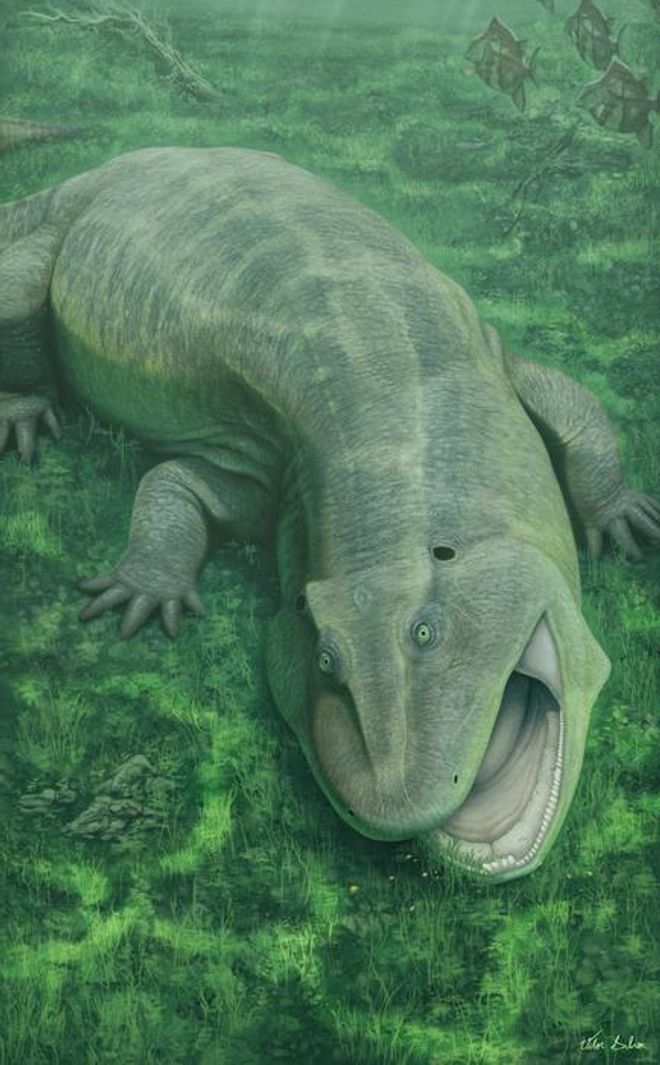
Illustration of Tanyka amnicola.
(Image Credit: Vitor Silva)
But it was not part of the more familiar branches that would eventually dominate life on land. Instead, it came from an older lineage that had mostly faded by the time more modern tetrapods diversified.
“Tanyka is a little like a platypus,” Pardo explained, a species that comes from an older evolutionary branch that persisted even as newer groups of tetrapods evolved. Much like how egg-laying mammals such as the platypus still exist today alongside more modern mammals, Tanyka appears to represent a lineage that survived long after most of its relatives had disappeared. In that sense, it was something like a “living fossil” in its own time.
Fossils from this period, the early Permian, are rare in what was once Gondwana, the southern supercontinent that included present-day South America, Africa, Antarctica, and Australia.
Read More: Fossils Show Pronghorn Speed Predates the American Cheetah by 5 Million Years
A Twisted Jaw That Helped Early Tetrapods Grind Plants
In most animals, the lower jaw angles upward, with teeth aligned toward the roof of the mouth. In Tanyka, the lower jaw was twisted so the main teeth pointed outward and slightly to the sides. Meanwhile, the inner surface of the jaw (the part that would face the tongue in humans) was rotated upward and lined with rows of small, tightly packed teeth known as denticles.
Those surfaces would have created a grinding motion as the lower denticles scraped against similar structures in the upper jaw. Rather than slicing flesh, the teeth appear designed to crush and shred plant material.
The fact that it ate plants is notable, as most of its close relatives were carnivorous. If confirmed, the finding points to plant-eating adaptations evolving earlier, and in more unexpected branches, of the tetrapod family tree than previously recognized.
Nine Fossil Jaws Offer Clues to Life in Gondwana
Despite the discovery of nine distinctive jaws, no skull or clearly associated skeleton has been found. That leaves much of the animal’s body unknown.
By comparison with related species, researchers estimate that Tanyka may have resembled a salamander with a slightly elongated snout and could have grown up to three feet long. The surrounding rock layers suggest it lived near lakes or slow-moving waterways.
The fossils come from Brazil’s Pedra de Fogo Formation, one of the few sites preserving animals from Gondwana during the early Permian. Discoveries from the formation are helping paleontologists reconstruct how vertebrate communities functioned in the southern supercontinent 275 million years ago.
Even from a handful of twisted jaws, Tanyka adds an unexpected piece to that ancient ecosystem.
Read More: Waiting for selection...
Article Sources
Our writers at Discovermagazine.com use peer-reviewed studies and high-quality sources for our articles, and our editors review for scientific accuracy and editorial standards. Review the sources used below for this article:
- This article references information from a recent study published in Proceedings of the Royal Society B: An aberrant stem tetrapod from the early Permian of Brazil
 English (US)