
.jpg) 2 hours ago
2
2 hours ago
2

The 2026 F1 season will mark the start of a new era with new regulation changes. According to F1 insider José M. Zapico, a fresh problem that almost every team is struggling with is the new minimum weight.
A key structural change includes the car configurations. The new rules mandate machines that are 20cm shorter and 10cm narrower, targeting a 3.4-metre wheelbase and 1.9-metre width. The minimum weight drops by 30kg to 768kg. On paper, these reductions aim to improve agility and make cars easier to race.
That is precisely where the concern lies for Spanish F1 collector, author, and commentator, Zapico. Known through “Virutas de Goma F1” on X, he suggested that teams were finding the new weight limit brutally difficult:
“Maybe there are more teams that are dragging their feet. They’re all way overweight. All of them. Aston still hasn’t passed the crash tests but they will, and there are teams that haven’t even mounted the engine in the car yet. This preseason is enough for a Netflix series.”He later added:
“Hey… keep in mind that this shouldn’t be taken literally. Cars keep evolving, they have some time before the first race, they’re going to keep scraping from all sides, and they can evolve. But the weight is, without a doubt, one of the battles of this year. The info is changing.”The sport is preparing for its biggest technical reset since the hybrid era began in 2014. The new rules overhaul the power unit, the aerodynamics, and the chassis.
Cars become far more reliant on electrical systems through the battery and energy recovery systems, while chasing dramatic reductions in size. At the same time, the new “Overtake Mode” replaces DRS. Active aero becomes standard, with movable wings reducing drag on the straights. A new “Boost Mode” will allow deployment of combined engine and battery output anywhere on the lap, like the original KERS concept.
 Lewis Hamilton of Scuderia Ferrari before the F1 Australian Grand Prix. Source: Getty
Zapico’s warning feels credible because engineers are being asked to do conflicting things at once: shrink the cars, keep them robust, carry new systems, and still drop weight. However, he added that teams are chipping away with every iteration. And over the next month, parts will be redesigned.
FIA toughens stance on F1 teams over 2026 rules: “We will not tolerate anyone exploiting loopholes”
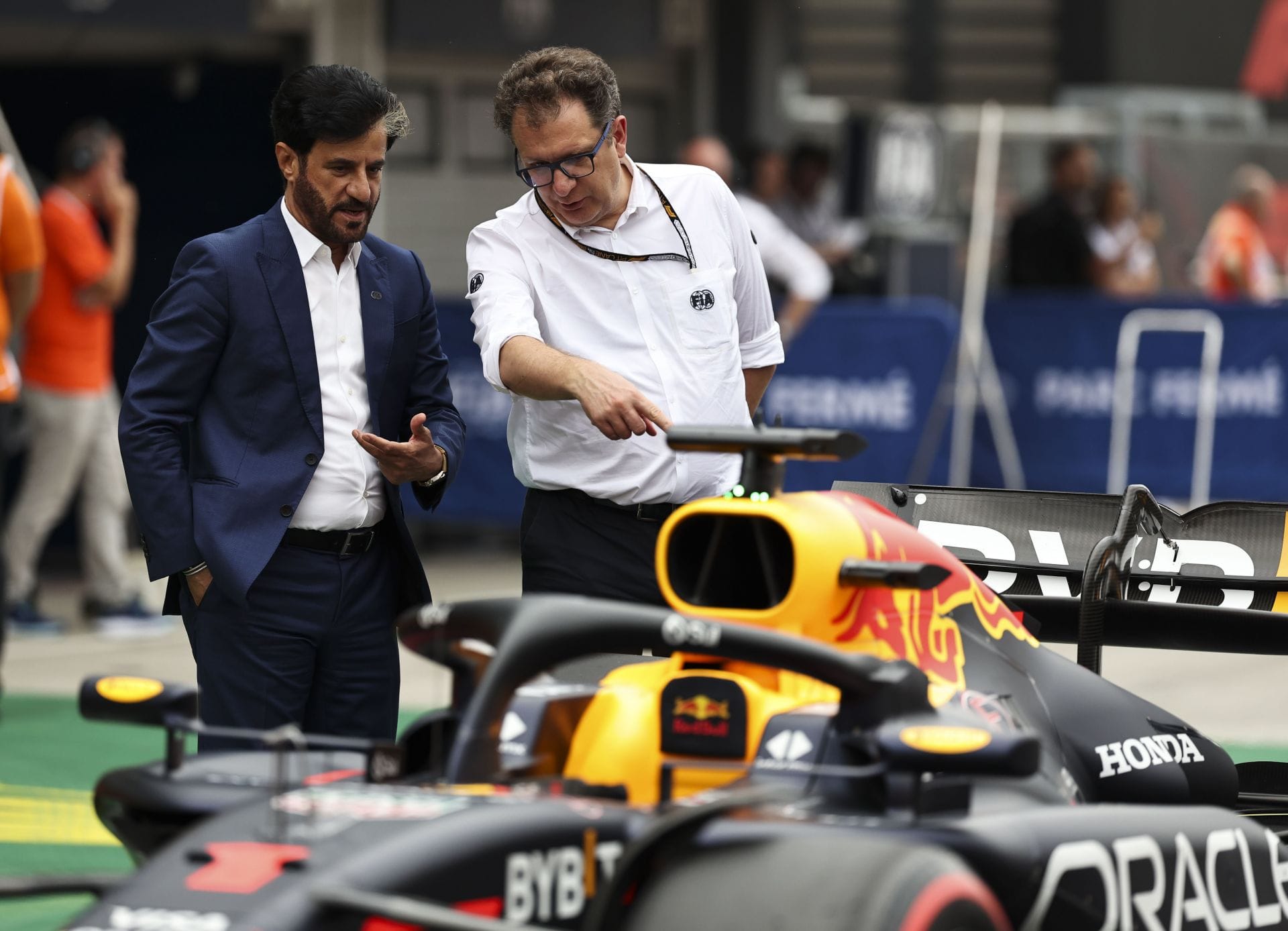 FIA President (L) Mohammed Ben Sulayem talks to Nikolas Tombazis at Hungaroring. Source: Getty
As the F1 teams prepare for the 2026 regulations, speculation grows around whether certain manufacturers may already be pushing the limits of the upcoming framework. Concerns have emerged with Mercedes and Red Bull Powertrains over a technical grey area linked to compression-ratio rules, which drop from 18:1 to 16:1.
As compliance checks are carried out with cold engines, questions were raised about whether thermal expansion at running temperature could be used to gain performance. The FIA moved quickly, signalling that anything approaching this sort of interpretation will be confronted. Nikolas Tombazis, the FIA’s single-seater director, said (via GP Blog):
“First of all, we made it clear to the teams that we will not tolerate anyone exploiting loopholes in the regulations that they have kept hidden from us. If a team came up with a solution based on a certain interpretation of the rules without asking us for clarification, we would never listen to them. If someone developed a concept based on a 50–50 ambiguous interpretation, it would be suicide for that team.”Another regulation under scrutiny was the fuel-flow system. With F1 moving to fully sustainable fuels, the old 100kg/h mass-flow ceiling is being replaced with a 3000MJ/h energy-flow limit. It required a different verification method. Instead of two fuel-flow meters, FIA has decided that all cars will now use a single Allengra ultrasonic unit that provides the same live data to both sides.
Tombazis's message lands at a time when every power unit manufacturer is under pressure. Audi steps in as the factory program replacing Sauber, and Honda moves to Aston Martin. All are now deep into simulation, integration, and systems work, with F1 testing only weeks away. And they want to stay ahead in the reset, even if the fight to meet the rules is proving harder than expected.
Why did you not like this content?
- Clickbait / Misleading
- Factually Incorrect
- Hateful or Abusive
- Baseless Opinion
- Too Many Ads
- Other
Was this article helpful?
Thank You for feedback
Edited by Hitesh Nigam
 English (US)