In Conversation with Whitney Terrell and V.V. Ganeshananthan on Fiction/Non/Fiction
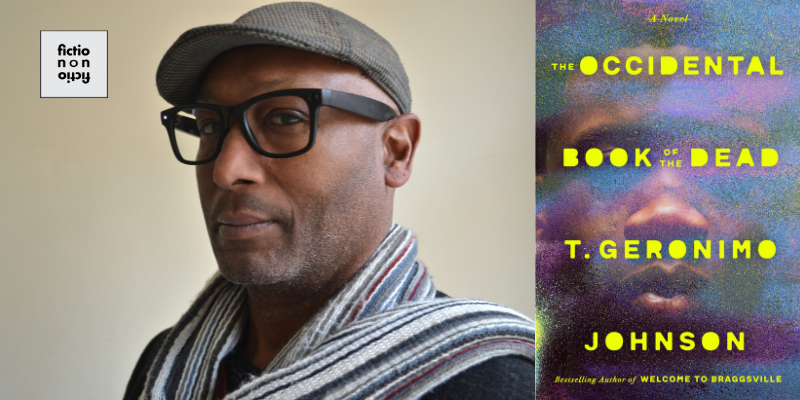
Award-winning fiction writer T. Geronimo Johnson joins co-hosts V.V. Ganeshananthan and Whitney Terrell to talk about his new novel, The Occidental Book of the Dead. He discusses how the book addresses white supremacy and the United States’ deep-seated and racist mythology through the perspective of George Washington Jonson, a black police officer working in a fictional version of Atlanta. Johnson talks about researching police work but almost entirely avoiding depicting scenes of it on the page, and also explains why the book transitions from third to first person. He reflects on how structures of The Egyptian Book of the Dead and other classics are incorporated into the story. He reads from The Occidental Book of the Dead.
To hear the full episode, subscribe through iTunes, Google Play, Stitcher, Spotify, or your favorite podcast app (include the forward slashes when searching). You can also listen by streaming from the player below. Check out video versions of our interviews on the Fiction/Non/Fiction Instagram account, the Fiction/Non/Fiction YouTube Channel, and our show website: https://www.fnfpodcast.net/ This podcast is produced by V.V. Ganeshananthan, Whitney Terrell, Archer Walsh, Elizabeth Willis, and Eric Thong.
T. Geronimo Johnson
The Occidental Book of the Dead • Hold It ‘Til It Hurts • Welcome to Braggsville
Others
A Man in Full by Tom Wolfe • The Handmaid’s Tale by Margaret Atwood • Autobiography of an Ex-Colored Man by James Weldon Johnson • The Egyptian Book of the Dead, translated by E.A. Wallis Budge • The Consolation of Philosophy by Boethius • Confessions by St. Augustine
EXCERPT FROM A CONVERSATION WITH T. GERONIMO JOHNSON
V. Ganeshananthan: This novel is broken up into different parts, and the first part is written in the third person, and then there’s this shift to [George Washington] Jonson’s first-person voice, which is prefaced with, among other things, a note about how it should not be read aloud. But there’s all of this text appended to the story that gives it the appearance of a certain other kind of story. For example, there’s episode credits or a fake copyright page, and then this perspective rupture. And I want to ask how you developed this structure and if you always knew that this was where you were headed.
T. Geronimo Johnson: No, I didn’t always know I was headed in this direction. At one point the book was, I think, a thousand pages. It covered 400 years, and we learned along the way that Anthony and George Washington Jonson are in family lines that have the same root, like on a plantation. This version also featured several trials. It was framed around these trials that were interrogating Founding Fathers, religious belief[s], and stuff like this.
There was this other legal framework. It was a long case, and after I escaped that, so to speak, there was a point where, as an important early reader said, it felt like there was too much racism in the book, and I didn’t agree at all. But I understood why they felt that way, and they felt that way as I interpreted it, because there was nothing racist happening in this version of the book, but there was a sense that there was all this atmospheric racism. And so the book was haunted in a way, but it wasn’t processing [racism], so I decided that I needed a first-person narrator to actually process what was happening. That was the only way to hold it together. I actually needed a human consciousness that the reader had direct access to, but a consciousness that also felt as if it had access to the reader, so to speak.
And then at some point after that, I think it was just a string of minor miracles. To be honest, literally, it was just persisting, persisting, persisting, persisting, persisting, and it eventually fell together and touched this emotional goal that I’d had in mind the entire time. But the the odd thing is that in terms of the the formal decisions, I think probably the two biggest formal decisions, or the most important ones were: introducing George Washington Jonson as a narrator, and the other one was—there are a few medieval texts that I’m fond of: The Consolation of Philosophy by Boethius, Augustine’s Confessions, and a few others—and just incorporating some of that provided structural inspiration to hold it together. There’s a point after which I feel like I can’t even take credit for writing the book, I can only take credit for having been diligent enough to keep showing up. That’s just how it started to feel.
Whitney Terrell: As someone who’s been involved in books that take a long time, there is that feeling when you’re like, “Oh shit, I don’t have anywhere to go but forward. I don’t know how to go forward, and it’s scary.” At least it is for me when I get in that position.
TGJ: Yeah, it is in ways, but at the same time, I’m also pathologically determined. I mean, I’m a black man in America. I’ve got something to say, and I’m going to finish the book. Like, that’s going to happen. There’s no question about that. And so I think that this gives me a little bit of extra gas when the tank is low because [of] the things that have to be said, and so many people have died for me to even be able to read. And I don’t mean only black people. There’s been so much that’s happened in the world that has made it possible for me to have this opportunity. Like I have to finish the damn book because to not is just—can we curse on this show?
VVG: Yes.
TGJ: It would just be bullshit. What am I crying about? It’s like, “take your ass back to the desk and finish the book.” I just feel like I have an obligation to everyone who came before me, and I also feel like I have an obligation to all my teachers and everyone I’ve ever known in the writing community who’s given me inspiration or read my work. I just feel like I’ve got to get it done. Otherwise, I feel like I’m just wasting or squandering.
Transcribed by Otter.ai. Condensed and edited by Eric Thong, Archer Walsh, and Elizabeth Willis. Photograph of T. Geronimo Johnson by Elizabeth Cowan.