
.jpg) 1 hour ago
2
1 hour ago
2
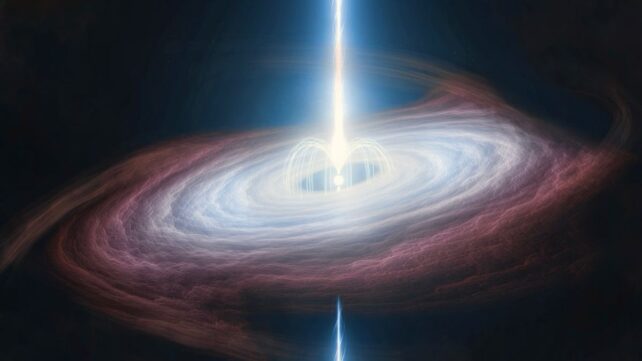 An artist's impression of a magnetar with a wobbly accretion disk. (Joseph Farah and Curtis McCully)
A never-before-seen 'chirp' in the light of an exploding star has revealed new clues about the engine powering some of the brightest supernovae in the Universe.
According to an analysis of the unprecedented signal, a superluminous supernova named SN 2024afav was most likely the violent birth of a magnetar – a rapidly spinning, extremely magnetic neutron star whose environment is 'wobbling' due to an effect predicted by general relativity.
The event, says a team led by astrophysicist Joseph Farah of Las Cumbres Observatory in the US, marks the first observational evidence of this effect, known as Lense-Thirring precession, in the environment of a magnetar.
"There was just no existing model that could explain a pattern of bumps that get faster in time," Farah says. "I started thinking about ways this could happen, because the signal seemed too structured to be due to random interactions."
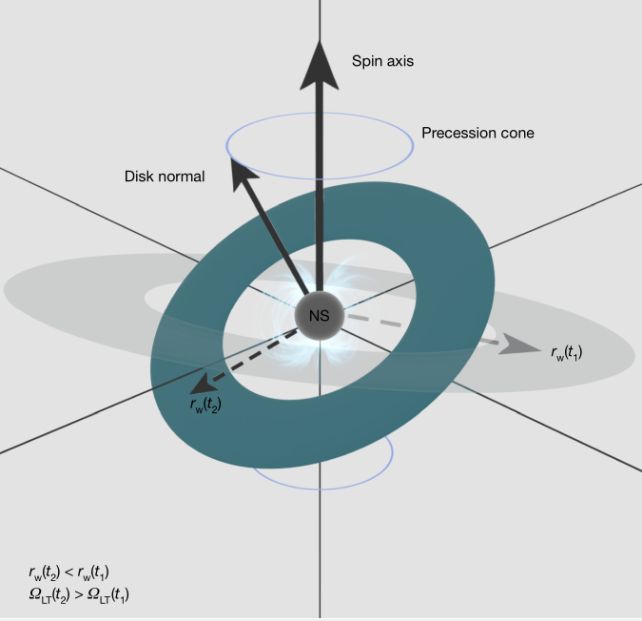 A diagram of the disk infall and precession thought to be behind the superluminous supernova signal. (Farah et al., Nature, 2026)
Superluminous supernovae are among the most powerful explosions in the cosmos, shining up to 100 times brighter than a typical supernova.
They also show an unusual pattern: Most supernovae follow a predictable path, brightening and then fading over time. Superluminous supernovae, by contrast, display a sort of undulating pattern, with 'bumps' in their brightness.
Scientists have long theorized that magnetars – newly formed, highly magnetized neutron stars that spin on millisecond timescales – may power these explosions.
According to models, the spin of a newly formed magnetar immediately decreases, transferring energy to the supernova ejecta blasting outward, which absorb and re-emit the energy as light. This, however, does not explain the bumps in the light curve.
SN 2024afav was a superluminous supernova observed in 2024, across a distance of more than a billion light-years. Astronomers monitored it for months using a global network of telescopes to track its changing brightness.
It displayed the characteristic bumps of a supernova of this kind, but Farah noticed something else. The bumps had a clearly periodic, wave-like pattern – and the gap between each wave was getting shorter.
Such a pattern is what astronomers call a chirp – a signal whose frequency increases over time.
In Farah's interpretation of the signal, the chirp can be attributed to material that fell back toward the newborn magnetar after the explosion. Some of this material flowed into a disk orbiting and slowly falling back into the magnetar.

Now, because the magnetar is so dense and spinning so rapidly, it sort of twists the fabric of spacetime around itself – an effect predicted by Einstein's theory of general relativity known as Lense-Thirring precession, or frame dragging.
This warped spacetime causes the tilted disk to wobble like a spinning top. As it wobbles, it periodically blocks or redirects some of the energy streaming from the magnetar into the expanding supernova debris. This is what creates the bumps seen in the light curve.
Over time, the disk gradually falls inward toward the magnetar. Closer to the star, the frame-dragging effect becomes stronger, and the disk wobbles faster. This is why the bumps in brightness occur closer together, producing the observed chirp.
"We tested several ideas, including purely Newtonian effects and precession driven by the magnetar's magnetic fields, but only Lense-Thirring precession matched the timing perfectly," Farah explains.
"It is the first time general relativity has been needed to describe the mechanics of a supernova."
Related: A Magnetar's Birthplace Deepens The Mystery of Its Origins
This finding provides strong evidence that magnetar spin-down powers superluminous supernovae and finally explains the mysterious bumps in their light curves.
That means astronomers have a much stronger context for analyzing and understanding these extreme explosions. On top of that, though, are broader implications: The result suggests that violent supernovae offer a new regime for testing general relativity at the limits of physics.
"This is the most exciting thing I have ever had the privilege to be a part of. This is the science I dreamed of as a kid," Farah says. "It's the Universe telling us out loud and in our face that we don't fully understand it yet, and challenging us to explain it."
The research has been published in Nature.
 English (US)