
.jpg) 1 hour ago
3
1 hour ago
3
Article content
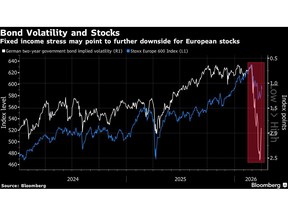
(Bloomberg) — The stock market is looking past the sharp interest rate hikes priced by Europe’s bond market, risking losses for investors backing the wrong outcome.

THIS CONTENT IS RESERVED FOR SUBSCRIBERS ONLY
Subscribe now to read the latest news in your city and across Canada.
- Exclusive articles from Barbara Shecter, Joe O'Connor, Gabriel Friedman, and others.
- Daily content from Financial Times, the world's leading global business publication.
- Unlimited online access to read articles from Financial Post, National Post and 15 news sites across Canada with one account.
- National Post ePaper, an electronic replica of the print edition to view on any device, share and comment on.
- Daily puzzles, including the New York Times Crossword.
SUBSCRIBE TO UNLOCK MORE ARTICLES
Subscribe now to read the latest news in your city and across Canada.
- Exclusive articles from Barbara Shecter, Joe O'Connor, Gabriel Friedman and others.
- Daily content from Financial Times, the world's leading global business publication.
- Unlimited online access to read articles from Financial Post, National Post and 15 news sites across Canada with one account.
- National Post ePaper, an electronic replica of the print edition to view on any device, share and comment on.
- Daily puzzles, including the New York Times Crossword.
REGISTER / SIGN IN TO UNLOCK MORE ARTICLES
Create an account or sign in to continue with your reading experience.
- Access articles from across Canada with one account.
- Share your thoughts and join the conversation in the comments.
- Enjoy additional articles per month.
- Get email updates from your favourite authors.
THIS ARTICLE IS FREE TO READ REGISTER TO UNLOCK.
Create an account or sign in to continue with your reading experience.
- Access articles from across Canada with one account
- Share your thoughts and join the conversation in the comments
- Enjoy additional articles per month
- Get email updates from your favourite authors
Sign In or Create an Account
or
Article content
Swaps imply three European Central Bank rate increases this year, reflecting how the region is particularly exposed to energy shocks triggered by the Iran war. While growth concerns are also starting to emerge, there’s widespread conviction that central banks will be eager to ensure inflation is kept under control.
Article content
Article content
Article content
Moves in stocks, however, are more in keeping with slowing economic growth that will keep rates stable, or even lead to easing.
Article content
By signing up you consent to receive the above newsletter from Postmedia Network Inc.
Article content
“The market is schizophrenic when it comes to possible ECB rate hikes or cuts,” said Karen Georges, an equity fund manager at Ecofi in Paris, describing the divergence between moves in equities and bonds. “We are clearly among those who don’t see two hikes — let alone three, given how a prolonged crisis would hit economic activity. It’s even possible to envisage a rate cut by the end of the year if there’s a substantial impact on growth.”
Article content
Benchmark German 10-year bond yields hit a 15-year high on March 27 and BlackRock Inc. is among major investors betting on further losses. While the Stoxx Europe 600 Index just recorded its worst month since June 2022, valuations remain high. Members of the benchmark gauge trade at around 15 times forward earnings, well above the average of the past two decades.
Article content
Market expectations for European earnings highlight a similar contrast: analysts predict profit growth of 11% for 2027. To make that a reality, companies will need benign economic conditions and favorable borrowing costs, rather than the aggressive rate-hike expectations showing up in bonds.
Article content
Article content
For Amélie Derambure, a senior multi-asset portfolio manager at Amundi in Paris, bond markets are responding to the conflict as if its inflation impact will resemble the fallout from Russia’s invasion of Ukraine four years ago.
Article content
“I find the market price reaction in the fixed income market particularly brutal,” she said. “Stock markets are still uncertain as for the economic consequences of the conflict, but the bond market is already looking at a 2022 type of scenario.”
Article content
The risk for stocks is that the economy falters, earnings disappoint and central bank easing fails to materialise, putting pressure on valuations that remain fairly rich.
Article content
In the US, the S&P 500 Index is seeking to snap a run of five consecutive weeks of losses, the longest losing streak since 2022. But Wall Street equity valuations remain elevated. The cyclically adjusted price-to-earnings Shiller ratio recently rose above 38 times, among its highest readings in over 150 years of data, despite the recent drop in equity prices.
Article content
‘Transitory Disruptions’
Article content
US investors, too, appear to have learned to ride out geopolitical shocks. The tactic has paid off numerous times in the past few decades, including after the Gulf and Iraqi wars when equity markets were higher within six months of the conflict, even as oil spiked. More recently, this has been true of the start of the Ukraine war and the “Liberation Day” tariff turmoil of April 2025.
 English (US)