
.jpg) 11 hours ago
3
11 hours ago
3
 A section of ice core extracted from Antarctica. (Alfred Wegener Institute/Esther Horvath)
This glittering spaceship Earth and the Solar System it inhabits are not fixed in space, but whirl, slowly and grandly, as part of the galactic-scale waltz around the heart of the Milky Way.
Where the Solar System has been on this ancient journey is often impossible for us to know – but new clues have just surfaced, frozen for tens of thousands of years in Antarctic ice.
There, a team of scientists led by nuclear astrophysicist Dominik Koll of the Helmholtz-Zentrum Dresden-Rossendorf in Germany has found rare iron isotopes that trace our planet's recent passage through an interstellar cloud of supernova dust – the leftover debris from long-dead stars.
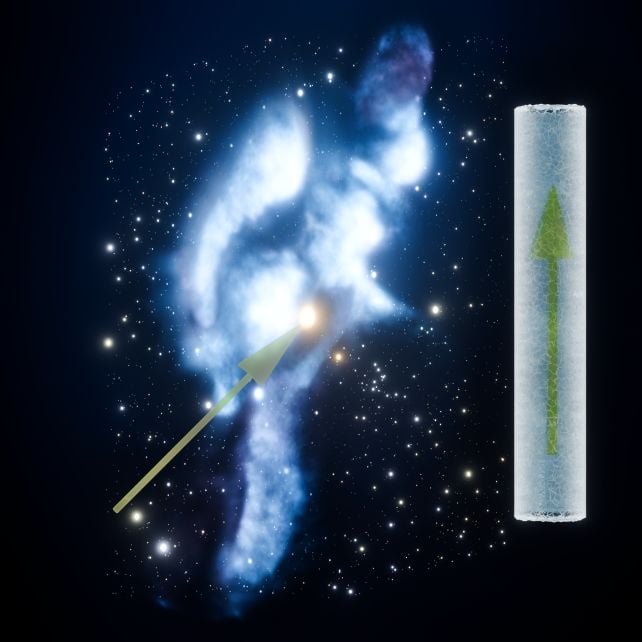 A diagram illustrating how the distribution of iron-60 in an ice core relates to Earth's journey through the Local Interstellar Cloud. (B. Schröder/HZDR/NASA Goddard/Adler/U Chicago/WesleyanImage)
In recent decades, the Antarctic ice sheet has emerged as an invaluable source of information about our planet's history. It started forming, layer by layer, from falling snow around 35 million years ago, and within each layer, particles from the atmosphere were captured and frozen.
Over time, this layered buildup, compressed by its own weight, turned into a vertical time capsule from which scientists can extract long cylinders of ice for a chronological record of atmospheric change over millions of years.
In 2019, Koll and his colleagues examined freshly fallen Antarctic snow and found trace amounts of an iron isotope called 60Fe or iron-60.
Now, they have found iron-60 frozen in ice cores dating back to between 40,000 and 81,000 years ago.
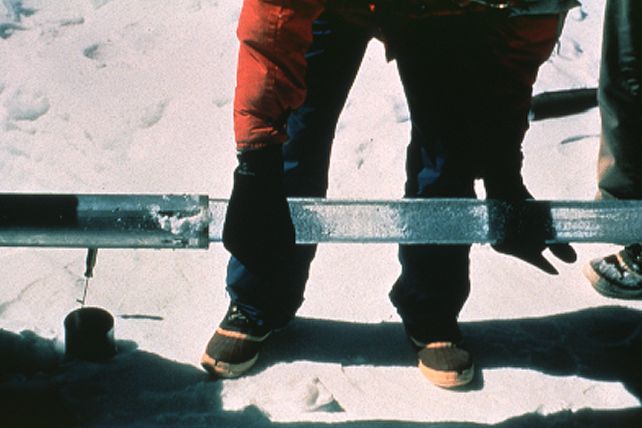 Scientists extract an ice core from a drill. (Lonnie Thompson, Byrd Polar Research Center, Ohio State University)
Iron-60 is special because it can only form in specific extreme conditions that don't occur naturally on Earth, such as supernova explosions.
It's possible that some iron-60 got caught up in Earth's formation, but with a half-life of just 2.6 million years, it's practically all decayed after about 15 million years. Any iron-60 that was present when Earth formed 4.5 billion years ago is long gone.
This means that any iron-60 we find on our planet above a certain background threshold has to have fallen from space. There is no known natural way for Earth to produce it in meaningful amounts.
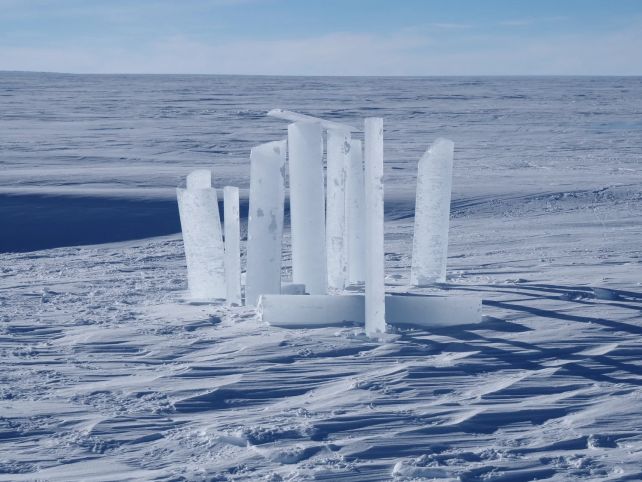 Antarctica's ice sheet traps a climate record spanning tens of millions of years. (NSF COLDEX)
In addition, given how it forms, scientists believe that its presence on Earth, in ocean sediments as well as in recent snowfall, means that our Solar System moved through – and may still be moving through – supernova debris.
After the discovery of iron-60 in surface snow, Koll and his colleagues wanted to literally dig deeper to see how far back the iron-60 record extends.
Using samples collected as part of the European Project for Ice Coring in Antarctica (EPICA), the researchers sifted through 295 kilograms (650 pounds) of Antarctic ice, looking for elusive iron-60 atoms.
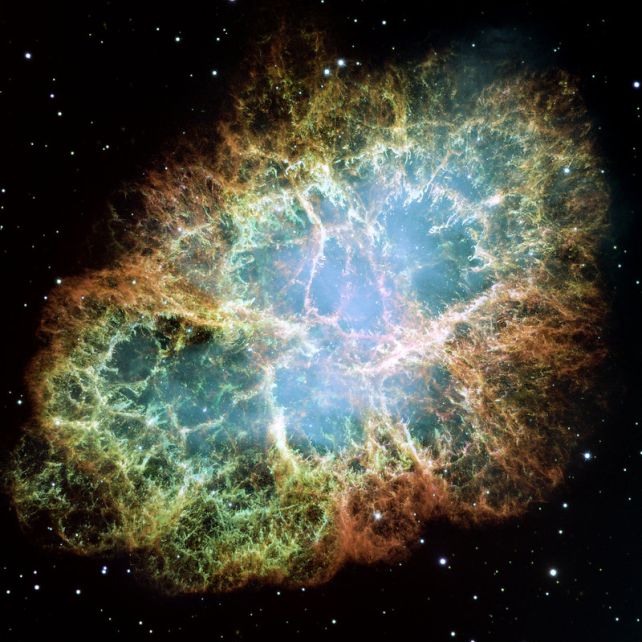 The Crab Nebula is what remains of a star that exploded around 1,000 years ago. Supernova remnants expand and dissipate quickly on cosmic timescales, scattering trace amounts of heavy metals. (NASA, ESA, J. Hester and A. Loll/Arizona State University)
They melted the ice, extracted what was left, and counted the iron-60 atoms they found.
Their results showed a higher concentration of iron-60 than can be attributed to the very small background contribution from cosmic rays that slam into Earth – suggesting that at least some of the iron-60 in the Antarctic ice had to have come from interstellar space.
Here's where that gets even more interesting. The concentration of iron-60 in ice from tens of thousands of years ago is significantly lower than the concentration in snow from the past few decades.
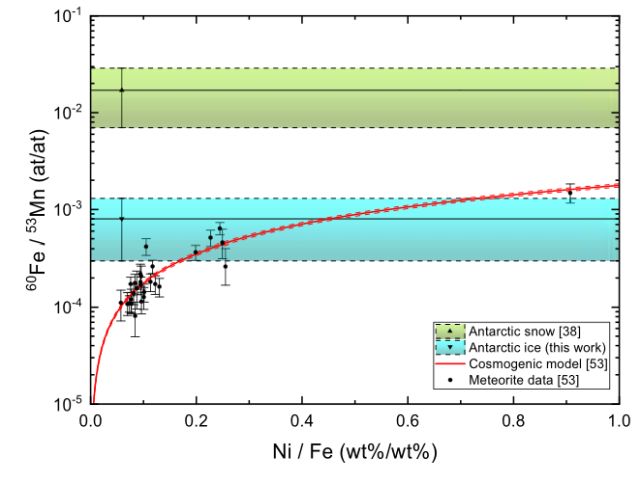 The measured ratios for iron-60 to manganese-53 for Antarctic ice, Antarctic snow, and meteorites, show that the concentration in the ice is lower than in snow. (Koll et al., Phys. Rev. Lett., 2026)
The Solar System is currently moving through a region called the Local Interstellar Cloud, made up of gas, dust, and plasma that scientists believe was seeded by supernova activity. It therefore stands to reason that this cloud is dusting Earth with a very faint rain of iron-60.
The findings of Koll and his team indicate that the Antarctic ice represents a flight record of Earth's journey through the cloud, which, in turn, reveals in detail how the cloud is structured. Moreover, it implies that the cloud contains denser and thinner regions of iron-60-bearing dust.
That's a really cool finding from a few atoms in a chunk of ice.

The ice core record shows evidence that the Solar System may have been moving through the cloud for at least 80,000 years, first passing through a sparser region before moving into a denser one that we are still traversing today.
Related: Star Trying to Swallow a Black Hole May Have Triggered a New Type of Supernova
We don't actually know the origins of the Local Interstellar Cloud with certainty. The team's findings are consistent with a supernova origin and highlight the opportunity to trace the cloud's structure from tangible material here on Earth.
"These results suggest that the Local Interstellar Cloud is a cosmic archive for supernova-produced iron-60," the researchers write.
"The imprinted iron-60 time profile is evidence for a changing local interstellar environment over the last 80,000 years."
The research has been published in Physical Review Letters.
 English (US)