
.jpg) 1 hour ago
3
1 hour ago
3
Article content
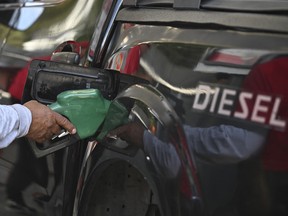
Canadians are naturally fixated on the hit to their finances from filling up at the gas pump, but it’s the rising cost of diesel — the “life of the economy” — that could really sock it to people’s pocketbooks and the economy.

THIS CONTENT IS RESERVED FOR SUBSCRIBERS ONLY
Subscribe now to read the latest news in your city and across Canada.
- Exclusive articles from Barbara Shecter, Joe O'Connor, Gabriel Friedman, and others.
- Daily content from Financial Times, the world's leading global business publication.
- Unlimited online access to read articles from Financial Post, National Post and 15 news sites across Canada with one account.
- National Post ePaper, an electronic replica of the print edition to view on any device, share and comment on.
- Daily puzzles, including the New York Times Crossword.
SUBSCRIBE TO UNLOCK MORE ARTICLES
Subscribe now to read the latest news in your city and across Canada.
- Exclusive articles from Barbara Shecter, Joe O'Connor, Gabriel Friedman and others.
- Daily content from Financial Times, the world's leading global business publication.
- Unlimited online access to read articles from Financial Post, National Post and 15 news sites across Canada with one account.
- National Post ePaper, an electronic replica of the print edition to view on any device, share and comment on.
- Daily puzzles, including the New York Times Crossword.
REGISTER / SIGN IN TO UNLOCK MORE ARTICLES
Create an account or sign in to continue with your reading experience.
- Access articles from across Canada with one account.
- Share your thoughts and join the conversation in the comments.
- Enjoy additional articles per month.
- Get email updates from your favourite authors.
THIS ARTICLE IS FREE TO READ REGISTER TO UNLOCK.
Create an account or sign in to continue with your reading experience.
- Access articles from across Canada with one account
- Share your thoughts and join the conversation in the comments
- Enjoy additional articles per month
- Get email updates from your favourite authors
Sign In or Create an Account
or
Article content
The United States-Israel-led war on Iran has put the screws to fuel supplies, removing 10 million barrels of oil a day from the global marketplace, creating a 10 per cent supply shortfall, according to an Oxford Economics Ltd. report on Wednesday.
Article content
Article content
Article content
The average price of diesel in Canada is up 45 per cent since the start of hostilities in the Middle East, and that could prove costly as it is critical to several industries, including freight, agriculture and construction.
Article content
By signing up you consent to receive the above newsletter from Postmedia Network Inc.
Article content
“Diesel is really kind of the life of the economy because it is what you consume to ship products by rail, by truck and, again, if you have a large agricultural sector, like we do in Canada, that’s the product you need in order to run the sector,” Randy Ollenberger, managing director and oil and gas analyst at BMO Capital Markets, said. “Diesel is often considered a good indicator of economic health.”
Article content
The average retail price for a litre of diesel in Canada was $2.37 on Tuesday, compared with $1.63 on Feb. 27, the day before the conflict started, and $1.46 at the beginning of 2026, according to Kalibrate Technologies Ltd.
Article content
Similar to when Russia attacked Ukraine, diesel prices have “rocketed” up more than gas prices, Douglas Porter, chief economist at BMO Capital Markets, said during an online session for investors on Wednesday.
Article content
That is stoking concerns over food prices because of the “tight linkage” between energy and groceries, he said.
Article content
Article content
Food inflation is already “sticky” and elevated energy prices won’t help. The latest consumer price index (CPI) data, out before the war started, put inflation for food purchased at grocery stores at 4.1 per cent year over year compared with the overall CPI of 1.8 per cent.
Article content
Article content
The problem for industries that rely on diesel is that they “cannot easily switch fuels or stop operating without broader economic disruption,” Bridget Payne, head of energy forecasting at Oxford, said in the report. “That means diesel demand falls relatively little through price alone, which is exactly why diesel shortages are so economically damaging.”
Article content
Countries whose energy supplies are more exposed to the Middle East are in rationing mode, with both the Philippines and Pakistan shortening the workweek to four days from five. Bangladesh has imposed fuel purchase caps, Myanmar has resorted to alternating driving days and Thailand capped diesel prices and banned fuel exports.
Article content
Physical shortages of diesel are “not emerging” in North America, but Canada exports and imports the fuel, Ollenberger said, “so the combination of those things does tie us to international markets.”
 English (US)