
.jpg) 1 hour ago
2
1 hour ago
2
Article content
(Bloomberg) — Nigeria plans to raise 4 trillion naira ($2.9 billion) from its domestic capital markets to settle outstanding debts owed to power companies as it seeks to end perennial blackouts in the West African nation.

THIS CONTENT IS RESERVED FOR SUBSCRIBERS ONLY
Subscribe now to read the latest news in your city and across Canada.
- Exclusive articles from Barbara Shecter, Joe O'Connor, Gabriel Friedman, and others.
- Daily content from Financial Times, the world's leading global business publication.
- Unlimited online access to read articles from Financial Post, National Post and 15 news sites across Canada with one account.
- National Post ePaper, an electronic replica of the print edition to view on any device, share and comment on.
- Daily puzzles, including the New York Times Crossword.
SUBSCRIBE TO UNLOCK MORE ARTICLES
Subscribe now to read the latest news in your city and across Canada.
- Exclusive articles from Barbara Shecter, Joe O'Connor, Gabriel Friedman and others.
- Daily content from Financial Times, the world's leading global business publication.
- Unlimited online access to read articles from Financial Post, National Post and 15 news sites across Canada with one account.
- National Post ePaper, an electronic replica of the print edition to view on any device, share and comment on.
- Daily puzzles, including the New York Times Crossword.
REGISTER / SIGN IN TO UNLOCK MORE ARTICLES
Create an account or sign in to continue with your reading experience.
- Access articles from across Canada with one account.
- Share your thoughts and join the conversation in the comments.
- Enjoy additional articles per month.
- Get email updates from your favourite authors.
THIS ARTICLE IS FREE TO READ REGISTER TO UNLOCK.
Create an account or sign in to continue with your reading experience.
- Access articles from across Canada with one account
- Share your thoughts and join the conversation in the comments
- Enjoy additional articles per month
- Get email updates from your favourite authors
Sign In or Create an Account
or
Article content
The first tranche of debt, totaling 501 billion naira, was issued earlier this month at a 17% yield and was fully subscribed, Olu Verheijen, President Bola Tinubu’s special adviser on energy, said in an interview. The balance will be issued each quarter or every six months, depending on market conditions, she said.
Article content
Article content
Article content
“The program represents a decisive reset of the electricity market,” Verheijen said, clearing legacy payment arrears owed to power-generation companies dating back a decade to build a sustainable market.
Article content
By signing up you consent to receive the above newsletter from Postmedia Network Inc.
Article content
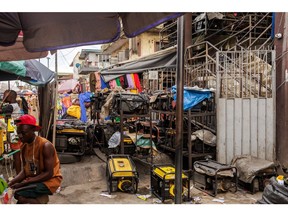
Africa’s most-populous nation endures chronic power shortages, with the grid supplying only about 4,000 megawatts to more than 230 million people, just over half of whom are connected. By comparison, South Africa, with about a quarter of Nigeria’s population, has more than 10 times its generation capacity.
Article content
Poor metering, high collection losses, aging infrastructure and a government energy-subsidy initiative have saddled the sector with a heavy debt overhang.
Article content
The inadequate power supply has pushed many companies off the grid, with self-generated electricity accounting for nearly half of consumption, an increasing share of it from solar panels.
Article content
Verheijen said some of the funds raised will help electricity distribution companies close the metering gap to improve revenue collection. Money will also be allocated to upgrade transmission infrastructure.
Article content
Article content
Only about half of grid-connected customers are metered, and the transmission network can wheel just a quarter of the country’s estimated 13,000 megawatts of available generating capacity.
Article content
The government expects the debt settlement to free up 4,484 megawatts of generation capacity and stabilize power supply for about 12 million registered customers, it said in an emailed statement. It is also adopting a more price-led electricity market.
Article content
“We have commenced a transition to a market-reflective tariff,” Verheijen said. “What we are going to do is clear a pathway to a consumption-based tariff framework so that what you pay for is what you consume.”
Article content
Sign up here for the twice-weekly Next Africa newsletter,and subscribe to the Next Africa podcast on Apple, Spotify or anywhere you listen.
Article content
—With assistance from Emele Onu.
Article content
 English (US)