
.jpg) 1 hour ago
3
1 hour ago
3
Beneath a modern Frankfurt neighborhood, archaeologists have uncovered one of the most extraordinary religious complexes ever found in Roman Europe. A vast, well-preserved cult district in the ancient city of Nida is now the focus of a major international research project that aims to reconstruct how religion was practiced on the empire’s northern frontier.
According to a grant funding announcement, researchers will spend the next three years conducting an in-depth analysis of the site. Archaeologists uncovered the site during excavations carried out between 2016 and 2018, and again in 2022, in Frankfurt’s Nordweststadt district. Archaeologists excavated more than 4,500 square meters at the heart of the Roman city, exposing a walled complex that has survived with remarkably little disturbance.
“The central cult district of Nida represents an archaeological discovery of almost unparalleled significance in Europe,” said Ina Hartwig, Frankfurt’s city commissioner of Culture and Science, in a press release.
Read More: Ancient Romans Gave Tiny Bronze Skeletons to Party Guests As a Morbid Reminder to Live Life
What Was Roman Nida?
In Roman times, Nida (today Frankfurt-Heddernheim) was one of the most important urban centers in Germania, known for its cultural diversity and strategic position until its abandonment around 275 C.E. The newly uncovered cult district sat at the city’s center, underscoring the importance of religion in everyday urban life.
The sanctuary itself is a stand-out in both scale and design. Archaeologists identified 11 stone buildings constructed in multiple phases, along with around 70 shafts and 10 pits used for ritual depositions. The layout is unlike anything else known from the Germanic or Gallic provinces of the Roman Empire, suggesting a locally distinctive approach to sacred architecture.
Thousands of fragments of painted wall plaster, along with bronze door and window fittings, point to elaborately decorated interiors. These remains may hold the key to learning more about the site.
"In many ancient sanctuaries, our knowledge is limited to the ground plans of the cult buildings. At Nida, however, the large number of preserved wall-painting fragments allows us to gain far deeper insight into room heights, spatial organization, and interior design,” said Anja Klöckner, professor of Classical Archaeology at Goethe University Frankfurt. “These findings offer a more nuanced understanding of how the sanctuary functioned as a space — and of the ritual practices that can be inferred from its architecture and decoration.”
How Do Archaeologists Know It’s a Cult District?
The strongest evidence for ritual activity comes from what was left behind. Shafts and pits held ceramic vessels alongside large quantities of plant and animal remains — including fish and birds — interpreted as the remnants of ritual meals and offerings to the gods.
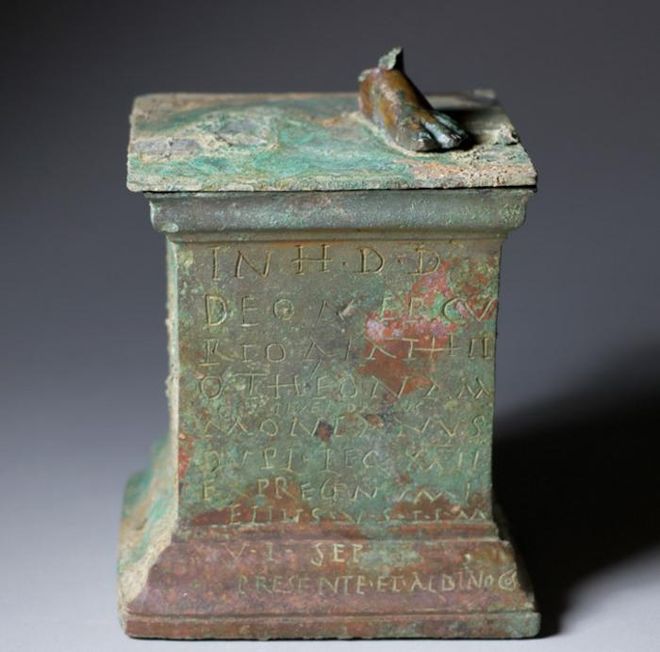
Inscribed bronze altar from the ancient Roman site of Nida, dedicated to the god Mercury Alatheus by a soldier of the 22nd Legion based in Mainz and dated to September 9, 246 CE.
(Image Credit: S. Martins / AMF)
“Animals and animal products appear to have played a central role in ancient religious practice – whether in ritual meals, acts of communication with the divine, or as offerings,” explained Benjamin Sichert, a researcher at the Institute for Prehistory and Natural Archaeology (IPNA) at the University of Basel. “For the first time, this interdisciplinary research project enables a comprehensive and systematic examination of these functions at the Roman site of Nida.”
Coins and personal objects also tell part of the story. The ongoing analysis of 254 Roman coins and more than 70 silver and bronze garment clasps is central to understanding sacrificial and votive practices. Such items are widely known as offerings in sanctuaries across the empire, linking Nida to broader Roman traditions.
Identifying the gods worshiped there has been more challenging. Inscriptions and iconography point to a diverse divine lineup, including Jupiter, Mercurius Alatheus, Diana, Apollo, and Epona. This diversity suggests Nida was likely a regional sanctuary where multiple deities were honored side by side.
What Will This Research Project Study?
Future research will focus on interior design, depositional practices, and animal remains to reconstruct how rituals actually unfolded.
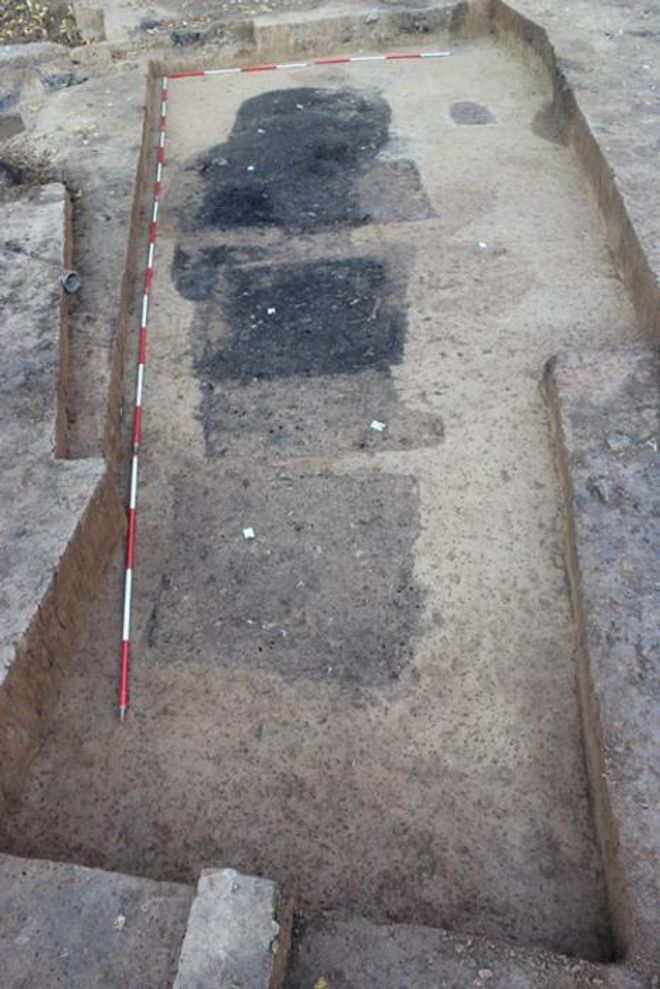
Overlapping cult pits at Nida point to repeated ritual activity, with pits likely used to deposit remains from sacrifices and cult meals.
(Image Credit: Monument Office, City of Frankfurt)
“The discovery of Nida’s sacred district came as a remarkable surprise,” said Carsten Wenzel, curator of Provincial Roman Archaeology at the Archaeological Museum Frankfurt. “With its many distinctive features, the sanctuary not only underscores Nida’s outstanding importance within Roman Germania; its systematic study within the DFG-funded project promises far-reaching new insights into religious life and cult practices in the northern reaches of the Roman Empire.”
Read More: Ancient Sewers Reveal Intestinal Parasites Sickened Roman Soldiers Near Hadrian’s Wall
Article Sources
Our writers at Discovermagazine.com use peer-reviewed studies and high-quality sources for our articles, and our editors review for scientific accuracy and editorial standards. Review the sources used below for this article:
- This article references information published by Goethe University: Unlocking the Sacred Landscape of Roman Nida
 English (US)