
.jpg) 2 hours ago
2
2 hours ago
2
Hair samples preserved in family scrapbooks across the past century have revealed the success of the US Environmental Protection Agency's (EPA) efforts to crack down on lead pollution since the 1970s.
Policies to phase out lead from products such as paint, pipes, and gasoline have drastically reduced human exposure to the neurotoxin in just a few decades.
Now, University of Utah researchers have traced this win for human health through locks of hair passed down through generations.
Human exposure to lead increased for thousands of years before we realized it was harming our health. A build-up of lead in the body raises the chances of cardiovascular disease and heart disease, and puts mental health and the IQ of children at risk.
Cutting exposure to lead is one thing. Demonstrating an actual decrease in lead absorption means collecting biological samples over long periods from individuals across a wide region.
While lead accumulates in hair, few people keep their locks intact over the decades.
Thanks to a tendency to hold interest in family history, many Utah residents – especially members of the state's large Mormon population – are more likely to keep mementos of their ancestry, including precious locks of hair.

"The practice of keeping a journal or 'book of remembrance' has been a long-standing tradition in the Church of Jesus Christ of Latter-Day Saints. In this spirit, childhood hair and teeth are often maintained as part of honoring their families," the researchers explain.
Members of the community obliged in providing 48 samples of their family members' hair, including some dating back to 1916.
Using mass spectrometry to determine lead levels in the samples, the researchers mapped a small but robust record of personal lead exposure across the Wasatch Front, a region in north-central Utah. This densely populated area previously experienced high levels of lead pollution from the smelting industry.
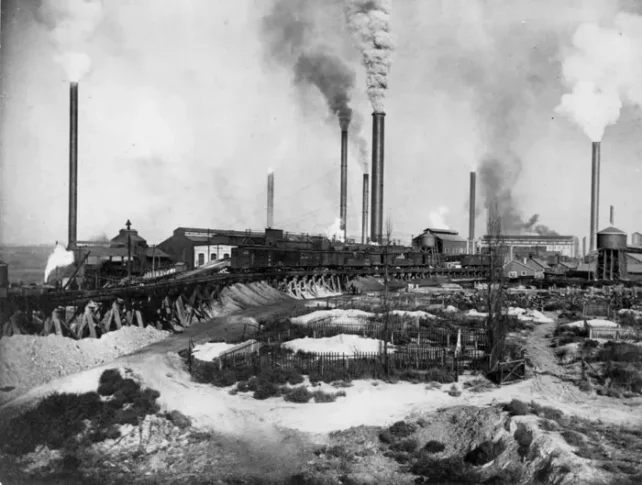 The US Mining and Smelting Co. plant in Midvale, Utah, 1906. (Photo used by permission, Utah Historical Society)
Before 1970, when the EPA was founded and began regulating industry, gasoline typically contained around 2 grams of lead per gallon. The emissions of this leaded fuel would blow out the tailpipes of America's much-loved automobiles, entering the lungs – and hair – of people in the vicinity. Similarly, Utah's smelters would have added to the levels of lead exposure.
Related: Lead Exposure in Childhood Linked to Future Crimes, Study Finds
While gasoline consumption continued to rise in the US after 1970, lead levels were curtailed by the new EPA regulations. And, in lock-step, lead levels in the Utah hair samples decline around this time, from 50 parts per million (ppm) down to 10 ppm in the 1990s. Samples from after 2020 averaged less than 1 ppm of lead.
"We should not forget the lessons of history. And the lesson is those regulations have been very important," says lead author Thure Cerling, a geologist and biologist from the University of Utah.
"Sometimes they seem onerous and mean that industry can't do exactly what they'd like to do when they want to do it or as quickly as they want to do it. But it's had really, really positive effects."
The research was published in the Proceedings of the National Academy of Sciences.
 English (US)