
.jpg) 2 hours ago
2
2 hours ago
2
A newly discovered exoplanet has to take the crown for the weirdest world we've ever spotted out there in the Milky Way galaxy.
It's called PSR J2322-2650b, and everything about it is absolutely loony. It's a hot Jupiter orbiting a millisecond pulsar, stretched into a lemon shape by the star's gravity. It has carbon vapor in its atmosphere and possibly a helium-dominated interior, and its entire atmosphere is rotating at ludicrous speed – in the opposite direction of the planetary spin.
"This was an absolute surprise," says astronomer Peter Gao of the Carnegie Earth and Planets Laboratory. "I remember after we got the data down, our collective reaction was 'What the heck is this?'"
Related: We've Just Found an Exoplanet That's as Stinky as Uranus
There's no doubt that our Universe is capable of making some strange worlds, running the gamut from cotton candy atmospheres to metal clouds and corundum rain to ultra-dense 'bullet' exoplanets.
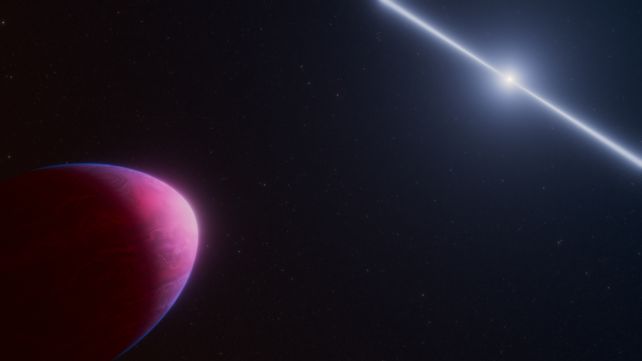 An artist's impression of the bizarre exoplanet and its crazy star. (NASA, ESA, CSA, Ralf Crawford/STScI)
Although they often push the limits of what seems possible, the properties and behavior of most worlds can be understood. PSR J2322-2650b defies easy explanation; its properties don't really fit with any known pathway for planetary evolution.
"It's very hard to imagine how you get this extremely carbon-enriched composition," says astronomer Michael Zhang of the University of Chicago. "It seems to rule out every known formation mechanism."
Let's break it down, starting with the star, PSR J2322-2650 (the same as the exoplanet, but without the "b" at the end), some 2,055 light-years away. It's a type of degenerate star known as a millisecond pulsar – a neutron star with added features.
A neutron star on its own is extreme enough, forming from the ultra-dense collapsed core of a massive star that died and went supernova. These remnants can be up to 2.3 times the mass of the Sun, packed into a sphere just 20 kilometers (12 miles) across.
Neutron stars get upgraded to millisecond pulsars when they spin at millisecond speeds – just 3.46 milliseconds for PSR J2322-2650 – while shooting powerful beams of radio and gamma radiation from their poles at precise intervals.
This is what led to the discovery of PSR J2322-2650b back in 2017. Astronomers noticed that the precision they expected to see in the radio pulses of the host star was a little… off. They examined the timing closely and traced the disruption to an unseen planetary mass companion, around 80 percent of the mass of Jupiter, whipping around the pulsar on a 7.8-hour orbit.
That was the extent of our knowledge until JWST took a closer look at the system. Because the space telescope observes the Universe in infrared wavelengths, but not the radio and gamma rays blazing from the star, it can see the exoplanet clearly, making for an excellent observation opportunity.
"This system is unique because we are able to view the planet illuminated by its host star, but not see the host star at all," says astronomer Maya Beleznay of Stanford University. "So we get a really pristine spectrum. And we can better study this system in more detail than normal exoplanets."
This resulted in an array of observations on the world's atmospheric conditions, including wind speed and direction, temperature, and composition.
Planetary scientists have a rough idea, based on previous studies of exoplanet atmospheres and knowledge of basic chemistry, what an exoplanet atmosphere should look like. It was possible that PSR J2322-2650b, as the first pulsar world whose atmosphere has been analyzed, may have some oddities, but no one fully expected what the JWST observations revealed.
Firstly, because the exoplanet is so close to the star, its atmosphere is being pulled into a football by the gravity of its host. That atmosphere is lashed by gamma radiation that heats it to temperatures around 1,900 Kelvin (1,630 Celsius, or 2,960 Fahrenheit) – far greater than the 1,300 Kelvin it would be if heated by starlight alone.
The atmosphere is also racing around the exoplanet in a westward direction, opposite to the planet's eastward spin, which is locked to its orbit around the pulsar.

The planetary composition is where it all gets a bit beyond weird, with huge amounts of carbon that may crystallize into diamond rain at lower altitudes.
"This is a new type of planet atmosphere that nobody has ever seen before," Zhang says. "Instead of finding the normal molecules we expect to see on an exoplanet – like water, methane, and carbon dioxide – we saw molecular carbon, specifically C3 and C2."
Some of the answers might lie in the question: How does a planet survive the core-collapse supernova that birthed the neutron star? Actually, there's a really good answer to that. It doesn't, at least in the case of PSR J2322-2650b.
Based on its properties, Zhang and his colleagues believe that the exoplanet may not have started as a planet at all – that it began its life as a helium star.
Pulsars known as black widows are found in binary systems with other stars, which they slowly devour like a black widow spider devouring its mate. This erosion explains the 'exoplanet's' helium interior and even the carbon in the atmosphere.
Even so, some questions remain.

"As the companion cools down, the mixture of carbon and oxygen in the interior starts to crystallize," says astrophysicist Roger Romani of Stanford University and the Kavli Institute for Particle Astrophysics and Cosmology.
"Pure carbon crystals float to the top and get mixed into the helium, and that's what we see. But then something has to happen to keep the oxygen and nitrogen away. And that's where there's controversy."
Because the companion is no longer at a mass where it can support the fusion of atoms in its core, it can no longer be classified as a star, or even a brown dwarf – yet one more piece of evidence that blurs the lines between planets and stars.
Future observations may help resolve the sheer strangeness of a system unlike anything we've seen before.
"It's nice to not know everything," Romani says. "I'm looking forward to learning more about the weirdness of this atmosphere. It's great to have a puzzle to go after."
The research has been published in The Astrophysical Journal Letters.
 English (US)