
.jpg) 1 hour ago
3
1 hour ago
3
Article content
(Bloomberg) — Commercial traffic through the Strait of Hormuz persisted at a reduced level after attacks on two ships raised fresh concerns about the ability and willingness of shipowners to traverse the waterway.

THIS CONTENT IS RESERVED FOR SUBSCRIBERS ONLY
Subscribe now to read the latest news in your city and across Canada.
- Exclusive articles from Barbara Shecter, Joe O'Connor, Gabriel Friedman, and others.
- Daily content from Financial Times, the world's leading global business publication.
- Unlimited online access to read articles from Financial Post, National Post and 15 news sites across Canada with one account.
- National Post ePaper, an electronic replica of the print edition to view on any device, share and comment on.
- Daily puzzles, including the New York Times Crossword.
SUBSCRIBE TO UNLOCK MORE ARTICLES
Subscribe now to read the latest news in your city and across Canada.
- Exclusive articles from Barbara Shecter, Joe O'Connor, Gabriel Friedman and others.
- Daily content from Financial Times, the world's leading global business publication.
- Unlimited online access to read articles from Financial Post, National Post and 15 news sites across Canada with one account.
- National Post ePaper, an electronic replica of the print edition to view on any device, share and comment on.
- Daily puzzles, including the New York Times Crossword.
REGISTER / SIGN IN TO UNLOCK MORE ARTICLES
Create an account or sign in to continue with your reading experience.
- Access articles from across Canada with one account.
- Share your thoughts and join the conversation in the comments.
- Enjoy additional articles per month.
- Get email updates from your favourite authors.
THIS ARTICLE IS FREE TO READ REGISTER TO UNLOCK.
Create an account or sign in to continue with your reading experience.
- Access articles from across Canada with one account
- Share your thoughts and join the conversation in the comments
- Enjoy additional articles per month
- Get email updates from your favourite authors
Sign In or Create an Account
or
Article content
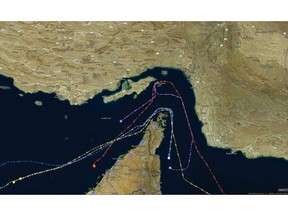
A handful of vessels made open transits over the weekend, according to tracking data. Among them, two very large crude carriers made their way into the Persian Gulf without cargoes, while a French-flagged container ship and two laden oil tankers left the inland sea, the data show.
Article content
Article content
Article content
Despite the drop in observed transits at the weekend, traffic was still higher than for most of the US-Iran war. That trend — of more shipowners willing to pass through Hormuz — has picked up since Washington and Tehran said earlier this month they had agreed on an interim plan to reopen the strait.
Article content
By signing up you consent to receive the above newsletter from Postmedia Network Inc.
Article content
Global investors, shipowners and insurers are zeroed in on activity in the chokepoint, which stands as a litmus test of whether the peace deal will endure and whether heavily disrupted supply chains can start to normalize. Following the two vessel attacks, there were tit-for-tat strikes between the US and Iran over the weekend that tested their fragile truce, though the two sides have since agreed to halt their assaults before negotiations resume this week.
Article content
Last week, a Singapore-flagged container ship was hit. Then on Saturday, the Kiku, which was carrying Qatari oil, was attacked in the strait. Following the strikes, the Joint Maritime Information Center — which liaises between navies and merchant shipping — raised its threat level in the region to substantial.
Article content
At present, the picture remains mixed among shipowners, with varying degrees of confidence in attempting transits. Some vessels that recently abandoned crossings, including two laden VLCCs and an inbound Qatar-owned gas carrier, have not made fresh attempts following the attacks. In addition, some shipowners had told Bloomberg News that they put exit plans on pause.
Article content
Article content
Still, of note for energy traders is the noticeable inbound traffic. That’s because the ability to dispatch empty vessels via Hormuz into the Persian Gulf stands to be crucial for regional energy producers as they seek to restart output after months of shut-ins. To do so, they’ll need empty vessels for loadings.
Article content
Aside from the two inbound VLCCs, a Norwegian-flagged products tanker, a US-sanctioned tanker and a liquefied-petroleum-gas carrier made their way into the gulf after the attack on Kiku. In the other direction, meanwhile, in addition to the three vessels, a products tanker and a US-sanctioned crude tanker sailed through.
Article content
Some observed ships have taken varied routes, with an Aframax tanker U-turning after it sailed into the channel separating Iran’s Qeshm and Larak islands to then move to the middle of the strait. The shift came despite the United Nations’ International Maritime Organization warning Friday that there are about 80 mines in historic, central lanes of the strait.
Article content
The strait connects the Persian Gulf to global markets and it is the world’s most important energy chokepoint. During the war, which erupted in late February, traffic collapsed to a trickle, with both the US and Iran imposing blockades. The partial reopening has driven a collapse in oil prices.
Article content
 English (US)