
.jpg) 3 hours ago
3
3 hours ago
3
A technique commonly used to prevent cancer might not be as effective as we thought – and a new study might have found the reason why.
It turns out that the trillions of microbes that call your gut home could be to blame.
The research suggests that the gut microbiome could remain disrupted for a decade or more after the common procedure, in ways that keep cancer risk elevated.
Colorectal cancer (CRC) is the second-leading cause of cancer-related deaths in the world, but thankfully, risk factors for this cancer can be caught early with regular screening.
Colonoscopies can reveal benign growths called adenomas in the colon. Since these can become cancerous later on, they're typically removed as a precaution.
However, a patient's risk of developing CRC often seems to remain elevated even after adenoma removal.
Exactly why this is the case has remained unclear, but a new study, led by researchers at the Harvard School of Public Health, may have linked it to the gut microbiome.
"Our study was the first to address whether gut microbial and metabolic alterations are still detectable many years after adenoma removal," says Mingyang Song, epidemiologist at Harvard and corresponding author of the study, which has been published in the journal Cell Host & Microbe.
"The answer is yes – suggesting that removing an adenoma doesn't return the gut to a low-risk state, and that the gut microbiome may therefore be a significant biological contributor to sustained CRC risk."
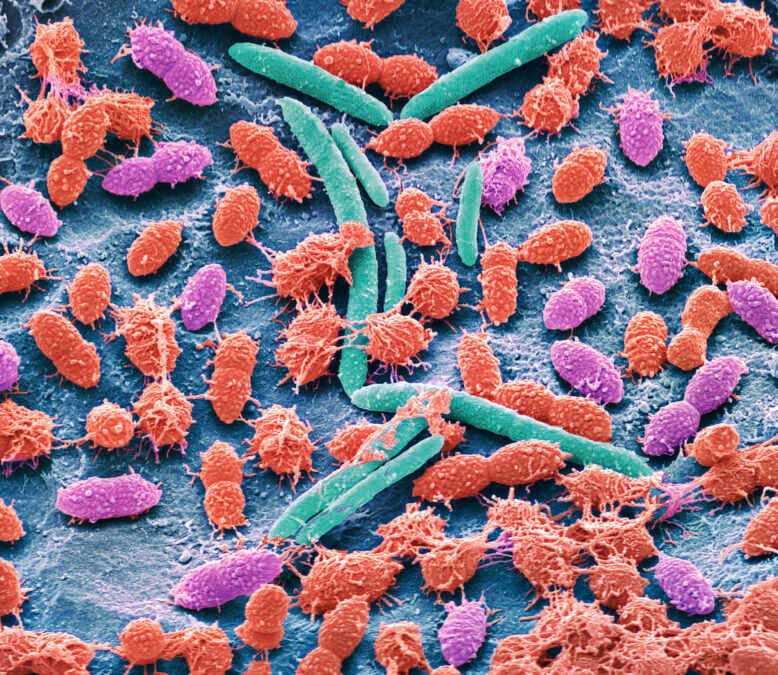 Culture of microbes shed from the human gut, seen under a scanning electron microscope. (Steve Gschmeissner/Science Photo Libary/Getty Images)
Your gut microbiome plays a key role in your health, in more ways than you might think. Some are obvious: these microscopic residents aid digestion, affect how you absorb nutrients from your food, and impact your weight.
But their influence extends far beyond your gastrointestinal system. The composition and concentration of different microbes in your gut have been linked to sleep, various neurological disorders, and even how effective exercise may be for you.
One of those diseases linked to your gut microbiome is cancer, and especially bowel cancer. Previous studies have investigated which gut microbes could be involved, by examining how the microbiome changed as adenomas advanced from benign to cancerous.
But what happens to the gut microbiome if you remove those adenomas at an early stage? That was the central question behind the new study.
The answer was striking.
The researchers examined the stool metagenomes of 354 women who had had adenomas removed roughly 12 years earlier, and compared them with those of 354 patients who had never had adenomas, matching both groups for age and several other factors.
The genomic profiles of the gut microbiome were then compared with 14 independent case-control studies of CRC.
And sure enough, the team identified significant changes in 31 different microbes between the two groups. And the microbiomes of patients who'd had adenomas removed partially resembled those associated with CRC cases.
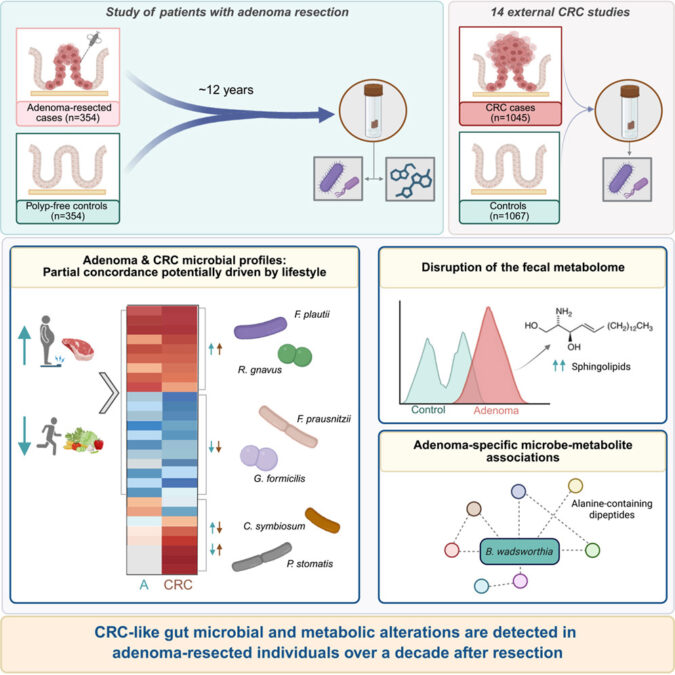 The graphical abstract for the study. (Nogal et al., Cell Host Microbe, 2026)
The samples were collected, on average, over a decade after the patients' adenomas were removed. That suggests that the microbial differences associated with CRC cannot simply be 'cut out' along with benign polyps.
It could also offer an explanation for why patients who had adenomas removed still had a higher chance of developing CRC than those without.
We may be treating a symptom, rather than the root cause.
If that's the case, the carcinogenic conditions (which may also have contributed to the adenoma) persist even after the polyp is removed.
"The fact that CRC-associated gut microbial and metabolic features are still detectable a decade later suggests the gut microbiome may be part of sustained CRC risk," says Ana Nogal, epidemiologist at Harvard and first author of the study.
"Diet and lifestyle were closely tied to these microbes, raising the possibility that these habits could influence the gut environment in people at higher risk."

Both diet and exercise are known to affect the gut microbiome, and that in turn could be influencing colorectal cancer risk.
Related: Colorectal Cancer Is Rising in Young People. Here's How to Lower Your Risk.
As with many of these kinds of studies, the new work can only suggest an association – whether the microbiome is a direct cause of cancer requires more work to determine.
But it's an intriguing look into a possible mechanism behind a long-standing biological mystery.
The research was published in Cell Host & Microbe.
This article was fact-checked by Carly Cassella and edited by Rebecca Dyer. While we pride ourselves on our process, we are only human. If you spot a mistake, please let us know.
 English (US)