
.jpg) 2 hours ago
3
2 hours ago
3
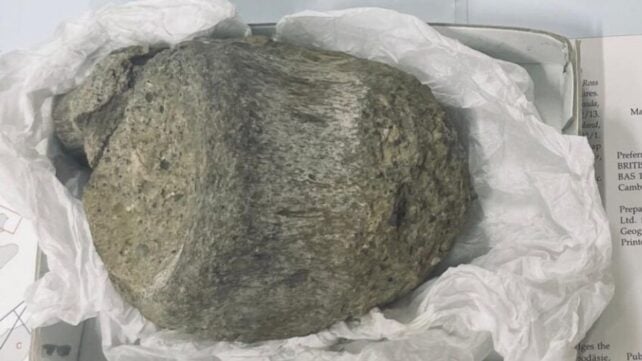 This is the first evidence of dinosaurs ever collected from Antarctica. (British Antarctic Survey)
A fossil that has been sitting in a drawer for 40 years has turned out to be the first piece of dinosaur ever retrieved from Antarctica.
Forty years ago, two scientists spent their summer mapping layers of rock on James Ross Island, off the southeast side of Antarctica, as part of a British Antarctic Survey expedition.
As they scoured the rocks, the two men – British geologist Michael Thomson and German geologist and paleontologist Reinhard Förster – encountered a number of fossils.
There were traces of invertebrates and plants; the scales of bony fish; and a large vertebra which they brought back to the UK.
Thomson's notes on the vertebra are brief, and accompanied by a small sketch of the specimen: just one item in a long list of fossil finds from the day.
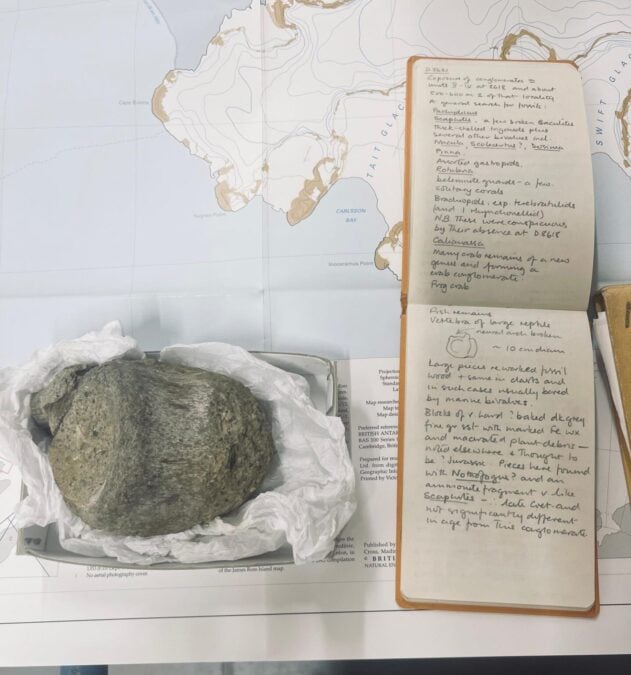 Mike Thomson's 1985 geological field notebook, next to the first-ever dinosaur fossil vertebra found in Antarctica. (British Antarctic Survey)
Forty years later, re-analysis of that fossilized bone has revealed it's something far more interesting: The very first dinosaur bone ever found in Antarctica.
And it had been sitting in the British Antarctic Survey archives, unexamined, for more than 40 years.
"When I first spotted this bone in our collections a few years ago, I suspected it was a dinosaur," says paleontologist Mark Evans, who manages geological collections and labs at the British Antarctic Survey.
Now, Evans and his colleagues have confirmed that it's an "exceptionally rare" specimen, a fossil bone from the upper tail of a sauropod that lived on the Antarctic continent late in the Cretaceous period.
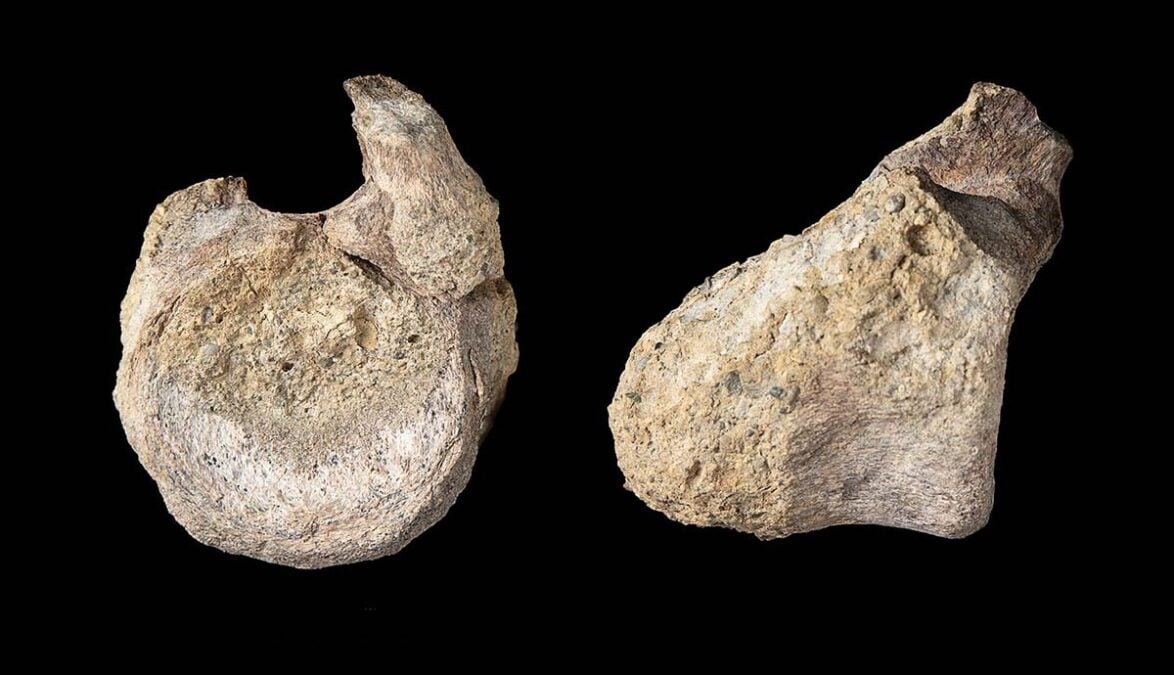 Two different angles of the Antarctic dinosaur fossil. (Barrett et al. 2026/Natural History Museum)
Antarctica is really not known for its dinosaurs: as far as we know, it has the lowest number of dinosaur fossils of any continent.
That might be more to do with our ability to find the fossils: much of Antarctica is now covered with ice, which may not have been the case during the Mesozoic period in which dinosaurs roamed Earth.
Just 12 species have been discovered, all found on either Mount Kirkpatrick or James Ross Island, both of which are relatively ice-free and have plenty of exposed rock.
But this dinosaur, which Evans and colleagues identified as a member of the Eutitanosauria clade, is now officially the earliest Antarctic dinosaur specimen ever collected.
It's also only the second sauropod fossil ever discovered in Antarctica.
Titanosaurs are among the largest dinosaurs to ever roam our planet, but this particular fossil is relatively small for its kind. Perhaps it was a young reptile, or a small adult.
The researchers were able to find its place in the dinosaur family tree based on the bone's distinct shape, with a concave indent on one side, and a corresponding convex surface on the other.

Based on this and other internal structures, Evans and team have classified it as a lithostrotian titanosaur.
There isn't enough information yet to say what species it is, but it bears a striking resemblance to a species from the Late Cretaceous that was discovered in Argentina, Muyelensaurus pecheni.
In future, the fossil may even help provide clues as to how animals dispersed across the ancient land mass of Gondwana, in which the Antarctic continent we know today was sandwiched between Australia and the lower reaches of Africa and South America.
Related: 'Mammoth' Bones Kept in a Museum For 70 Years Turn Out to Be Entirely Different Animal
"To date no titanosaurs have been found in Australia, and there is only limited evidence of them in New Zealand," says Paul Barrett, a paleobiologist at the Natural History Museum in London.
"Confirmation of the presence of these animals in Antarctica makes it seem likely that they traveled on to these areas, which were connected."
It just goes to show that sometimes, the best scientific discoveries are those already hiding right under our noses.
"Looking back at Mike's notebooks, he knew it was a large reptile, so it's very special to confirm his find 40 years later," Evans says.
The research was published in Acta Palaeontologica Polonica.
This article was fact-checked by Carly Cassella and edited by Rebecca Dyer. While we pride ourselves on our process, we are only human. If you spot a mistake, please let us know.
 English (US)