
Published Nov 6, 2026, 12:00 PM EST
The team behind Godzilla Minus Zero break down the sights and sounds of King Ghidorah, and that awesome New York City scene
 Image: Toho
Godzilla Minus One was a primordial blast of pure kaiju energy, calling back to the 1954 original while pushing the limits of storytelling and special effects in the monster movie genre. So how did writer-director Takashi Yamazaki follow that up? By going even bigger with a direct sequel in Godzilla Minus Zero, which is playing now in theaters across the planet.
In an interview with Polygon, the film's producer, Kazuaki Kishida, wouldn't say exactly how big the budget for Godzilla Minus Zero was (though it's been confirmed to be a significantly "more" than Minus One's $15 million), but he did reveal one way that extra money changed how Yamazaki and his team approached making the sequel.
"With Godzilla Minus One, there were 35 artists working on the VFX," Kishida says. "With the additional resources, we had the option to scale that up a lot more, but we only increased it to about 50."
According to the producer, this choice directly reflects Yamazaki's style of filmmaking. He's not just the writer and director, he's also the VFX supervisor overseeing every piece of art created for the film. Keeping the team small allowed Yamazaki to retain that same level of quality control.
He likes the idea of everyone being on the same floor
"He likes the idea of everyone being on the same floor," Kishida says. "He can just roll his chair around, take a look at different shots, give feedback, go to the next artist, etc. That exchange of ideas and that environment was very important to him."
Speaking to Kishida and the team behind Godzilla Minus Zero, it quickly becomes clear just how vital that "exchange of ideas" really is to Yamazaki. In our interview, the team behind this new kaiju spectacle break down some of its most memorable moments, from the sights and sounds of King Ghidorah to that awesome New York City sequence.
Spoilers ahead for Godzilla Minus Zero.
Godzilla vs. New York
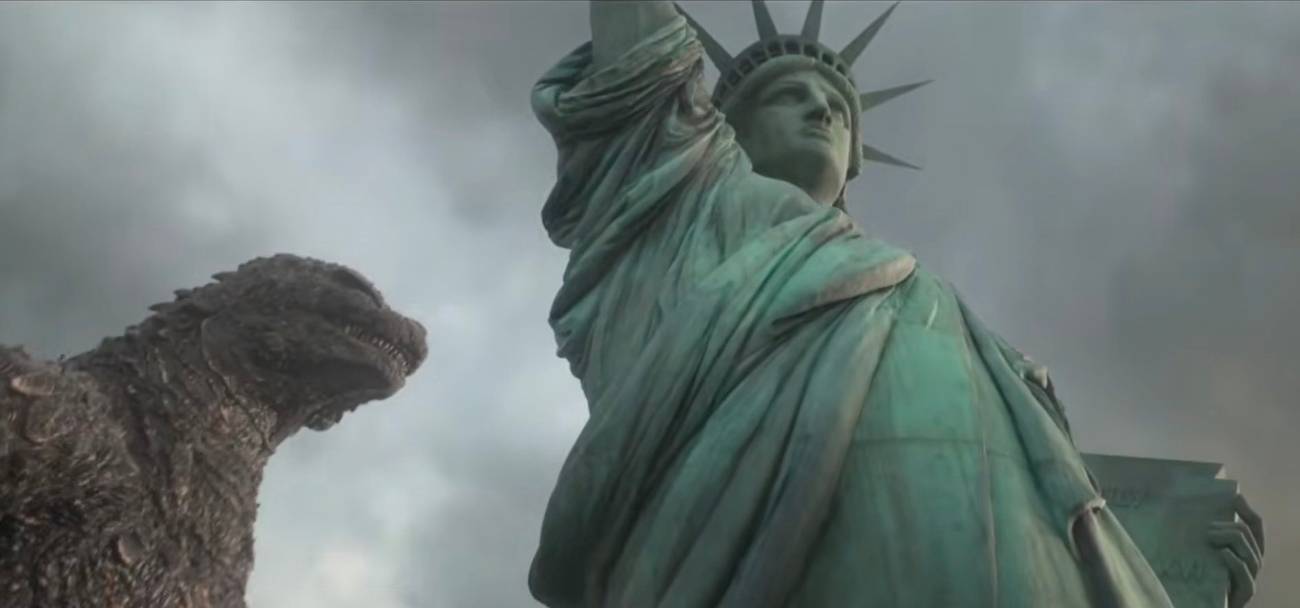 Image: Toho
Godzilla's arrival in New York City was teased in the earliest trailer for Minus Zero, but this turned out to be a bit of a trick. The monster never actually travels to America in the movie. Instead, we're seeing the fantasy of one character who survived the nuclear bombing of Hiroshima and plans to weaponize Godzilla to get revenge on the United States. The sequence begins with the kaiju toppling over the Statue of Liberty and ends with a massive energy blast that eviscerates a large chunk of Manhattan as the flesh melts off the faces of anyone unlucky enough to be in the blast radius.
We increased the size of Godzilla for that scene.
It's a terrifying, visually stunning moment, and the fact that it doesn't actually happen in the movie gave Yamazaki and his team the freedom to go even further than they normally would with Godzilla — but it also introduced some unique limitations.
"We were really conscious of the design," Kishida says. "Because everything takes place in the mind of the character who's imagining it, the design of Godzilla is actually the design from Godzilla Minus One, not the Zero design. That's the only Godzilla that character has a reference to."
At the same time, placing the sequence within one character's twisted fantasy also unleashed new opportunities.
“We increased the size of Godzilla for that scene," Kishida says. "In Godzilla Minus One, Godzilla's supposed to be 50 meters tall, but it's much bigger in the New York scene because we felt that was a projection of that character's imagination — what Godzilla feels like as a symbol or icon, rather than reality — which is why Godzilla is much taller than the Statue of Liberty."
(From the ground level to the top of her torch, the Statue of Liberty is 93 meters tall.)
King Ghidorah's gravity beam
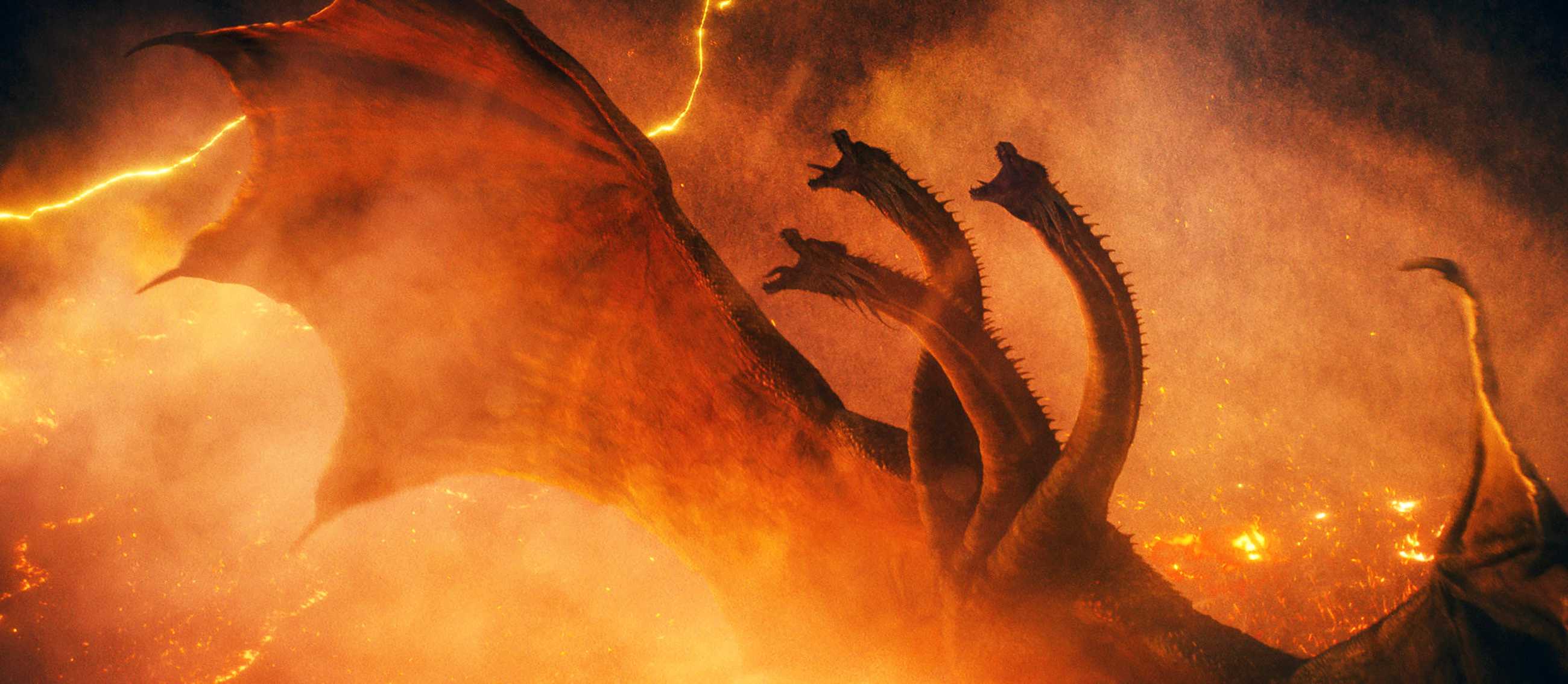 Ghidorah in Godzilla: King of the Monsters (2019)Image: Warner Bros./Everett Collection
King Ghidorah has always been one of the most iconic kaiju in the Godzilla franchise, but one crucial detail about the monster had remained mostly unexplored for decades: its gravity beam.
"We wanted to really develop the gravity beam," Kishida says." Ghidorah has always had this attack historically throughout the films, but despite it being called the gravity beam, we never really see gravity. It's more of just a beam that attacks. So we wanted to show: What if the gravity beam actually manipulated gravity? How do we visualize that? That became a key turning point."
Visual effects artist and compositor Tatsuji Nojima describes working directly with Yamazaki to bring the director's concept to life:
"I don't think anything really exists in the world, or in past movies, from a visual effects point of view. I had no idea where to turn to get inspiration for the look or the color. So I talked to director Yamazaki and he gave me this very cryptic sketch of a lot of blue lines flying in all directions. My task became: How do I take this sketch with a bunch of blue lines and translate it into a photorealistic visual expression in 3D space?"
"If you watch the movie, it might look like lines, but if you're able to zoom in somehow, you'll notice they're actually a bunch of particles. So I sent out a bunch of particles and had them twisting and spiraling, and added alpha layers to create that illusion that there are lines occurring in 3D."
The sounds of King Ghidorah
 Image: Toho
Godzilla Minus Zero is a very loud movie. Godzilla yells and roars a lot, with a timbre directly inspired by the original 1954 film. But King Ghidorah is no slouch either.
"We felt that the voice of Ghidorah and King Ghidorah was going to be really key in terms of how the movie is defined," sound designer and foley artist Natsuko Inoue tells Polygon.
While Ghidorah as it appears early in the movie was directly inspired by earlier cinematic versions of the creature, once it transforms into the three-headed King Ghidorah, Inoue knew she needed something "new and fresh to complement the new design."
"I wanted to design its voice so there's more of a melodic musical element to it," she says. "It's almost singing in a way."
To pull this off, Inoue went out into the world and recorded real-life audio.
We went to a dam and used the alarm warning system to play Ghidorah's voice.
"We went to a dam and used the alarm warning system to play Ghidorah's voice and captured that to make it feel as though Ghidorah was in fact in the wild," Inoue reveals.
It's just one more example of how Takashi Yamazaki inspired the team behind Godzilla Minus Zero to push the limits of kaiju cinema.
"Yamazaki really loves sound in general, whether it's music, sound design, dialogue. He has a lot of fun, which is very contagious. I enjoy the process of presenting new sound design to him every time."
Godzilla Minus Zero is in theaters now.