
.jpg) 1 hour ago
2
1 hour ago
2
Earthquakes are typically understood as fractures in the planet’s crust, where tectonic plates grind and strain until rock gives way. But some quakes begin much deeper than those familiar fault lines. A new global survey has mapped a rare class of earthquakes that originate in the mantle beneath continents, a layer once thought too warm and pliable to fracture at all.
Published in Science, the study presents the first worldwide catalogue of continental mantle earthquakes, revealing that they occur across the globe but cluster in regions such as the Himalayas and near the Bering Strait. These events are usually too deep to produce strong shaking at the surface. Instead, they offer a clearer view of how stress is distributed between Earth’s crust and the mantle below it.
“Until this study, we haven’t had a clear global perspective on how many continental mantle earthquakes are really happening and where,” said lead study author Shiqi (Axel) Wang, in a press release. “With this new dataset, we can start to probe at the various ways these rare mantle earthquakes initiate.”
Read More: Mini Earthquakes Expose Hidden Tectonic Features Buried Beneath Earth's Surface
Mantle Earthquakes Below the Mohorovičić Discontinuity
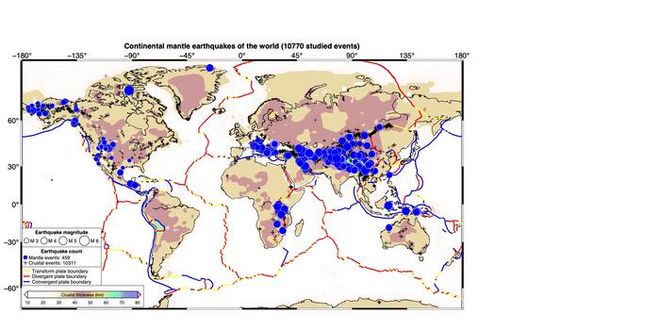
A map of the continental mantle earthquakes around the world.
(Image Credit: Axel Wang)
The crust forms Earth’s outer shell, but it is thin compared to the mantle below. The boundary between them, the Mohorovičić discontinuity or Moho, is marked by a shift in seismic wave speeds rather than a visible change in rock.
Most continental earthquakes originate 6 to 18 miles below the surface within the brittle upper crust. The mantle, by contrast, is hotter and deforms more gradually, leading many researchers to question whether it could generate earthquakes beneath continents.
“Although we know the broad strokes that earthquakes generally happen where stress releases at fault lines, why a given earthquake happens where it does, and the main mechanisms behind it are not well grasped,” said senior study author Simon Klemperer in a press release. “Mantle earthquakes offer a novel way to explore earthquake origins and the internal structure of Earth beyond ordinary crustal earthquakes.”
Over the past decade, evidence has shown that some earthquakes originate below the Moho, even outside subduction zones. What was missing was a reliable way to identify them.
How Seismic Waves Help Identify Mantle Earthquakes
To distinguish mantle earthquakes from crustal ones, the team analyzed how seismic waves move through different layers. Every earthquake sends vibrations through the planet, but those waves behave differently in the crust and mantle.
Sn waves travel through the uppermost mantle, while Lg waves move efficiently within the crust. Comparing their relative strength reveals whether a rupture began above or below the Moho.
“Our approach is a complete game-changer because now you can actually identify a mantle earthquake purely based on the waveforms of earthquakes,” said Wang.
Using global seismic records dating back to 1990, the researchers examined more than 46,000 earthquakes. After accounting for crustal thickness, they identified 459 continental mantle earthquakes, producing the clearest global picture yet.
Rethinking Earth’s Interior
The newly mapped events are not evenly distributed. Clusters in the Himalayas and near the Bering Strait suggest that deep structure and tectonic history influence where mantle quakes occur.
Expanding seismic networks, particularly in remote regions such as the Tibetan Plateau, could reveal more. Some mantle earthquakes may be influenced by interactions between crustal and mantle stress fields. Others may reflect heat-driven processes or the recycling of tectonic slabs within the mantle. Rather than confining earthquakes to the crust, the findings point to a system in which stress spans multiple layers.
“Continental mantle earthquakes might be part of an inherently interconnected earthquake cycle, both from the crust and also the upper mantle,” said Wang. “We want to understand how these layers of our world function as a whole system.”
Read More: What Happens When Magma and Earthquakes Align in Yellowstone National Park?
Article Sources
Our writers at Discovermagazine.com use peer-reviewed studies and high-quality sources for our articles, and our editors review for scientific accuracy and editorial standards. Review the sources used below for this article:
- This article references information from a recent study published in Science:
Continental mantle earthquakes of the world
 English (US)