3,500-Year-Old Ancient Fragrances Reveal What Egyptian Mummification Smelled Like
1 hour ago
2
Sometimes all it takes is a little whiff to take us back into our past: the scent of our grandparents’ detergent or the smell of our childhood home can induce surprisingly strong emotions. Researchers long assumed the scents of ancient worlds wouldn’t stand the test of time, but reviving them could help us better relate to and engage with societies of the past. An interdisciplinary research team of archaeologists, chemists, and a perfumer did exactly that.
For their project Scent of the Afterlife, they developed a way to convert biochemical traces sampled from embalming jars of ancient Egypt into fragrances suitable for museum exhibitions. Summarized in a paper published in Frontiers, the team hopes to provide methods for museums that expand how visitors can engage with the past using their senses.
“This research represents a significant shift in how scientific results can be shared beyond academic publications,” explained archaeo-chemist Barbara Huber from the Max Planck Institute of Geoanthropology and the University of Tübingen in a press release.
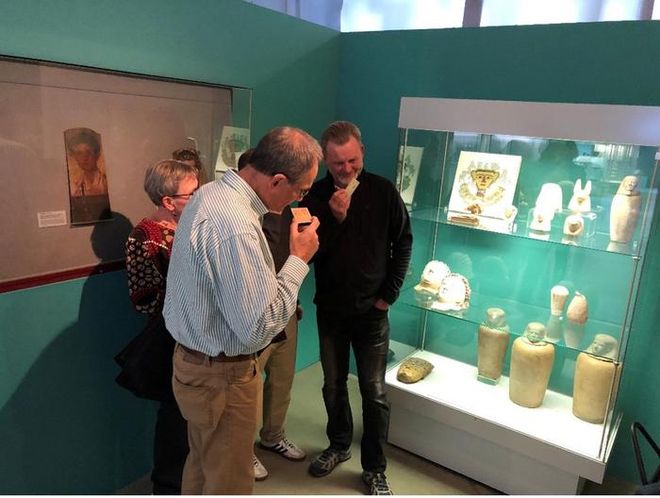
Museum visitors smelling the Scent of the Afterlife card.
(Image Credt: Ehrich SC, Calvez C, Loeben CE, Dubiel U, Terp Laursen S and Huber B (2026) Archaeol. 4:1736875/CC BY)
Reviving Ancient Fragrances for Museums
Microscopic traces of DNA, proteins, and fats on artifacts can offer little clues about the past. Recently, the attention of biomolecular archaeology has expanded to include other molecular traces — chemicals that evaporate from solids and float in the surrounding air — such as volatile organic compounds (VOCs).
Experts previously ignored these compounds because they didn’t expect them to survive. Advances in technology can now identify aromatic fingerprints from ancient objects like incense, perfumes, resins, and medicine, giving us the opportunity to explore ancient rituals and daily life like never before.
Archaeologists, chemists, curators, a perfumer, and an olfactory heritage consultant worked collaboratively to translate the biochemical signatures of 3,500-year-old Egyptian canopic jars into an authentic fragrance that can be used in museums and other public outreach facilities.
Egyptian Mummification Scent Takes Visitors Back in Time
Creating a compelling fragrance requires more than identifying chemical compounds in a sample.
“The real challenge lies in imagining the scent as a whole,” explained perfumer Carole Calvez, who developed a series of formulations. “Biomolecular data provide essential clues, but the perfumer must translate chemical information into a complete and coherent olfactory experience that evokes the complexity of the original material, rather than just its individual components.”
The result was the creation of the Scent of the Afterlife in two different formats suitable for public settings. One is a portable scented card handed out to visitors, and the other is a fixed scent diffuser within the exhibition.
Feedback from visitors to the August Kestner Museum in Hanover, Germany — home to the artifacts sampled for the project — was positive. They reported that the integration of scent made them feel immersed in ancient Egypt, with the cards becoming a key part of the museum’s guided tours.
“Scent provides a new approach to mummification, moving away from the scare factor and horror movie clichés toward an appreciation of the motivations behind the actions and the desired results,” said curators Christian Loeben and Ulrike Dubiel in the statement.
Creating Multisensory Museum Experiences
The Moesgaard Museum in Aarhus, Denmark, installed the fixed scent station as part of their Ancient Egypt – Obsessed with Life exhibition, drawing immediate attention.
“The scent station transformed how visitors understood embalming,” said curator Steffen Terp Laursen in the releaase. “Smell added an emotional and sensory depth that text labels alone could never provide.”
This collaborative project shows how combining different disciplines can create innovative ways to bring the past back to life by engaging a multitude of our senses.
“We hope to offer museums compelling new tools for bringing visitors closer to past environments and practices via sensory interpretation and engagement,” said olfactory consultant Sofia Collette Ehrich in the release.
Besides increasing visitor interest and engagement, similar projects can help us understand ancient perfume-making, healing, sanitation, and cosmetic practices in more detail, and with them, past societies themselves.
Our writers at Discovermagazine.com use peer-reviewed studies and high-quality sources for our articles, and our editors review for scientific accuracy and editorial standards. Review the sources used below for this article:

.jpg) 1 hour ago
2
1 hour ago
2
 English (US)