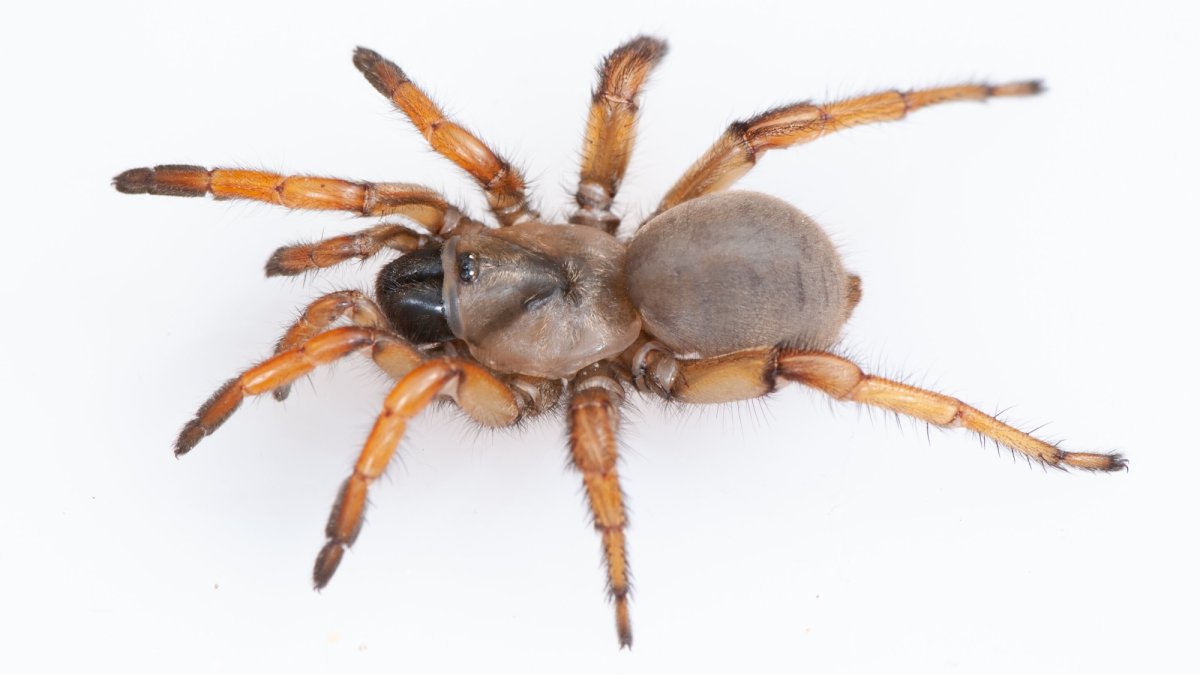
Portia fimbriata—the fringed jumping spider. Credit: iNaturalist
What could a spider dream about? For Portia fimbriata, a tiny predator that hunts other spiders, perhaps its the next kill.
At night, this Australian jumping spider settles upside down beneath a little platform of silk. Its legs curl and its mouthparts twitch, drool not included. The movable retinal structures inside its eyes swivel back and forth, as though following something no one else can see. That sounds mighty similar to the REM stage when humans dream during sleep.
Now scientists have confirmed that these uncanny movements occur during genuine sleep. More remarkably, when the spiders lose sleep, they make up for it later, including by increasing their REM-like activity.
The discovery suggests that some features of human sleep may be shared by animals whose brains evolved along entirely different paths. But whether spiders actually dream the way you or I are used to remains an open question.
A Cunning Hunter With a Secret Nightlife
Portia is no ordinary spider. Barely a centimeter long, it stalks other spiders and sometimes plucks their webs to imitate the vibrations of trapped insects. When a prospective meal comes to investigate, Portia turns the tables.
Its sophisticated hunting strategies make it an intriguing subject for scientists studying sleep and memory.
The investigation began with a different jumping spider, Evarcha arcuata. During the pandemic in 2020, behavioral ecologist Daniela Rößler noticed that her captive spiders suspended themselves from silk threads at night. In a 2022 study, her team reported rhythmic episodes of twitching legs and moving retinas, which resembled rapid-eye-movement, or REM, sleep.
In people, REM sleep brings heightened brain activity and often vivid dreams.
There was one problem. Looking asleep is not the same as being asleep.
For the new study, Rößler, Nadja Geiger, and their colleagues examined Portia fimbriata using infrared cameras. Ten spiders yielded 109 REM-like episodes. The spiders spent most of the night resting, averaging about 10.7 hours in their sleeping posture, with occasional brief awakenings. But their sleep was anything but uniform. Roughly 11 times each night, they entered a peculiar REM-like state lasting about 83 seconds.
The spiders alternated between prolonged stillness and bursts of twitching, leg-curling and retinal movement. Their day-night activity rhythm persisted even under constant near-darkness. This suggests they likely have an internal biological clock.
But the team still needed to establish that the animals weren’t merely resting.
How Do You Wake a Sleeping Spider?
The researchers played a rising sound while spiders were active, motionless, or displaying REM-like movements.
Awake spiders reacted after about 1.7 seconds, on average. During REM-like episodes, responding spiders took around 4.3 seconds. Four of the 10 spiders tested in that state did not respond within the 10-second window at all.
To find out whether spiders make up for lost sleep, the researchers deliberately kept them awake by releasing 25 fruit flies into each enclosure. For 12 hours, the flies buzzed and crawled around, repeatedly startling the spiders, forcing them to change position, and interrupting their normal sleep. Once the researchers removed the flies, the spiders compensated by spending roughly an extra hour resting over the following day and night.
The spiders also spent nearly 80% more time in REM-like sleep after the disruption, increasing from an average of 9.4 to 16.9 minutes in total. This wasn’t because each episode lasted longer. Instead, the spiders entered REM-like sleep more frequently, averaging 10 episodes during recovery compared with about six before the disturbance.
Scientists call this sleep rebound. Rather than simply sitting motionless at night, the spiders appeared to track a need for sleep and compensate when researchers interfered.
“This paper is far and away the most complete behavioural case for sleep in any arachnid,” Thomas White, an entomologist at the University of Sydney who was not involved in the research, told ABC News.
Yet even this careful work cannot tell us whether spiders dream. The team did not record brain activity, and REM-like movements cannot prove that an animal experiences imagined scenes.
Why Is Sleep So Ancient?

In 2023, researchers identified quiet and active sleep stages in octopuses, including periods when their brains showed patterns resembling wakefulness.
In January 2026, another team found that sleep in jellyfish and sea anemones, animals without centralized brains, coincided with a reduction in DNA damage in nerve cells. It seems like cellular maintenance may be one ancient purpose of sleep.
But here’s the thing: Spiders and humans last shared a common ancestor roughly half a billion years ago. Did some features of sleep arise in that distant ancestor, or did evolution develop similar solutions independently?
Sleep makes animals vulnerable to predators and takes time away from feeding or finding mates. Yet even some of nature’s simplest nervous systems seem to insist on it.
One clue may lie inside our cells. A 2025 study published in Nature found that mitochondria, the powerhouse of the cell, may help regulate our need for sleep. Working with fruit flies, researchers discovered that prolonged wakefulness disrupted energy processing in certain brain cells, causing electrons to leak from mitochondria and generate potentially damaging molecules. By manipulating this process, they could increase or reduce the flies’ need for sleep.
Sleep may have evolved, at least partly, to protect cells from the chemical stresses of producing energy. Whether the same mechanism operates in spiders remains unknown.
Perhaps the greater mystery isn’t what Portia dreams about, but why evolution has made sleep so important that even this tiny, vulnerable hunter must make up for a disturbed night.
The study was published in the journal Proceedings of the National Academy of Sciences.