In Mike Klubnika's growing oeuvre of brilliantly deplorable games, the same elements tend to recur. First, smoking: deep, long drags to make the lungs burn and eyes water. Second, club music: hard and fast, accented with just a faint sense of melancholy. Third, guns: big and loud, usually aimed at you from point-blank range, ready to blow your brains out.
Across three excellent games in almost as many years - 2023's Buckshot Roulette, 2025's S.p.l.i.t, and 2026's Machine Party - Klubnika has remixed each of these elements with design verve and stylistic aplomb. Buckshot Roulette is a gruesome game of chance delivered at the business end of a pump-action shotgun. S.p.l.i.t. is a Matrix-esque hacking game with the gnarliest, most harrowing ending I've played in recent years. Machine Party, meanwhile, delivers a seedy, hyper-violent take on Mario Party: funny, yes; brutal, too.
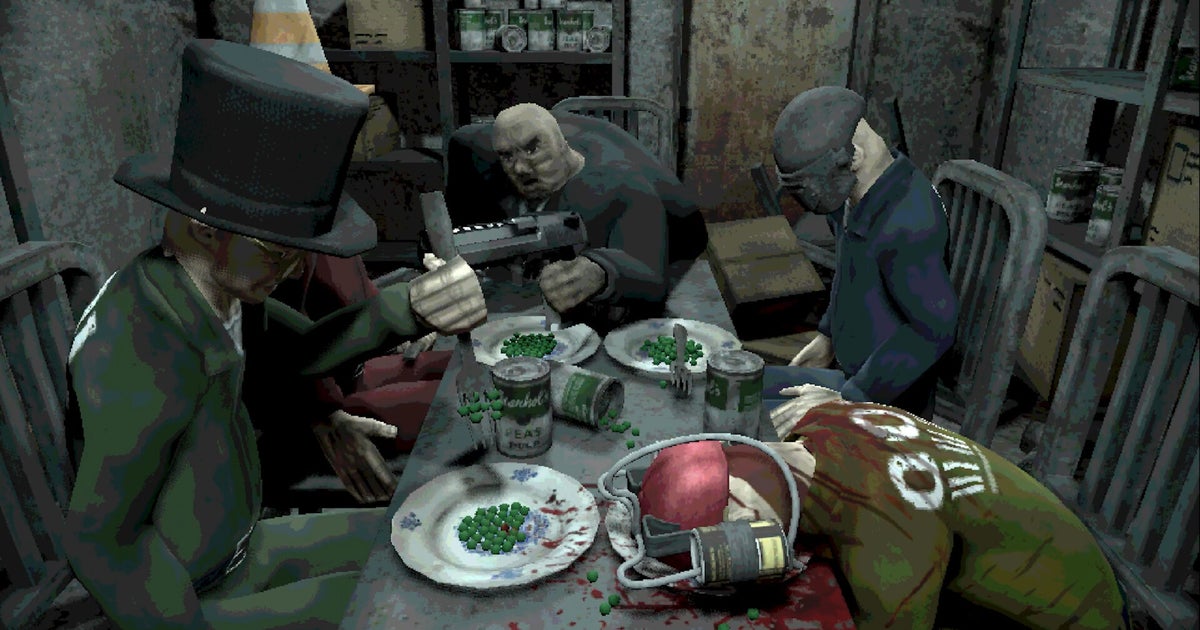
But each of these games also contains further tell-tale signs of the expanding Klubnikaverse: grubby low-poly graphics whose every surface seems to be coated in some kind of unpleasant residue; bleak settings that hint at a shared near-future authoritarian setting. These games are short, too, lasting just an hour apiece. But that means they land even harder - thwack - like a pistol whip to the face.
There is a "shared vibe," Klubnika tells me over a video call. "It's like, if you're someone living in this type of universe then you probably don't have what you want most of the time."
Klubnika, a 24-year old university drop-out from the tucked-away enclave of Tallinn, Estonia, describes more specific emotions that he intends his games to arouse: "isolation", "desperation", "risk", "worry." It's hardly crowd-pleasing stuff, but that hasn't stopped his three most recent titles enjoying massive commercial success. Buckshot Roulette has sold 10 million copies. S.p.l.i.t has shifted 200,000. Machine Party currently sits at 1.5 million.
Like other young creatives working in and around horror - notably Backrooms director Kane Parsons and Obsession director Curry Barker - Klubnika was a child of the computer. He was part of a "tech-savvy" friendship group in Tallinn: some made YouTube videos, others were self-taught programmers. Early on, Klubnika made 3D art in Blender while messing about with sound design and video editing. All of them played video games.
Klubnika's desktop PC, then, was both a creative instrument and portal into exotic worlds and taboo-feeling media: Klubnika remembers pirating the edgy top-down shooter Hotline Miami when he was 10 or 11 years old before discovering the music of Aphex Twin in one particularly strange level of the Half-Life multiplayer mod Sven Co-op.
When Klubnika wasn't glued to his screen, he was hitting house parties in Tallinn. But then it was back to the computer with a view to pushing his 3D art skills towards architectural visualisations. However, Klubnika grew bored because "archviz is very technical," he says. "I started making art instead." Klubnika applied to the world-renowned Estonian Academy of Arts, though his application was unsuccessful (clearly, the admissions staff didn't appreciate the young artist's eye for the macabre). Thereafter, he began studying English Language, though he dropped out after a single term because Buckshot Roulette was blowing up.
Ever since, Klubnika seems to have possessed a knack for unlocking Steam's inscrutable algorithm - of winning the wishlist war and riding high on the recommendations tab. This success did not occur overnight: Klubnika self-published 19 small games prior to this moment, five of which are collected on 2023's Unsorted Horror. "I got into game development with the idea it's probably not going to work out as a career," he says. "I did it for the love of the game."
All games are born from specific circumstances: a forest that naturally invites a game of hide and seek; the military-funded MIT computer labs that birthed nascent video games in the 60s. Klubnika's games are no different: first and foremost, their greyscale atmospheres are inspired by the huge, concrete buildings of Tallinn's Soviet era (which offer a stark counterpoint to the city's more straightforwardly picturesque medieval architecture). More specifically, Klubnika, like all young men in Estonia, was required to complete mandatory military service.
He trained in communications, which meant he spent a lot of time fiddling with radios. "I had a pretty easy time," he says, comparing the more technical requirements of his role to the physicality demanded of a machine gunner. "But it was still very demanding," he stresses. Especially challenging was spending large amounts of time away from home: he was stationed three hours away from Tallinn and needed a permit to return.
"There's something a little bit weird about this type of bureaucracy which doesn't feel human to me," says Klubnika. Rather than freely cavorting about Tallinn, he found himself incorporated into a stringently controlled military system. "My games take those ideas to the extreme," he says. "The people in them are very small small cogs in the machine."
It's easy to imagine the protagonist of S.p.l.i.t. toiling away in front of a large, old-fashioned computer as something of a mirror to the radio-operating Klubnika during his military service. But the events of S.p.l.i.t. are no mere training exercise. One mistake and everyone dies, including the player. The game's ending, which involves a devilish triptych of life-ending options - a noose, power drill, and screwdriver - makes this point in awful, hilarious fashion, like a cross between Pi and Eraserhead. It took my breath away and also left me feeling queasy - a testament to Klubnika's commitment to stacking one grim punchline on top of another.
But the Estonian game maker's military service days also yielded moments of levity. He enjoyed smoking with his fellow trainees; a "great ritual," he says, and a means of "decompression" (it's also a pastime Klubnika loves seeing in other media - video games like Arctic Eggs and TV shows such as True Detective). That explains one of his major motifs, then.
Klubnika's eyes also light up at the mention of firearms in the military. "Yeah, we had firearms and shooting drills and stuff," he says, casually noting the "super cool" feeling of firing an AR-15 assault rifle and the "sheer destruction" of a hand grenade. That, then, seems to explain Klubnika's fondness for including ballistic, brain-splattering weaponry in his games. He recalls one explosive training exercise, in particular: "You start off in a bunker and then you go out and you do the exercise. Then you go into a different bunker, and the entire unit goes through. So you're sitting there with a bunch of people that are, like, 20-years-old, and they're all holding high-explosive grenades. It's like, ‘This is crazy bro. Surely nothing will go wrong.'"
The anecdote seems to speak to a central sensibility of Klubnika's gritty games: a foregrounding of violent power that finds no contradiction in the powerlessness of those who wield it. Discussing Machine Party, Klubnika describes the contrapuntal nature of his work in simpler terms. "The idea was to have this fun party game, but it's industrial horror - and it's also kind of sad," he says. At one memorable moment, players get to enjoy respite from the otherwise murderous experience, running across a field of golden wheat, as if fleetingly inhabiting a scene from Terence Malick's 1978 movie, Days of Heaven. Klubnika's right: it is sad - a better life is dangled in front of these people, and then cruelly snatched away.
Barring any kind of major geopolitical rupture involving Estonia, neighbouring Russia, and Europe, Klubnika plans to keep making precisely the type of games that has brought him such success. He has toyed with the idea of scaling up but decided against it for fear of becoming an "administrator" - a suit who delegates the creative process rather than actually does it. "If I end up doing that then a large part of the reason why I make games is gone," he says.
The next game, reveals Klubnika, should harmonise two aspects of his work: the replayable arcade mechanics of Machine Party and Buckshot Roulette, and the single-player story focus of S.p.l.i.t. "I want to find a balance between the two styles," he says.
Regardless of its ultimate form, Klubnika will make it in a staunchly DIY manner: he will laboriously hand-paint each grotty surface, stretch every texture into a warped shadow of itself, and smash together 3D models of varying fidelity into a single scene. In the Klubnikaverse, a nightmarish fun-house distortion of the real world, these kinds of ostensible visual flaws deepen immersiveness rather than interrupt it. This is a fast, dirty way of making video games - and it suits Klubnika's nasty fiction down to its trash-strewn ground.