
.jpg) 1 hour ago
2
1 hour ago
2
Article content
Third consecutive year of compressed early-stage capital in Canada as the country navigates trade tensions and tighter capital markets, while Northern Ontario widens its per-capita lead, women’s representation reaches a record 40%, and cumulative angel investment passes $1.92 billion since 2010.

THIS CONTENT IS RESERVED FOR SUBSCRIBERS ONLY
Subscribe now to read the latest news in your city and across Canada.
- Exclusive articles from Barbara Shecter, Joe O'Connor, Gabriel Friedman, and others.
- Daily content from Financial Times, the world's leading global business publication.
- Unlimited online access to read articles from Financial Post, National Post and 15 news sites across Canada with one account.
- National Post ePaper, an electronic replica of the print edition to view on any device, share and comment on.
- Daily puzzles, including the New York Times Crossword.
SUBSCRIBE TO UNLOCK MORE ARTICLES
Subscribe now to read the latest news in your city and across Canada.
- Exclusive articles from Barbara Shecter, Joe O'Connor, Gabriel Friedman and others.
- Daily content from Financial Times, the world's leading global business publication.
- Unlimited online access to read articles from Financial Post, National Post and 15 news sites across Canada with one account.
- National Post ePaper, an electronic replica of the print edition to view on any device, share and comment on.
- Daily puzzles, including the New York Times Crossword.
REGISTER / SIGN IN TO UNLOCK MORE ARTICLES
Create an account or sign in to continue with your reading experience.
- Access articles from across Canada with one account.
- Share your thoughts and join the conversation in the comments.
- Enjoy additional articles per month.
- Get email updates from your favourite authors.
THIS ARTICLE IS FREE TO READ REGISTER TO UNLOCK.
Create an account or sign in to continue with your reading experience.
- Access articles from across Canada with one account
- Share your thoughts and join the conversation in the comments
- Enjoy additional articles per month
- Get email updates from your favourite authors
Sign In or Create an Account
or
Article content
Article content
Article content
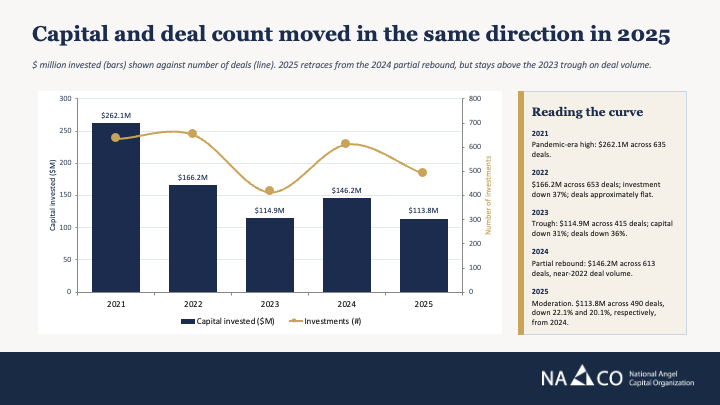
TORONTO, May 21, 2026 (GLOBE NEWSWIRE) — Canadian angel investment fell to a five-year low in 2025, with $113.79 million deployed across 490 investments – a 22.1% drop in capital deployed and a 20.1% drop in deal count from 2024, according to the 2026 State of Angel Investing in Canada report released today by National Angel Capital Organization (NACO).
Article content
Article content
The retreat reverses 2024’s partial rebound and extends a three-year compression in early-stage capital deployment. Capital deployed in 2025 is 57% below 2021’s $262.1 million pandemic-era peak, while deal count is 23% below the same period.
Article content
By signing up you consent to receive the above newsletter from Postmedia Network Inc.
Article content
Even as 2025 marked a five-year low, Canada’s angel investor base broadened. Women’s participation in reporting Canadian angel networks reached a record 40%, the highest level since NACO began tracking the measure in 2017, when the share was 14%. Cumulative angel investment in Canada has now passed $1.92 billion across more than 3,000 entrepreneurial companies since 2010, a 16-year base of private risk capital deployed at the earliest, most capital-constrained stage of company formation.
Article content
Article content
Key findings
Article content
- Canadian angels deployed $113.79 million across 490 investments in 2025, down 22.1% in capital deployed and 20.1% in deal count from 2024’s $146.16 million deployed across 613 investments.
- 2025 marks a five-year low in capital deployed, with the second-lowest deal count over the same period.
- Northern Ontario leads Canada on a per-capita basis with approximately 36 deals per million population, 64% above Southern Ontario, an advantage that widened from 50% in 2024, and posted the largest mean cheque size of any reporting region at $579,000, roughly 2.5× the $232,000 national mean.
- Women now represent 40% of members in reporting Canadian angel networks, up from 35% in 2024 and nearly tripling from 14% in 2017. Four Canadian angel networks now operate at 100% women membership.
- Cumulative angel investment in Canada since 2010 has surpassed $1.92 billion across approximately 3,000 companies in every region of the country, a 16-year measure of the asset class’s role in Canadian company formation.
Article content
Article content

Article content
Regional snapshot
Article content
Reporting in 2025 spanned six regional development agency areas. Central Canada (Southern Ontario, Northern Ontario, and Québec) accounted for 76% of investments and 75% of capital deployed. British Columbia recorded 11.2% of deals and 16.8% of capital, and Nova Scotia returned to Atlantic Canada’s dataset through a newly-reporting organization. Significant parts of the country, including Saskatchewan, Manitoba, and the Northern Territories, remain thinly served by formal angel infrastructure.
Article content
Notably, Northern Ontario continued to lead the country on a per-capita basis with approximately 36 deals per million population, roughly 64% above Southern Ontario, and posted the largest mean cheque size in Canada at $579,000.
Article content
Five organizations entered the 2025 dataset for the first time or for the first time in several years.
Article content
“Canada needs to take more shots on goal. If we want more Canadian anchor companies, we have to fund the early-stages of the pipeline. By taking more shots on goal today, we will have more global champions moving through the capital continuum,” said Claudio Rojas, CEO of NACO. “High-growth companies raise capital within an interconnected system. Early-stage investment, growth capital, and the liquidity that comes from institutional investors are sequential stages, not separate ones. A weakness at any one stage compounds across the others.”
 English (US)