
.jpg) 20 hours ago
3
20 hours ago
3
Article content
(Bloomberg) — As Bolivians try to resume a sense of normalcy after 53 days of blockades that roiled the economy, President Rodrigo Paz is right back where he was just two months ago: attempting to reform the nationalistic laws that dictate the country’s key industries.

THIS CONTENT IS RESERVED FOR SUBSCRIBERS ONLY
Subscribe now to read the latest news in your city and across Canada.
- Exclusive articles from Barbara Shecter, Joe O'Connor, Gabriel Friedman, and others.
- Daily content from Financial Times, the world's leading global business publication.
- Unlimited online access to read articles from Financial Post, National Post and 15 news sites across Canada with one account.
- National Post ePaper, an electronic replica of the print edition to view on any device, share and comment on.
- Daily puzzles, including the New York Times Crossword.
SUBSCRIBE TO UNLOCK MORE ARTICLES
Subscribe now to read the latest news in your city and across Canada.
- Exclusive articles from Barbara Shecter, Joe O'Connor, Gabriel Friedman and others.
- Daily content from Financial Times, the world's leading global business publication.
- Unlimited online access to read articles from Financial Post, National Post and 15 news sites across Canada with one account.
- National Post ePaper, an electronic replica of the print edition to view on any device, share and comment on.
- Daily puzzles, including the New York Times Crossword.
REGISTER / SIGN IN TO UNLOCK MORE ARTICLES
Create an account or sign in to continue with your reading experience.
- Access articles from across Canada with one account.
- Share your thoughts and join the conversation in the comments.
- Enjoy additional articles per month.
- Get email updates from your favourite authors.
THIS ARTICLE IS FREE TO READ REGISTER TO UNLOCK.
Create an account or sign in to continue with your reading experience.
- Access articles from across Canada with one account
- Share your thoughts and join the conversation in the comments
- Enjoy additional articles per month
- Get email updates from your favourite authors
Sign In or Create an Account
or
Article content
His government was able to end the protests that called for his resignation after enacting a 90-day state of emergency that would allow for military intervention and the suspension of some individual rights. And for Paz and heads of industry, now is the time to attract more foreign investment into mining, hydrocarbons, lithium and energy. On Friday, Bolivia’s Finance Ministry announced the country would move to a flexible exchange-rate system to strengthen macroeconomic stability.
Article content
Article content
Article content
“During these 90 days, what the government urgently needs to do is present, approve and implement the laws necessary for the country’s economy recovery,” said Bolivian Exporters Chamber chief Oswaldo Barriga.
Article content
By signing up you consent to receive the above newsletter from Postmedia Network Inc.
Article content
It will take months for a full recovery of foreign trade, and the government should help businesses by guaranteeing fuel supplies and assistance to avoid fines from shipping companies and contract losses, he said.
Article content
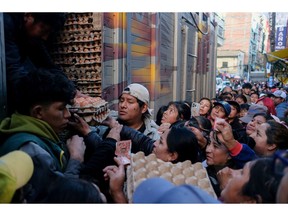
There were about $3 billion in total economic losses, or 6% of Bolivia’s gross domestic product, during the nearly two months of blockades organized by the national labor union, the La Paz farmers federation and followers of former President Evo Morales. The resulting shortages of food, medicine and fuel left residents of La Paz and El Alto in despair — along with those stuck along the routes into those cities.
Article content
As lawmakers get back to the negotiating table, buses have started running again, businesses reopened and some groceries began to reappear on supermarket shelves.
Article content
Still, much of the country remains in distress. Freight agencies are in chaos, with depots full of packages and endless lines of customers who couldn’t send goods for almost two months. Stressed traffic officers argue with irritated drivers in the recently reopened La Paz bus terminal, while truckers who spent more than 50 days stranded on the roads are now queuing at a nearby gas stations for diesel.
Article content
Article content
Tomás Flores, a 53-year-old truck driver, was one of thousands stranded in the roads. He spent 51 days and nights inside the cabin of his truck, enduring the freezing temperatures of the Bolivian highlands in the border town of Desaguadero. By Wednesday, the day after all blockades were lifted, he remained in his cabin, this time waiting in a kilometer-long line in El Alto to refuel with diesel.
Article content
“Thank God we were in a privileged location,” Flores said, because he and his colleagues got provisions and medical care from neighboring Peru. Others, however, were stranded in remote areas, digging wells in search of fresh water or even dying from health complications, according to local media reports.
Article content
Hydrocarbons Minister Marcelo Blanco told local radio Fides that the government was working to guarantee the quality of fuel — after thousands of vehicles were damaged from poor-quality gasoline at the beginning of the year, sparking protests that later escalated into the blockades. He denied any financial difficulties in importing fuels. However, he said Bolivia owes commodity traders Vitol SA and Trafigura Group Pte more than $500 million for fuel purchased on credit.
 English (US)