

I've been captivated by the idea of wrong-footing an audience ever since playing Faith: The Unholy Trinity. That game presents like an 8-bit horror, then proceeds to bend the rules of what an 8-bit game can do - or perhaps what you remember they could do - in order to surprise and scare you. Tenebris Somnia is very similar. Indeed, it's executive produced by the developer of Faith, Airdorf Games, so the connection runs even deeper. Tenebris Somnia utilises the same retro aesthetic with its grinding chiptune music, its pixelated graphics, and old-school presentation. But the difference is it takes the rule-bending a step further, essentially welding two very different experiences together: a retro-styled 2D adventure and a full-on live-action film. And it's horrific, in all the right ways.
To begin with, Tenebris Somnia is a slow, plodding, fairly unremarkable affair that plays a bit like a point-and-click adventure. You're a young woman on her way to her former boyfriend's apartment, checking it out because you suspect something has happened there. You move from screen to screen, examining points of interest as you pass them, collecting odds and ends - an empty bottle, a mysterious book - and storing them in your inventory for later. Eventually, there's a locked door, and you'll have to piece together the scattered clues in order to unlock it. And despite the apparent urgency of the situation - the carnage you find in your ex-boyfriend's apartment - the pace is slow; deliberately old-school in its approach. Walk back and forth, examine everything, try "combining" items in your inventory, "use" them on the environment. Did it work? No? Try something else.
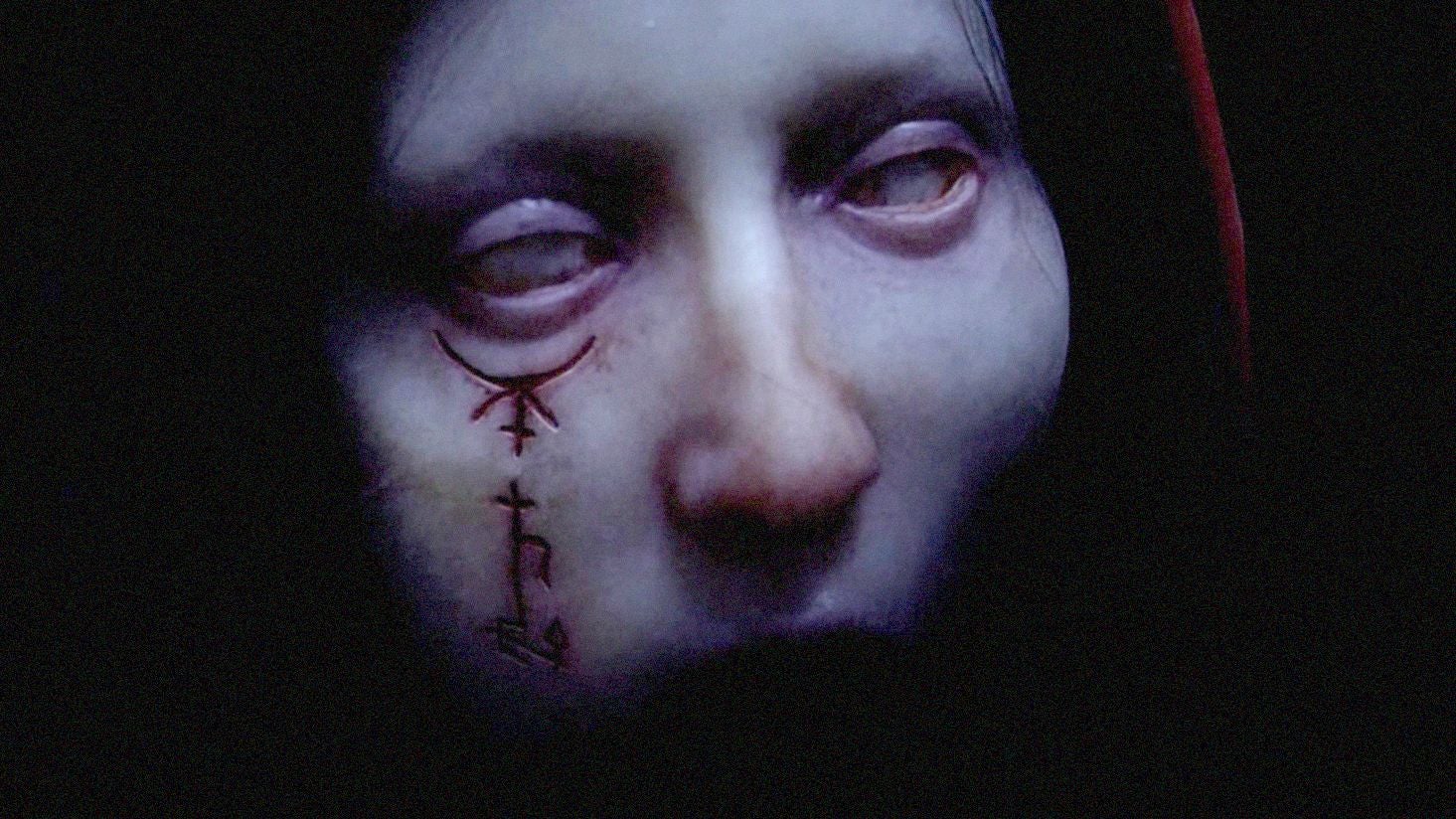
But this is where Tenebris Somnia begins to distinguish itself: your busywork is often rewarded with a glossy live-action sequence - clips of real actors in impressive costume and make-up enacting key moments from the unfolding adventure. A person with what appears to be two faces, one inverted, rushes out of the darkness toward you. A strange woman suddenly appears in a lift, offering you a gift. Two waxen figures embrace each other in bed. A giant lady with a hole in her face stretches towards the ceiling. It's captivatingly weird and very well-produced, finished with a level of polish that's impressive in an otherwise lo-fi indie experience such as this. And there's a reason for this: the live-action scenes are made by filmmaker Andrés Borghi, who's worked on a number of films including acclaimed Argentinian horror When Evil Lurks. Borghi has also made games of his own, so there's a natural overlap and understanding there.
It's these live-action sequences that stand Tenebris Somnia apart, that bring another, unusual dimension to it. That pixelated creature rushing toward you in the hallway: it has more substance in your mind now you've seen it up close. That enigmatic lady in a cocktail dress: you know the contours of her face and the strange demonic symbols branded there. You know the world better, more intimately now, and that gives it more impact. These live-action moments also create a kind of propulsive anticipation, knowing that when you do solve a puzzle or unlock that mysterious door, lavish reward and revelation awaits you there.
But I have my doubts about the game overall. Granted, I'm only early on, so perhaps I'm yet to really settle in. But I find its plodding stop-start rhythm works against the suspense and horror. Laboriousness deflates the tension. Frequently revisiting areas robs them of their surprises. And I haven't found much inherent interest in exploring new areas of the game; the writing feels functional to me rather than intriguing, and that's a problem, because in the adventure game sequences it has to do so much of the heavy lifting.
But I remain hopeful. I've watched a little more of Tenebris Somnia than I've managed to play, and the movie-making story at its heart - one focusing on a horror short of your ex's creation - appears to deepen and circle back on itself in interesting ways. Everything you do somehow seems tied to that movie - around deals with devilish entities and the grotesque consequences they bring. That filmic motif repeats again and again. And who knows? Perhaps the live-action sequences represent more than the things our character is experiencing. So there's intrigue there, depth, thought, layers, and, by the looks of it, plenty of imagination to support it.


