
.jpg) 19 hours ago
2
19 hours ago
2
We know that the genes we're born with contribute to the risk of psychiatric disorders during our lifetimes, and a new study shows there is significantly more biological overlap across these conditions than previously thought.
The international team of scientists behind the research believes that their findings can help improve how these conditions are diagnosed and treated: not just through symptoms and behavior, but also through shared genetic factors.
"Right now, we diagnose psychiatric disorders based on what we see in the room, and many people will be diagnosed with multiple disorders. That can be hard to treat and disheartening for patients," says neuroscientist Andrew Grotzinger, from the University of Colorado Boulder.
"This work provides the best evidence yet that there may be things that we are currently giving different names to that are actually driven by the same biological processes."
Related: Cat Ownership Linked to Increased Risk of Schizophrenia, Research Suggests
The researchers analyzed DNA data from more than 1 million people diagnosed with 14 different psychiatric disorders, comparing their genomes with those of another 5 million people without these diagnoses.
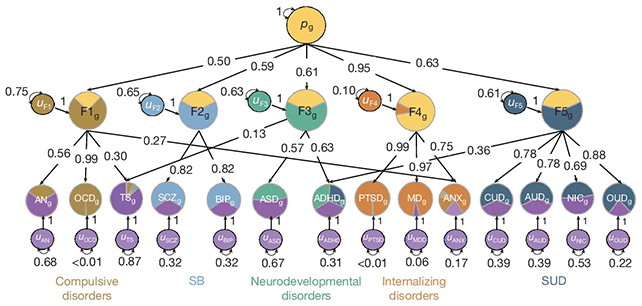 Disorders were grouped based on shared genetics. (Grotzinger et al., Nature, 2025)
That analysis revealed five genomic factors – or recurring patterns across genes – underlying these disorders. Together, these five factors, composed of 238 genetic variants, accounted for an average of around two thirds of the genetic differences between participants with psychiatric disorders and those without.
Each factor was most strongly linked with a particular group of conditions: compulsive disorders (like obsessive-compulsive disorder), internalizing disorders (such as anxiety and depression), substance use disorders, neurodevelopmental conditions (including autism), and finally bipolar disorder and schizophrenia.
In the case of bipolar disorder and schizophrenia – which typically aren't diagnosed together – the researchers found that 70 percent of the genetic signaling common with these two conditions was shared between them.

"Genetically, we saw that they are more similar than they are unique," says Grotzinger.
"By identifying what is shared across these disorders, we can hopefully come up with ways to target them in a different way that doesn't require four separate pills or four separate psychotherapy interventions."
Previous research has already shown substantial overlap between psychiatric disorders: More than half of those diagnosed with one condition are eventually diagnosed with at least one additional disorder. This study helps explain the biological basis for that overlap.
Related: Several Psychiatric Disorders Share The Same Root Cause, Study Shows
The researchers also identified biological pathways influenced by the shared genetic risk variants, which could eventually guide new treatments or prevention strategies. Some of these pathways are involved in early brain development and neuron signaling.
Genetic factors common to bipolar disorder and schizophrenia are associated with excitatory neurons, whereas the variants shared in the depression/anxiety gene cluster appear to involve oligodendrocytes, cells that support neurons.
Scientists have been studying the genetic underpinnings of psychiatric disorders for years now, with the ultimate aim of improving diagnostic accuracy and treatment effectiveness, particularly for those with multiple conditions.
Although the findings won't immediately change clinical diagnostic practices, the researchers hope their data will inform future guidelines. They also plan to extend their analyses to larger and more diverse populations.
"These findings provide valuable clues for advancing our understanding and treatment of mental illness with greater precision," says geneticist Jordan Smoller, from the Broad Institute of MIT and Harvard.
The research has been published in Nature.
 English (US)