
.jpg) 2 hours ago
3
2 hours ago
3
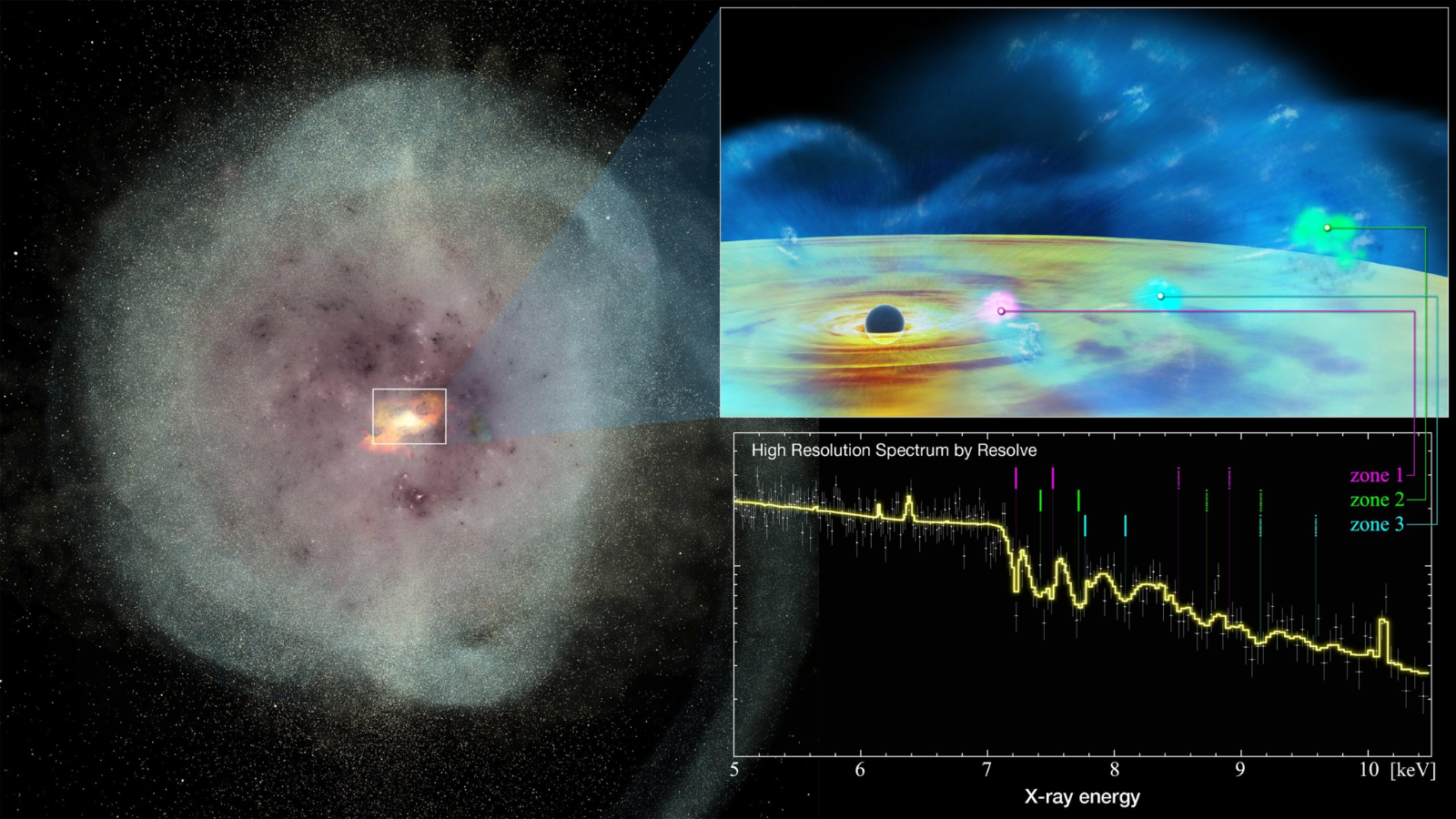
The joint NASA and Japan Aerospace Exploration Agency (JAXA) mission XRISM has spotted a monster black hole awakening in a distant "starburst" galaxy.
The research is revolutionary to black hole science, because it represents the first observation of the exact stage at which "winds" from a black hole begin to shape an entire galaxy.
Article continues below
The team found that these black hole bullets carried with them energy 100 times greater than that of slower molecular winds that spread through the distant galaxy, which is the result of a recent merger and is currently in the midst of intense star formation.
The energetic nature of these outflows shows they are more than capable of redirecting the evolution of this galaxy.
Supermassive black holes and galaxies grow up together
when it was created via a merger between two progenitor galaxies. This collision delivered a vast amount of gas and dust, which triggered an intense bout of star formation, referred to as starburst.
However, much of this gas flows toward the heart of the galaxy and its central supermassive black hole, gathering around it in a flattened swirling cloud called an "accretion disk." As the accretion disk gradually feeds the black hole, the huge gravitational influence of the supermassive black hole, estimated to be 420 million times more massive than
the sun, generates powerful tidal forces in the accretion disk, causing it to glow brightly.
This region is referred to as an active galactic nucleus (AGN), and its bright emissions are seen on Earth as a
quasar.
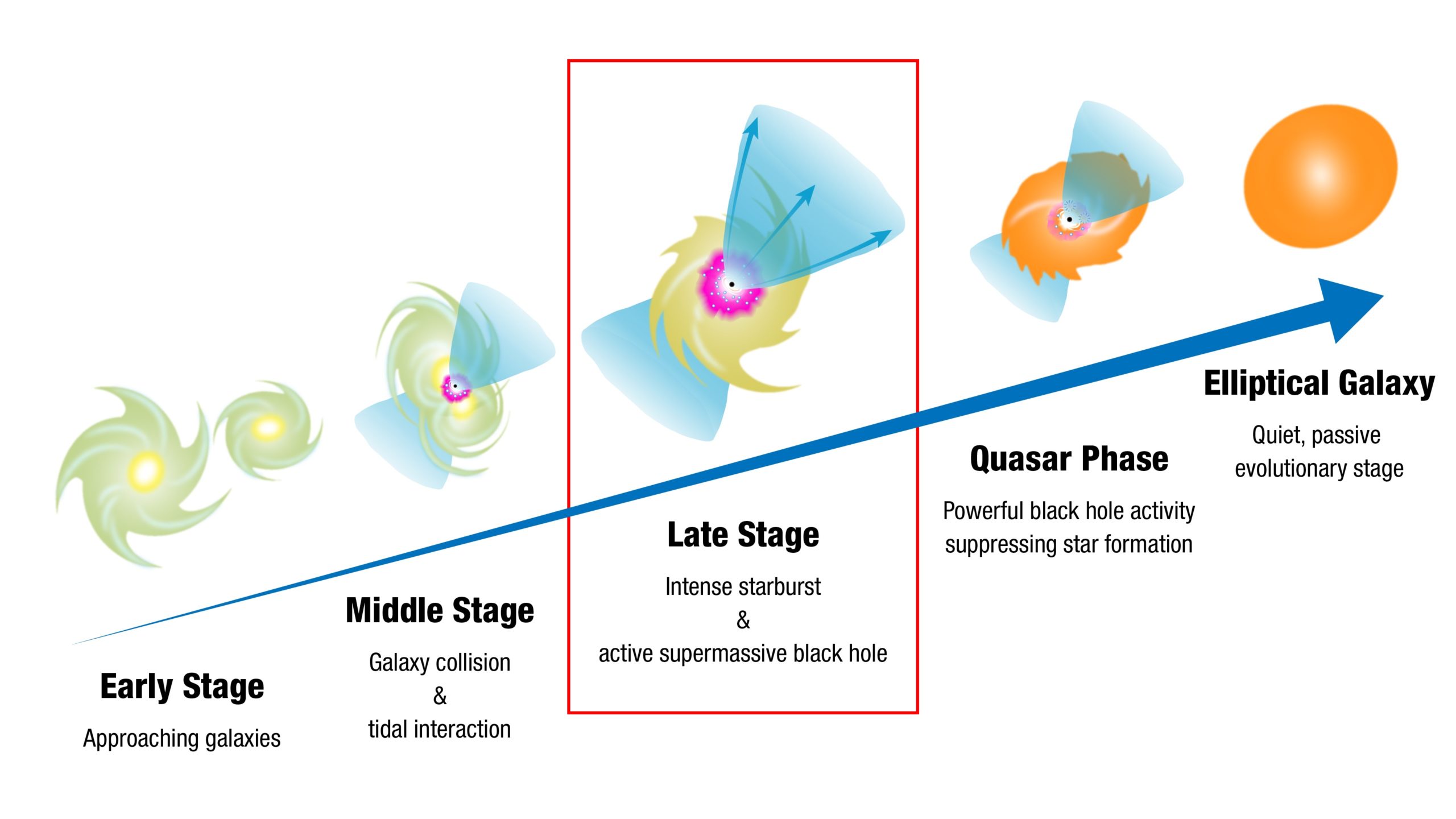
Not all the matter in the accretion disk is fed to the supermassive black hole, though. Some is channeled to the black hole's poles, from where it is blasted out as powerful jets. Other matter is blown away by intense black hole winds.
These factors can push gas and dust away from the AGN, starving the black hole, and away from the host galaxy as a whole. This has the effect of "killing" the galaxy by cutting off star formation. This leads to a quiet phase in the galaxy, now with a settled elliptical shape, without star formation, and with a slumbering black hole.
IRAS 05189-2524 presents a unique opportunity for scientists to study this process, as it is in the late stages of merging, with an active starburst ongoing and an active supermassive black hole in an AGN.
The scientists not only studied these black hole bullets in great detail but also found that this supermassive black hole is still voraciously feeding. In fact, this violent consumption of matter is close to the theoretical limit for such a black hole. The team expects the outflows of matter from this black hole to intensify, eventually killing star formation in this galaxy.
The researchers hope to further study IRAS 05189-2524 with XRISM, as well as collect observations with the forthcoming NewAthena spacecraft, set to be the largest X-ray observatory ever built.
The new results will soon appear in a special edition of the Astrophysical Journal Letters.
 English (US)