
.jpg) 2 hours ago
3
2 hours ago
3
Article content
(Bloomberg) — Australia’s central bank raised its key interest rate for a second straight meeting on Tuesday, stepping up its battle against stubborn inflation as rising energy costs from the widening war in Iran threaten to intensify price pressures.

THIS CONTENT IS RESERVED FOR SUBSCRIBERS ONLY
Subscribe now to read the latest news in your city and across Canada.
- Exclusive articles from Barbara Shecter, Joe O'Connor, Gabriel Friedman, and others.
- Daily content from Financial Times, the world's leading global business publication.
- Unlimited online access to read articles from Financial Post, National Post and 15 news sites across Canada with one account.
- National Post ePaper, an electronic replica of the print edition to view on any device, share and comment on.
- Daily puzzles, including the New York Times Crossword.
SUBSCRIBE TO UNLOCK MORE ARTICLES
Subscribe now to read the latest news in your city and across Canada.
- Exclusive articles from Barbara Shecter, Joe O'Connor, Gabriel Friedman and others.
- Daily content from Financial Times, the world's leading global business publication.
- Unlimited online access to read articles from Financial Post, National Post and 15 news sites across Canada with one account.
- National Post ePaper, an electronic replica of the print edition to view on any device, share and comment on.
- Daily puzzles, including the New York Times Crossword.
REGISTER / SIGN IN TO UNLOCK MORE ARTICLES
Create an account or sign in to continue with your reading experience.
- Access articles from across Canada with one account.
- Share your thoughts and join the conversation in the comments.
- Enjoy additional articles per month.
- Get email updates from your favourite authors.
THIS ARTICLE IS FREE TO READ REGISTER TO UNLOCK.
Create an account or sign in to continue with your reading experience.
- Access articles from across Canada with one account
- Share your thoughts and join the conversation in the comments
- Enjoy additional articles per month
- Get email updates from your favourite authors
Sign In or Create an Account
or
Article content
The Reserve Bank’s nine-member policy committee split five-to-four in favor of raising the cash rate to 4.1% from 3.85%. This was the first back-to-back hike since mid-2023 and reverses two of the three cuts delivered last year.
Article content
Article content
Article content
Three-year government bond yields slid eight basis points and the Australian dollar edged lower, reflecting the tight vote. Meantime, traders boosted bets on a follow-up hike in May to about a 50-50 chance.
Article content
By signing up you consent to receive the above newsletter from Postmedia Network Inc.
Article content
“The statement itself still retains its hawkish bias but it’s the close 5-4 split which is being interpreted as less hawkish than otherwise,” said Michael Tang, a rates strategist at Commonwealth Bank of Australia. It “shows how much the board composition matters, and the risk that they don’t hike in May given how close this one was, and the perceived pull forward of the May hike.”
Article content
The move puts into effect hawkish signals from Bullock, who earlier this month pushed back against expectations the RBA would skip tightening in March. That message was amplified by further jawboning from her deputy Andrew Hauser, who warned last Tuesday that Middle East-driven price rises would not be helpful to ongoing efforts to restrain inflation.
Article content
“I would argue this is reasonably hawkish and that the split vote is a reflection of members debating ‘when’ rather than ‘if’ they should raise rates,” said Philip McNicholas, Asia sovereign strategist at Robeco in Singapore. “Judging by the market reaction, however, others are taking the opposite interpretation.”
Article content
Article content
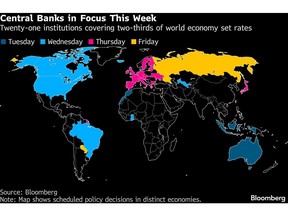
The RBA’s meeting is the first of eight among major central banks this week and comes against the backdrop of escalating conflict in the Middle East. The Federal Reserve will announce its decision on Wednesday and the Bank of Japan on Thursday.
Article content
The US-Israeli attack on Iran, which started at the end of February, and Iran’s counterstrikes on nearby states has drawn more than a dozen countries into the fray. The effective closure of the Strait of Hormuz, the chokepoint connecting the Persian Gulf to international markets that carries about one-fifth of world oil supply, has sent oil prices soaring and poses a significant upside risk to global inflation.
Article content
The RBA board judged that there is a “material risk” that inflation will remain above its 2-3% target range for longer than previously anticipated, according to its statement.
Article content
“Developments in the Middle East remain highly uncertain, but under a wide range of possible scenarios could add to global and domestic inflation,” the board said. “In light of these considerations, the board judged that inflation is likely to remain above target for some time and that the risks have tilted further to the upside, including to inflation expectations.”
 English (US)