
.jpg) 9 hours ago
3
9 hours ago
3
When researchers digitally reconstructed the face of a 1.6-million-year to 1.5-million-year-old hominin from Ethiopia, the result wasn’t the familiar look of early Homo erectus. Instead, the fossil revealed a face that appeared strikingly more archaic than expected.
Known as DAN5, the specimen represents the most complete Early Pleistocene hominin cranium yet recovered from the Horn of Africa and suggests that the first human populations to migrate out of the continent may not have looked as anatomically modern as long assumed. The findings, published in Nature Communications, add a new layer of complexity to early human evolution and migration.
Reconstructing the Face of an Early Homo erectus
The DAN5 fossil was discovered at Gona, one of the most important sites for studying early human evolution. The region has yielded hominin fossils dating back more than six million years, along with stone tools spanning the last 2.6 million years.
DAN5 includes a partial braincase and several fragments of the face and teeth recovered during fieldwork in 2000. To reconstruct the skull, researchers used high-resolution micro-CT scans to create detailed 3D models of four major facial fragments. These pieces were digitally reassembled, with the teeth fitted into the upper jaw, before the reconstructed face was attached to the braincase.
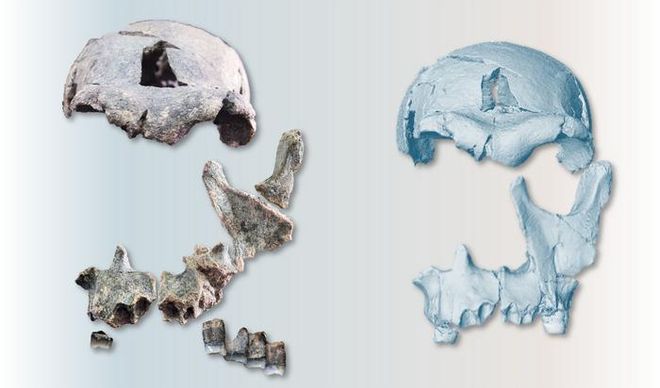
Reassembled fossil fragments of complete cranium of a human ancestor from the Horn of Africa.
(Image Credit: Dr. Karen L. Baab. Scans provided by National Museum of Ethiopia. Photographs courtesy of M. Rogers and G. Suwa)
When the reconstruction was complete, it revealed a notable mix of traits. The braincase showed features typical of H. erectus, but the face appeared far more ancestral, with a relatively flat nasal bridge and large molars — characteristics more often seen in earlier hominin species.
“We already knew that the DAN5 fossil had a small brain, but this new reconstruction shows that the face is also more primitive than classic African Homo erectus of the same antiquity. One explanation is that the Gona population retained the anatomy of the population that originally migrated out of Africa approximately 300,000 years earlier,” said Dr. Baab, who was responsible for the reconstruction, in a press release.
That combination of features had previously been documented mainly in Eurasian fossils, making its appearance in Africa particularly unexpected.
Why the DAN5 Face Matters for Human Evolution
H. erectus is widely regarded as the first hominin species to spread beyond Africa, appearing across Africa, Asia, and Europe after about 1.8 million years ago. Traditionally, scientists have envisioned this dispersal as involving populations with increasingly modern anatomy.
But the DAN5 fossil complicates that picture. The mix of H. erectus traits in the braincase and more primitive features in the face and teeth suggests that early members of the species were far more anatomically diverse than previously recognized.
Similar combinations of traits had been documented in Eurasian fossils, but this is the first time such a pattern has been clearly identified within Africa. That finding challenges the idea that H. erectus evolved its characteristic anatomy only after leaving the continent.
One possibility, Baab noted, is that the Gona population retained features from an earlier group that migrated out of Africa roughly 300,000 years earlier. Another is that H. erectus in Africa included multiple populations with different evolutionary trajectories.
Rethinking the Path Out of Africa
The DAN5 fossil also sheds light on early human behavior. The individual was associated with both Oldowan stone tools and early Acheulian handaxes, marking some of the earliest evidence that these two tool traditions overlapped in direct association with a hominin fossil.
Looking ahead, researchers hope to compare DAN5 with early human fossils from Europe, including H. erectus and Homo antecessor, to better understand how early humans adapted as they moved across continents. There is also the possibility that admixture between different hominin species — a process known from later human evolution — played a role.
Read More: Homo Ergaster: The Early Human Who Looked Almost Like Us
Article Sources
Our writers at Discovermagazine.com use peer-reviewed studies and high-quality sources for our articles, and our editors review for scientific accuracy and editorial standards. Review the sources used below for this article:
- This article references information from a recent study published in Nature Communications: New reconstruction of DAN5 cranium (Gona, Ethiopia) supports complex emergence of Homo erectus
 English (US)