
.jpg) 15 hours ago
4
15 hours ago
4
A new study has measured the levels of indoor air pollution emitted by everyday home appliances, revealing which ones you might want to think twice about running.
Led by a team from Pusan National University (PNU) in South Korea, the researchers set up a special lab chamber, then measured the emissions of airborne ultrafine particles (UFPs) emitted by various household devices.
These UFPs measure less than 100 nanometers in size – small enough to sink deep into the body.
The team tested different types of toasters, air fryers, and hair dryers, and most of these appliances emitted a high number of UFPs. The worst offender was a pop-up toaster, which without any bread inside it, gave off around 1.73 trillion UFPs per minute.
Related: New Kind of Ultraviolet Light Safely Kills Airborne Pathogens Indoors, Scientists Say
While the potential effects on human health weren't directly measured in this study, simulations run by the team showed that the UFPs would be too fine for the nose to filter them out, allowing them to penetrate deep into the lungs of adults and children. With their smaller airways, children could be most at risk from these particles sticking around.
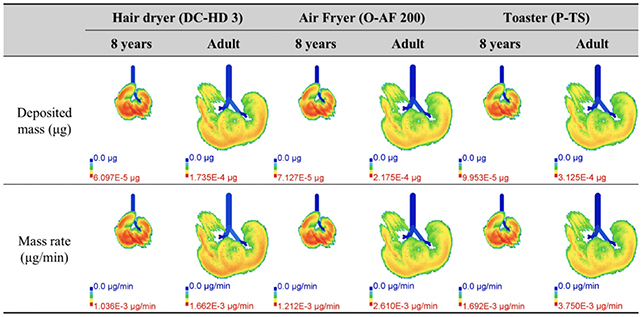 The researchers modeled, in computer simulations, the deposition of ultrafine particles in the lungs of adults and children. (Ryu et al, J. Hazard. Mater., 2025)
"Our study emphasizes the need for emission-aware electric appliance design and age-specific indoor air quality guidelines," says Changhyuk Kim, an environmental engineer from PNU.
"In the long term, reducing UFP emissions from everyday devices will contribute to healthier indoor environments and lower chronic exposure risks, particularly for young children."
Electric heating coils and brushed DC motors in the devices seemed to play a large role in UFP emission. The brushless hair dryers tested emitted some 10 to 100 times fewer particles than the hair dryers with motors inside.
What's more, as well as the UFPs, the researchers found evidence of heavy metals – copper, iron, aluminum, silver, and titanium – in the airborne particles too. It seems these metals are most likely coming off the coils and motors directly.
"These associated heavy metals increase the risk of cytotoxicity and inflammation when the particles enter the human body," says Kim.
It's important to emphasize that this study didn't test the potential health impacts of these appliances and the UFPs they produce – but plenty of prior research has done that, and the findings aren't promising.
These particles have been linked to conditions including asthma, cardiovascular disease, hypertension, diabetes, and cancer.

An increasing amount of research is now looking at problems with indoor air quality, whether that comes from appliances, deodorants, or hairsprays. With a warming climate and a global pandemic, many of us are now tending to spend more of our time indoors than we ever have.
The researchers want to see more done to improve the safety of home appliances, and the level of UFP emissions they give off – a problem starkly highlighted in this study. Design and efficiency improvements can be put in place by manufacturers, but it's likely that tighter regulations will be required to enact change.
"Understanding the source of the pollutants helps to develop preventive measures and policies for keeping healthy indoor air quality," says Kim.
The research has been published in the Journal of Hazardous Materials.
 English (US)