The results from last week’s poll show that touchscreens do have a place on some laptops. It’s mainly the ones with a 360° hinge or the ones where the screen can detach from the keyboard – in other words, the laptops that can be used as a tablet.
According to commenters, a touchscreen enables quick and easy navigation – especially for people who don’t like using a touchpad. Also, it has clear applications for artists, designers and developers.
The second-largest voting block has no need for a touchscreen on a laptop and is mainly concerned with not paying extra for a feature that they won’t use – a perfectly understandable position.
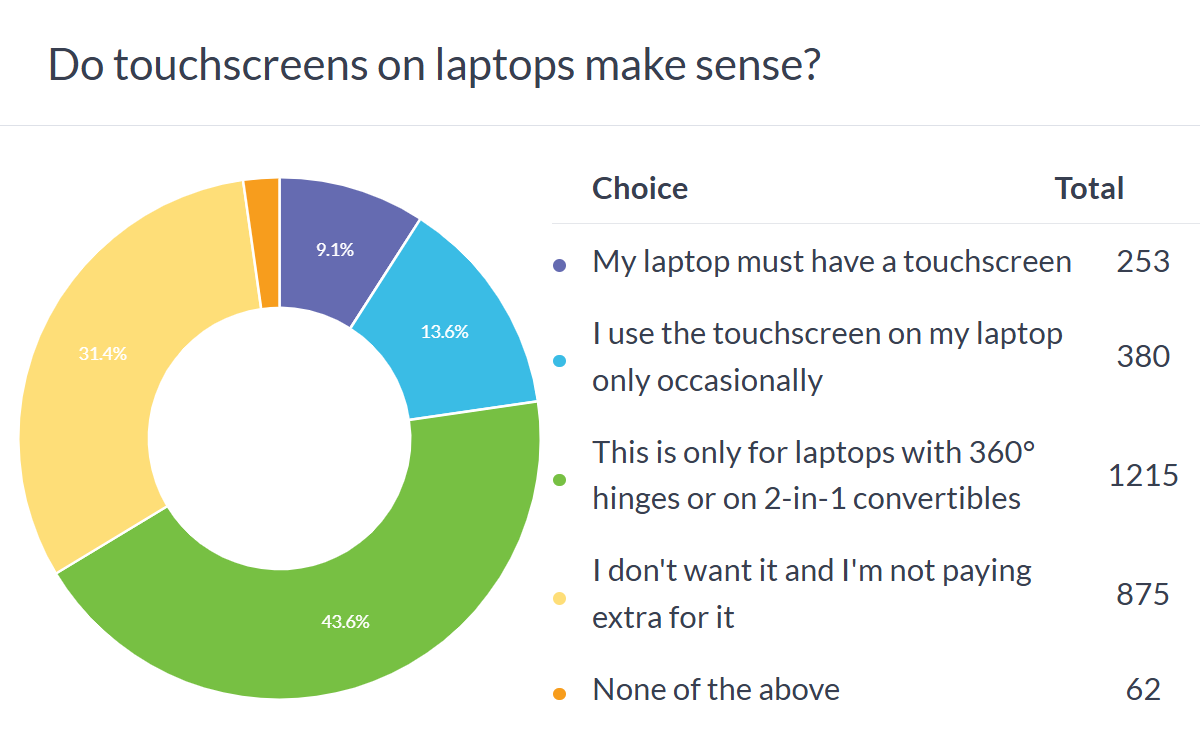
Then there are those who do actually use the touchscreen feature on laptops that can’t turn into a tablet – they represent nearly a quarter of voters. That said, the majority of them admit to using the touch function only occasionally.
The group that uses touch constantly was the smallest with just over 9% of the vote.
Focusing on Apple for a moment, the company was right to launch a touch-enabled MacBook – but it picked the wrong form factor. macOS can run iPadOS apps natively, so a MacBook with a 360° hinge would have had a wealth of apps to use. Using iPad apps when you have to reach your finger across your desk is not going to be a popular use-case, though.
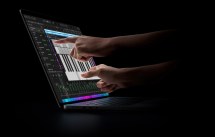

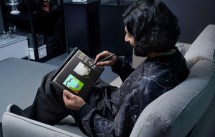
Do touchscreens on laptops make sense?
As for non-Apple makers, Google recently launched the Googlebook project – Android-powered laptops. Obviously, Android is a touch-native OS, but from what we’ve seen so far, it doesn’t make for a great laptop OS. Confusingly, there is also Google’s ChromeOS for laptops.
And, of course, there is Windows. Microsoft has been trying to make the Windows UI usable on a tablet since Windows 8 (that launched in 2012!) and it is still a mess. Chances are that touch-enabled laptops will remain a niche product.