
.jpg) 1 hour ago
3
1 hour ago
3
Article content
(Bloomberg) — Volkswagen AG’s battery business is being forced to seek external financing after the German carmaker cut its five-year spending plan, creating a mid-term squeeze for the unit.

THIS CONTENT IS RESERVED FOR SUBSCRIBERS ONLY
Subscribe now to read the latest news in your city and across Canada.
- Exclusive articles from Barbara Shecter, Joe O'Connor, Gabriel Friedman, and others.
- Daily content from Financial Times, the world's leading global business publication.
- Unlimited online access to read articles from Financial Post, National Post and 15 news sites across Canada with one account.
- National Post ePaper, an electronic replica of the print edition to view on any device, share and comment on.
- Daily puzzles, including the New York Times Crossword.
SUBSCRIBE TO UNLOCK MORE ARTICLES
Subscribe now to read the latest news in your city and across Canada.
- Exclusive articles from Barbara Shecter, Joe O'Connor, Gabriel Friedman and others.
- Daily content from Financial Times, the world's leading global business publication.
- Unlimited online access to read articles from Financial Post, National Post and 15 news sites across Canada with one account.
- National Post ePaper, an electronic replica of the print edition to view on any device, share and comment on.
- Daily puzzles, including the New York Times Crossword.
REGISTER / SIGN IN TO UNLOCK MORE ARTICLES
Create an account or sign in to continue with your reading experience.
- Access articles from across Canada with one account.
- Share your thoughts and join the conversation in the comments.
- Enjoy additional articles per month.
- Get email updates from your favourite authors.
THIS ARTICLE IS FREE TO READ REGISTER TO UNLOCK.
Create an account or sign in to continue with your reading experience.
- Access articles from across Canada with one account
- Share your thoughts and join the conversation in the comments
- Enjoy additional articles per month
- Get email updates from your favourite authors
Sign In or Create an Account
or
Article content
Third-party funding “is an option that we are looking into more closely than before,” PowerCo Chief Executive Officer Frank Blome told reporters at the unit’s plant in Salzgitter, Germany, on Tuesday. Bank loans, external investors and a potential public offering are all options under consideration after the unit’s budget was reduced, he said.
Article content
Article content
Article content
Volkswagen management is in the midst of deciding the details of its five-year planning round, which has been reduced to €160 billion ($188 billion) from €180 billion two years ago. The carmaker annually decides on how to divide up spending between factories, vehicle models and new technologies such as batteries, software and EVs. The plan is expected to be unveiled in March.
Article content
By signing up you consent to receive the above newsletter from Postmedia Network Inc.
Article content
Related: VW Weighs Producing Range Extender Cars for US, Europe
Article content
PowerCo doesn’t plan to halt construction at its three plants in Germany, Spain and Canada, but a solution for mid-term financing is needed, Blome said, adding that less investment is needed given the slower-than-expected uptake of EVs.
Article content
“It’s true that things aren’t progressing quite as quickly as originally planned,” Blome said.
Article content
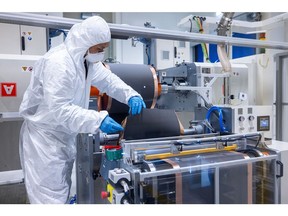
PowerCo on Wednesday commissioned the Salzgitter gigafactory, Volkswagen’s first battery-cell manufacturing site. The automaker is aiming to regain control of a key part of the electric-vehicle supply chain as Europe’s shift away from gasoline-powered vehicles loses steam. The cells will debut in EVs made by Volkswagen, Škoda and the Cupra brand next year after completing final road tests.
Article content
Article content
Germany’s higher costs will make the Salzgitter plant primarily a lead example for new batteries, establishing operations blueprints for the other two planned factories in Spain and Canada. Those will start serial production in 2027 and 2028, respectively.
Article content
The company has halved its capacity target for the initial ramp-up of the Salzgitter plant to 20 gigawatt hours a year. While it still has a long-term goal of producing batteries with a capacity of 200 gigawatt hours overall in its three plants, it hasn’t provided more details.
Article content
The three plants together would have a maximum capacity of 190 gigawatt hours if built out completely. A company spokesperson said PowerCo would look into how to get to the 200 gigawatt-hour target when it gets closer to that mark, but it’s “still very far“ from the goal.
Article content
The Spanish factory could be able to produce a maximum of 60 gigawatt hours, while the Canadian one’s capacity could be as much as 90 gigawatt hours. The Salzgitter plant will top out at 40 gigawatt hours.
Article content
PowerCo initially set out to supply about half of Volkswagen’s battery needs to help the automaker reduce its dependence on Chinese suppliers.
 English (US)