
.jpg) 1 hour ago
3
1 hour ago
3
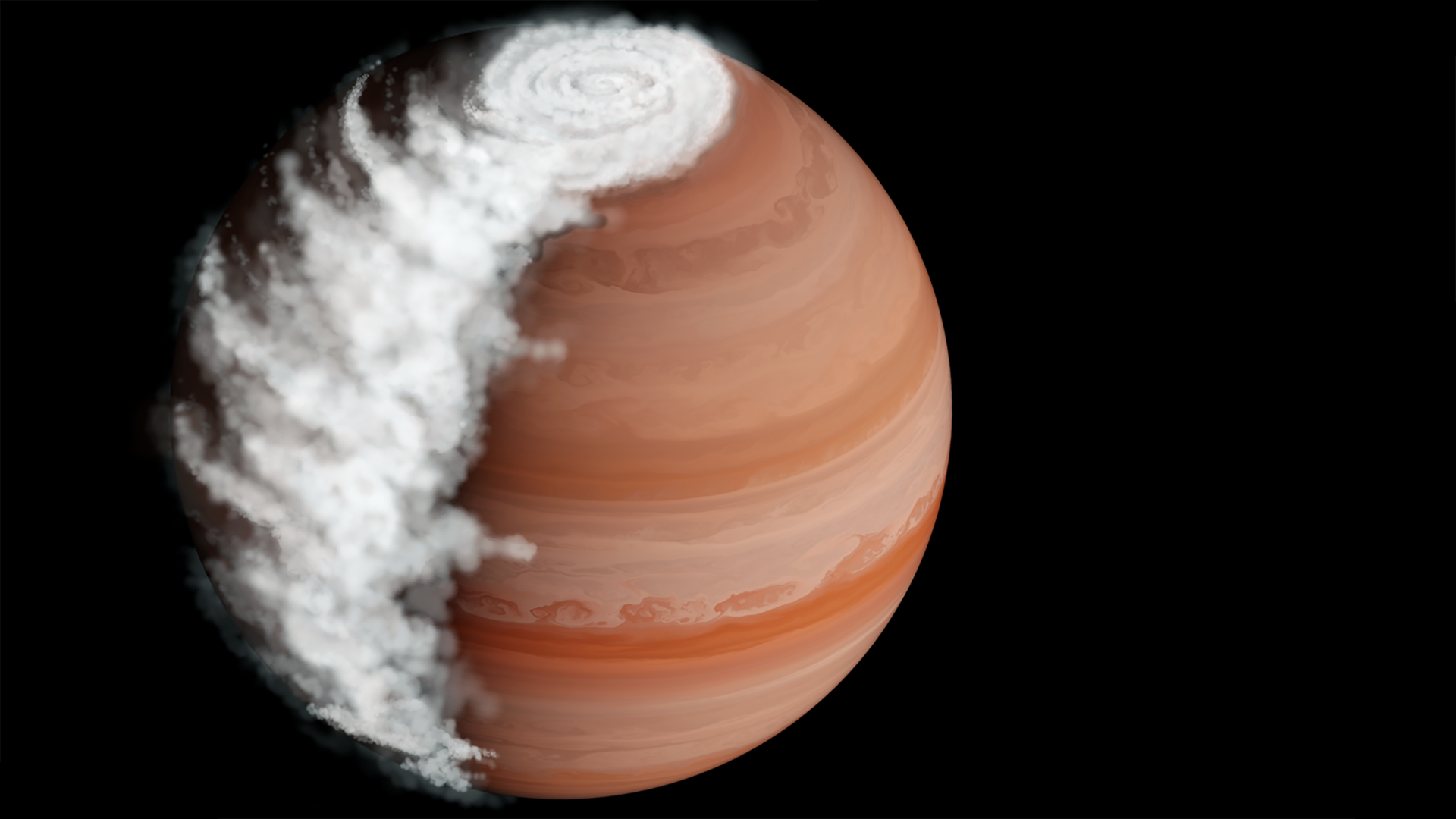
The James Webb Space Telescope (JWST) has made a weather forecast for the exoplanet WASP-94Ab, a world with clouds of sand in the morning that gradually give way to a clear sky at sunset.
It is the first time that the daily cycle of weather has been observed on a hot Jupiter exoplanet. Furthermore, the clear evening sky has provided astronomers with an unobscured view of WASP-94Ab's atmospheric composition, finding it to be closer to that of our own Jupiter than previous inaccurate measurements had suggested.
WASP-94Ab is located about 690 light-years from Earth and orbits one of two stars in a wide binary system. The planet is a gas giant 1.7 times larger than Jupiter and orbits its star every four days at a distance of 5.1 million miles (8.2 million kilometers) — close enough to be hotter than over 2,200 degrees Fahrenheit (1,200 degrees Celsius). Hence, we call such worlds "hot Jupiters."
Previous attempts to get a handle on the composition of hot Jupiters has been stymied by the fact that they are often very cloudy, which obscures much of the atmosphere. Unlike Earth's clouds of water vapor, a hot Jupiter's clouds are made of vaporized metals and rock, like giant flying sandstorms. In the case of WASP-94Ab, the clouds are composed of vaporized magnesium silicate.
"I've been looking at exoplanets for 20 years and general cloudiness has been a thorn in our side," David Sing of Johns Hopkins University said in a statement. "We've known for quite a while that clouds are pervasive on hot Jupiter planets, which is annoying because it's like trying to look at the planet through a foggy window."
But are hot Jupiters cloudy all of the time? Astronomers led by Sing put this to the test by watching WASP-94Ab with the James Webb Space Telescope (JWST) as the planet transited, or crossed the face of, its star from the spacecraft's point of view. Using a technique called transit spectroscopy, the astronomers were able to watch as the light from the star was filtered through the atmospheric gases and clouds on the leading and trailing limbs of WASP-94Ab as it transited. Some of this light is blocked by gases in the atmosphere, and the wavelengths at which that light is absorbed gives away the identity of those gases.
Sing's team saw that on the leading edge, where it was considered "morning" with air flowing from the nightside to the dayside, there were plenty of magnesium silicate clouds. However, on the trailing edge where it was "evening" with air flowing back to the nightside, the clouds had disappeared, leaving an unencumbered view of the hydrogen-dominated atmosphere. Previous Hubble Space Telescope observations had not been able to split the absorption effects of the leading and trailing limbs, so it seemed as though WASP-94Ab had hundreds of times more oxygen and carbon than Jupiter does. Given what we know about how gas giants form, this seemed improbable.
However, by detecting the cloudless sky of the trailing edge the JWST was able to get a more accurate reading by removing the effect of the clouds, finding that oxygen and carbon were only five times more abundant than on our Jupiter.
So WASP-94Ab seems like a fairly ordinary gas giant planet after all, but why are the clouds clearing? According to Sing and his colleagues there are two possibilities. WASP-94Ab is tidally locked, meaning that it always shows the same face to its star, so it has one hemisphere of permanent daylight and one hemisphere of permanent darkness. Strong winds at the terminator between day and night could be blowing the magnesium silicate high into the atmosphere, where it forms clouds over the nightside. Winds then blow these clouds around to the dayside, where they gradually descend deeper into the planet where they can no longer be seen, only to be dredged back up when the magnesium silicate circulates back around to the nightside.
The alternative is that the magnesium silicate clouds are like morning fog on Earth, steadily dissipating over the course of the day in 2,200-degree-Fahrenheit heat.
"Not only have we been able to clear the view, but we can finally pin down what the clouds are made out of and how they’re condensing and evaporating as they move around the planet," said Sing.
He and his team then used the JWST to follow up on another eight hot Jupiters, finding a similar cycle of clouds on two of them, WASP-17b, which is a large but very low density world with a bloated atmosphere and orbiting backwards around its star, and WASP-39b, which is another low density world with an atmosphere unusually rich in water vapor as well as carbon and sulfur dioxide.
The next step is to expand the search for cloudy weather on exoplanets by looking at a greater variety of worlds, including one gas giant that is on a highly eccentric orbit that takes it from its star’s habitable zone to much closer in and then back out again. The dramatic changes in heating could drive all manner of powerful weather systems that could be visible to the JWST.
The clouds on WASP-94Ab, WASP-17b and WASP-39b were reported on May 21 in the journal Science.
 English (US)