
.jpg) 2 hours ago
2
2 hours ago
2
Aging is inevitable, but it's certainly not consistent.
We might think aging proceeds in a steady, linear fashion, with each day, week, and month marching us sedately into our Golden Years, but new research suggests that aging is more like a mosaic or patchwork quilt, stitched together by hormonal cues.
A new study, published in Nature Aging, mapped structural changes across dozens of human tissues, and found that different parts of the body follow surprisingly variable aging schedules.
Some begin changing rapidly in our 30s. Others remain relatively stable until around menopause in female bodies. And still others appear to go through two distinct periods of accelerated aging.
In other words, there may be no single "aging process" happening throughout the body. Instead, different organs or bodily systems may have their own timelines –-and different organ systems can influence each other.
To figure this out, the research team, led by computational biologist Sanju Sinha at the Sanford Burnham Prebys Medical Discovery Institute in California, developed a computational system called PathStAR to analyze the microscopic structure of tissues in routine pathology images.
Rather than being trained to guess a person's chronological age, the system examined the physical architecture of tissue changes.
The researchers applied the PathStAR analysis to images of more than 25,000 post-mortem tissue samples from 970 donors aged 21-70, covering 40 different tissue types.
"This is a public dataset used by hundreds of groups, but nearly everyone uses the molecular data," Sinha says, referring to the Genotype-Tissue Expression Project, for which the samples were collected.
"There are tens of terabytes of imaging data that have gone nearly untouched."

Arteries were among the body's early agers, with their fastest period of structural change occurring in the 30s. This lined up with pathology records showing that early plaque formation in arteries also increased most steeply during that decade before leveling off later.
People whose arteries showed more accelerated structural aging were also more likely to have atherosclerosis (where plaque builds up inside your arteries, hardening them).
So while your 30s may feel a little premature for "old age", your arteries apparently aren't waiting.
The reproductive system was quite different.
In female bodies, the uterus and vagina remained comparatively stable through early adulthood, then showed their greatest structural changes in the early and mid-50s – around the transition into menopause.
The changes included features such as tissue atrophy and thinning of the endometrium (the lining of the uterus), consistent with the effects of declining estrogen.
The ovaries were different again. Instead of changing steadily, ovarian tissue showed a burst of structural aging around ages 35 to 40 and another around 55 to 60, corresponding to the postmenopausal period.
The researchers could see this pattern in the tissue's physical structure even though comparable analyses of gene expression and DNA methylation did not reproduce the same two peaks.
Other organs also showed a similar two-stage aging pattern.
Nine of the other 14 tissues for which the researchers could establish high-confidence trajectories showed what they called "biphasic" aging, with two periods of accelerated structural change generally occurring in the 30s and 50s.
These included organs that have seemingly nothing to do with reproduction – the esophagus, stomach, colon, and small intestine. In male bodies, the prostate and testis also followed this aging pattern.
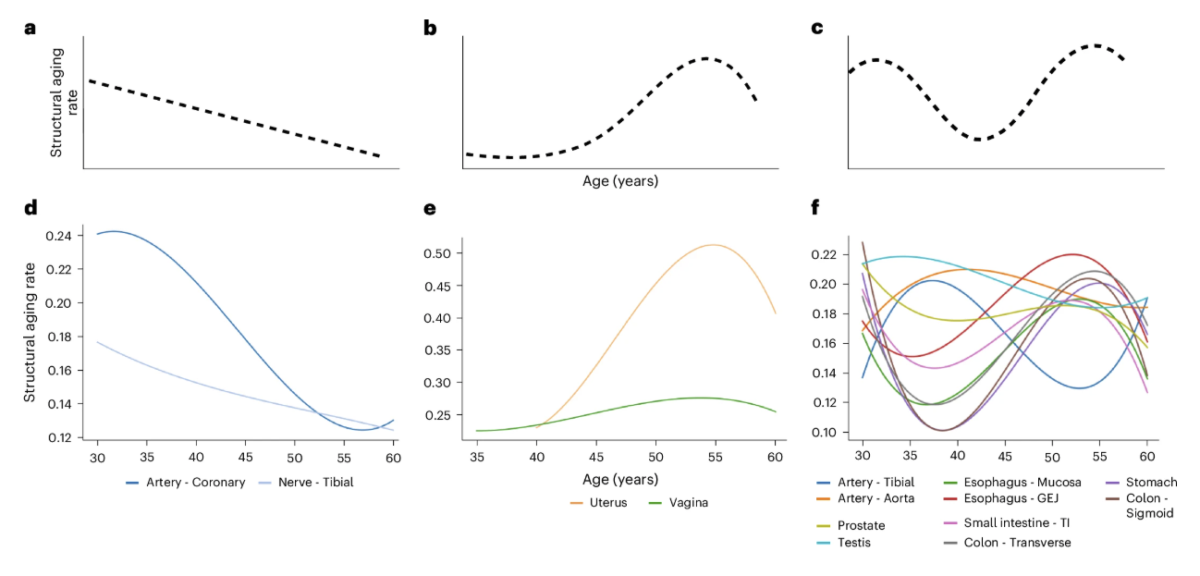 Most of the organs analyzed showed a pattern of "biphasic" aging (c, f), whereas arteries aged early (a,d) and the uterus and vagina aged more in later decades (b, e). (Yadav et al., Nature Aging, 2026)
So it seems these organs are aging in sync, with connections not just limited to nearby organs, either.
People showing accelerated structural aging in the colon and esophagus also tended to show it in the prostate, but the synchronicity appeared more widespread than that.
"More than half the tissues we studied followed the structural aging of the ovaries," Sinha says, "so we see the ovaries as a kind of pacemaker for whole-body aging."
Hormones could be the key because they flood our bodies as signaling molecules; they aren't confined to reproductive systems.
"The steepest drops [in hormone signaling capacity] occurred in gastrointestinal tissues," the researchers report, "consistent with the known expression of estrogen receptors throughout the digestive epithelium and their role in mucosal barrier maintenance."
So it makes sense that the gut ages at similar rates to the uterus or prostate.

Across these different organs, accelerated structural aging had a shared signature: More inflammation was seen alongside declines in energy production, cell proliferation, and cellular quality-control systems.
The researchers say understanding how organs and systems age could eventually change how we think about interventions intended to slow aging. Rather than treating aging as one uniform process, it might make more sense to target particular organs during the periods when they are most vulnerable.
"By developing therapies to protect reproductive aging, we see the potential to protect multiple other organs and increase the overall healthspan," Sinha says.
Related: 47-Year Study Reveals The Age We Hit Our Physical Peak
There are some important provisos to this study. First, these are post-mortem samples, and how the person died could affect their tissue ages, especially in younger people.
And the researchers acknowledge that change doesn't always mean aging: "Not all age-associated changes imply functional decline; some may reflect adaptive remodeling or neutral variation," they note in their paper.
The analysis also used relatively broad age windows, so it can't tell us exactly when an individual's tissue changes begin.
However, this work does seem to show that it's likely our bodies don't just have just one biological clock, ticking away.
It may have dozens of them – and they're not all keeping the same time.
The study has been published in Nature Aging.
This article was fact-checked by Rachel Garner and edited by Clare Watson. While we pride ourselves on our process, we are only human. If you spot a mistake, please let us know.
 English (US)