
.jpg) 3 hours ago
2
3 hours ago
2
One of the most special treasure collections in the world has been stolen.
At 5.16 am on the morning of August 27, an alarm rang out at a sports center in the Spanish city of Villena, drawing attention to the site.
Just minutes later, another alarm sounded at the Villena Museum (MUVI), some 2 kilometers (1.2 miles) away.
By the time police arrived just minutes later again, the thieves were gone – and with them, most of the priceless Treasure of Villena, a Bronze Age collection of objects mostly forged from glistening gold.
Investigators believe there were three masked suspects, several vehicles, and a highly coordinated strike that may have used the sports center alarm as a diversionary tactic, reports Spanish news agency EFE.
But among the handful of objects left behind was one of the most valuable in the entire collection.
It doesn't look like much – just a rusty old bangle.
Yet it was forged from material from the stars – meteoritic iron – one of two such artifacts in the Treasure of Villena, and among the earliest iron objects known from the Iberian Peninsula.
The Treasure of Villena was discovered in 1963, when archaeologist José María Soler unearthed 66 objects dating back around 3,000 years, including bowls, bottles, bracelets, and other ornaments fashioned from gold, silver, iron, and amber.
Taken together, it contained an astonishing nearly 10 kilograms (22 pounds) of gold.
But two items in the hoard represented a puzzle. A torc-like bracelet and a hollow hemisphere decorated with gold had a pitted, corroded, unassuming appearance.
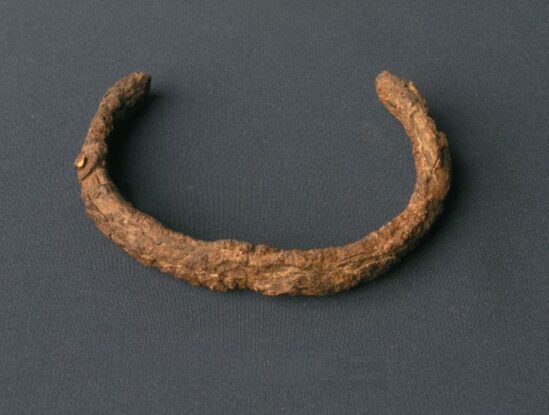 The iron bracelet, which measures 8.5 centimeters (3.35 inches) across. (Villena Museum)
At the time the treasure was made, iron smelting had not yet become established on the Iberian Peninsula. So where had the metal come from?
Answers didn't arrive until 2023, when a team led by Salvador Rovira-Llorens, now-retired head of conservation at Spain's National Archaeological Museum, found strong evidence that the two objects had an extraterrestrial origin.
That made them the first objects attributable to meteoritic iron ever identified on the Iberian Peninsula.
Now, only the bangle remains.
The hollow hemisphere was scooped up by the thieves, possibly because of the glittering gold decorating it, while the more homely bracelet was not.

What the thieves left behind is sobering. Three silver vessels survived alongside the iron bracelet, along with much of the ornamentation from a ceremonial staff and some small gold objects. One of the treasure's crowns was apparently dropped at the scene.
For Ignacio Montero, Research Professor at the Instituto de Historia-CSIC and one of the scientists who studied the meteoritic iron, the pattern points to a grim conclusion.
"This confirms that the sole interest was the economic value of the gold and that the theft is unrelated to the historical value of the cultural heritage," he told ScienceAlert.
"If the underlying motivation is limited to the economic value of the gold, the possibility of irreversible destruction becomes evident; this would entail a permanent loss that would preclude any future research."
For archaeologists, the concern now is not simply whether the missing treasure can be recovered, but whether it will survive intact long enough to be found.
The haul would be extraordinarily difficult to sell openly. The Treasure of Villena has been designated an Asset of Cultural Interest in Spain, and its distinctive pieces are well documented and immediately recognizable.
But if the thieves were interested primarily in the value of the gold itself, the objects could instead be dismantled or melted down – destroying priceless artifacts that survived intact for millennia, and reducing them to the mere price of gold.
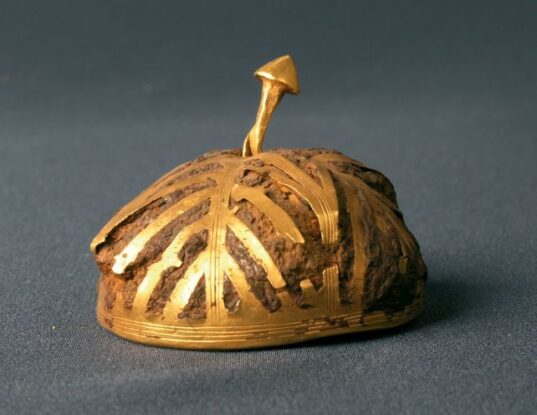 The iron-and-gold hemisphere, which has a maximum diameter of 4.5 centimeters (1.77 inches). (Villena Museum)
For the stolen hemisphere, the likely fate is slightly different, but no less dire.
"The future is bleak," Montero said.
He suspects the thieves could simply strip away the gold sheets covering the hemisphere. The meteoritic iron underneath has little obvious economic value, despite its extraordinary archaeological significance.
"The thieves have no use for it, and I would assume they will simply toss it in the trash somewhere," Montero said.
"It is impossible to distinguish corroded meteoric iron from other discarded iron with the naked eye."
That would also erase an opportunity to answer questions that still surround the two objects.
When Rovira-Llorens and his colleagues examined the two iron objects, corrosion made it hard to determine their composition precisely.
Their results nevertheless strongly suggested that both were made from meteoritic iron, and the researchers proposed that newer, non-invasive techniques could reveal more.
Montero says an earlier attempt to obtain osmium isotope measurements from the iron was unsuccessful, but the technique has since improved.
Researchers still want to pin down the origin of the meteoritic iron more precisely and investigate whether the Villena objects could have originated in the Eastern Mediterranean, where other ancient artifacts made from meteoritic iron have been found.

And there is another tantalizing question. The two Villena objects have similar minor and trace-element compositions, but researchers have not been able to establish whether they were made from the same meteorite fragment.
Without recovering the hemisphere, Montero says, that question cannot be answered.
And it isn't just the iron that scientists hadn't finished studying.
Montero says researchers Mercedes Murillo-Barroso of the University of Granada and Gabriel García Atiénzar of the University of Alicante had been awaiting authorization to more precisely characterize the treasure's gold. Montero himself is preparing research into the provenance of its silver.
The Guardia Civil's Judicial Police are investigating the theft, analyzing evidence from the scene and security-camera footage inside and outside the museum. Authorities say all hypotheses remain open.
Related: This Ancient Weapon Was Made From an Object That Fell Out of The Sky
Investigators have not yet determined whether the earlier alarm at the sports center was connected to the heist.
Meanwhile, the Villena City Council is establishing a separate commission to examine the museum project and the security measures meant to protect the treasure.
Whatever happens next, though, the scientific consequences of destroying the objects may reach far beyond the questions researchers are asking today.
"Today, archaeology possesses new scientific tools for extracting information from objects, something unthinkable two decades ago," Montero told ScienceAlert, "and new techniques will undoubtedly emerge."
If the missing pieces are destroyed, what they might have told future archaeologists will disappear with them.
This article was fact-checked by Rachel Garner and edited by Clare Watson. While we pride ourselves on our process, we are only human. If you spot a mistake, please let us know.
 English (US)