
.jpg) 1 hour ago
3
1 hour ago
3
Article content
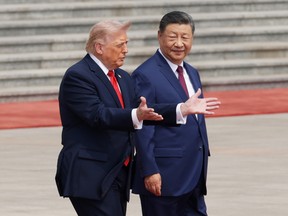
Determining the cause of the dramatic rise of China’s annual GDP per capita to US$14,000 today from less than US$1,000 in 2000 has long been a topic of heated economic and political debate — one that hovered in the background in the past few weeks leading up to Wednesday’s summit meeting between U.S. President Donald Trump and Chinese leader Xi Jinping.

THIS CONTENT IS RESERVED FOR SUBSCRIBERS ONLY
Subscribe now to read the latest news in your city and across Canada.
- Exclusive articles from Barbara Shecter, Joe O'Connor, Gabriel Friedman, and others.
- Daily content from Financial Times, the world's leading global business publication.
- Unlimited online access to read articles from Financial Post, National Post and 15 news sites across Canada with one account.
- National Post ePaper, an electronic replica of the print edition to view on any device, share and comment on.
- Daily puzzles, including the New York Times Crossword.
SUBSCRIBE TO UNLOCK MORE ARTICLES
Subscribe now to read the latest news in your city and across Canada.
- Exclusive articles from Barbara Shecter, Joe O'Connor, Gabriel Friedman and others.
- Daily content from Financial Times, the world's leading global business publication.
- Unlimited online access to read articles from Financial Post, National Post and 15 news sites across Canada with one account.
- National Post ePaper, an electronic replica of the print edition to view on any device, share and comment on.
- Daily puzzles, including the New York Times Crossword.
REGISTER / SIGN IN TO UNLOCK MORE ARTICLES
Create an account or sign in to continue with your reading experience.
- Access articles from across Canada with one account.
- Share your thoughts and join the conversation in the comments.
- Enjoy additional articles per month.
- Get email updates from your favourite authors.
THIS ARTICLE IS FREE TO READ REGISTER TO UNLOCK.
Create an account or sign in to continue with your reading experience.
- Access articles from across Canada with one account
- Share your thoughts and join the conversation in the comments
- Enjoy additional articles per month
- Get email updates from your favourite authors
Sign In or Create an Account
or
Article content
One could reduce the issue down to the question: Which of the two leaders is the most or least capitalist? If it had been Ronald Reagan meeting Xi, the answer would have been clear cut. Between Trump and Xi, it looks to be more of a toss-up.
Article content
Article content
Article content
The Trump-Xi proposition, however, is not the real question at hand. The heart of the issue was importantly and accurately posed recently by a couple of writers holding contradictory ideological positions, one on the socialist left, the other on the free-market right — a sign that resolving the debate will be one of the most important determinants of the future of global economic structures.
Article content
By signing up you consent to receive the above newsletter from Postmedia Network Inc.
Article content
The question became even more relevant as Trump and Xi acted as if the two sparring global hegemons — who can resist using that term? — embraced in Beijing. “The great rejuvenation of the Chinese nation and making America great again can go hand in hand,” said Trump.
Article content
So here we go.
Article content
On the left: Writing in the left-oriented Canadian Dimension magazine late last month, Owen Schalk asked the important question: Is China capitalist or socialist? According to Schalk, “few questions pose more confusion — and sharper disagreement — on the left today than whether China is capitalist or socialist.” Schalk’s conclusion, however, is that China is socialist, despite a declining social development regime that has left hundreds of millions of people in poverty amid “rampant inequality.”
Article content
Article content
On the right: On April 1, almost a month before Schalk’s comments, veteran American free-market economist David Friedman wrote a commentary titled “How China Went Capitalist.” The title says it all, as Friedman reviewed the findings and conclusions in a 2012 book written primarily by economist Ronald Coase titled How China Became Capitalist.
Article content
Article content
Coase, a Nobel economist, meticulously plotted the evolution of China out of Mao Zedong’s totalitarian socialism toward an economic regime that gradually allowed, and even encouraged, forms of capitalism to emerge, including the development of private enterprise, some individual freedom, and other reforms.
Article content
In the views of Coase, Friedman, and many others, it is the capitalism aspect of China’s still omni-powerful Communist state that has served as the country’s springboard to economic growth. Friedman’s summary of Coase’s conclusions is that China has been transitioning to capitalism “under the banner of socialism.” Along with the export boom, China’s first stock exchange opened in 1990 in Shanghai, which now lists more than 2,300 companies and the largest market capitalism in the world.
 English (US)