
.jpg) 2 hours ago
3
2 hours ago
3
An archaeological site in the Middle East now stands as one of the oldest areas that humans occupied outside of Africa, a distinction that has been set in stone by snails and ancient sediments. The site of ‘Ubeidiya, located just south of the Sea of Galilee in the Jordan Valley, has received a revised age that dates back to 1.9 million years ago.
A new study published in Quaternary Science Reviews has confirmed that ‘Ubeidiya contains the oldest evidence of early humans outside of Africa, together with the Dmanisi site in the nation of Georgia. A variety of dating techniques revealed that ‘Ubeidiya is hundreds of thousands of years older than once thought, rewriting the turning point in history when early humans first began to journey to unfamiliar lands.
Read More: A 2-Million-Year-Old Skeleton Shows Early Humans Were Still Built for the Trees
Migrating to New Territories
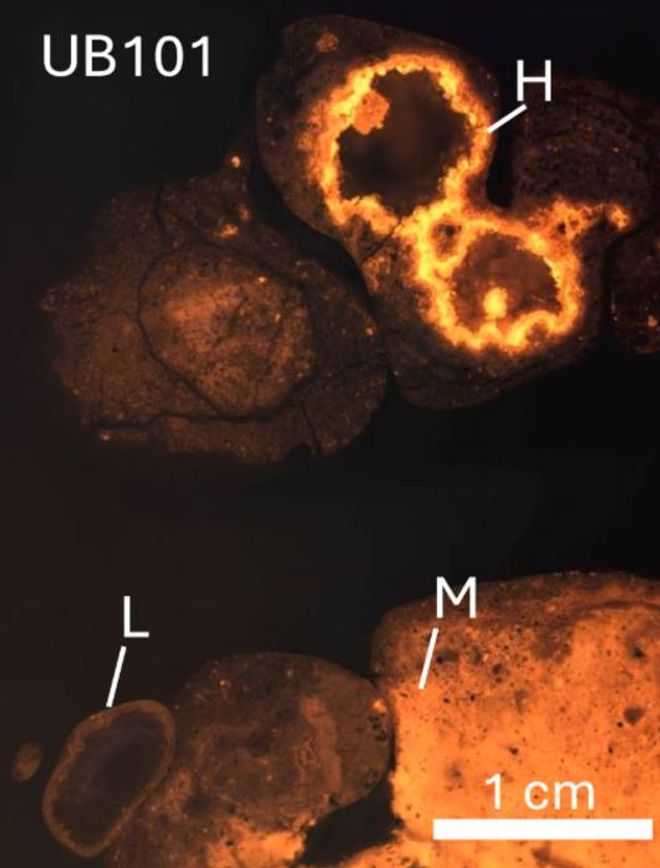
Mineral layers preserved within a fossilized shell.
(Image Credit: Perach Nuriel)
Ancestors of modern humans are believed to have migrated out of Africa around 2 million years ago, gradually spreading throughout Eurasia. Archaeologists have explored various sites that offer evidence of early human occupation.
The medieval Georgian town of Dmanisi, for example, is home to a site that dates to around 1.8 million years ago. This site contains about 100 ancient human fossils, over 8,000 animal remains, and over 11,000 stone and stone artifacts, according to the International Commission on Geoheritage.
‘Ubeidiya is another significant prehistoric site that was occupied by early humans who left behind large bifacial stone tools that fit within the Acheulean culture (often associated with Homo erectus individuals that crafted pear-shaped hand-axes). However, establishing ‘Ubeidiya's exact age has been a challenge for archaeologists, according to a statement on the new study.
Previous estimates dated the site to between 1.2 and 1.6 million years ago, but these were acquired through relative chronology; this method only puts specimens in chronological order without determining their actual age, according to the American Museum of Natural History.
Investigating Sediments and Snails
To determine a definitive age range for ‘Ubeidiya, the researchers involved with the new study used a trio of dating methods that were able to yield more accurate measurements than relative chronology. These methods relied on various aspects of the sediment at the site.
"Accurate burial dating of sediments in a sedimentary basin strongly depends on an understanding of the sediment's pre-burial history, recognition of sediment sources, and understanding of sediment recycling,” the researchers wrote in the study.
With one method known as cosmogenic isotope burial dating, the researchers measured rare isotopes hidden within ancient rocks. Since the isotopes have decayed at predictable rates over time, they essentially act as a geological clock that tells how long the rocks have been underground.
Another method allowed researchers to examine traces of Earth’s ancient magnetic field in sediments at the site. The sediments carry a record of the magnetic field’s direction at any given time, which the researchers matched with known reversals in magnetic polarity throughout the planet’s history. With this method, they found that the sediment layers at ‘Ubeidiya formed during the Matuyama Chron, a geological time interval that occurred more than 2 million years ago.
Along with the isotopes and magnetic clues, the researchers also turned to Melanopsis snail shells fossilized within the sediment. They used uranium-lead dating on the shells to establish the age of layers where stone tools were found.
A Range of Prehistoric Tools
These three methods helped researchers come to a conclusion on ‘Ubeidiya’s age — the site is now considered at least 1.9 million years old, roughly around the same age as the Dmanisi site.
Despite being similar in age according to the new study, Dmanisi and ‘Ubeidiya have one intriguing difference: ‘Ubeidiya contains the aforementioned Acheulean tools, but Dmanisi contains Oldowan tools, an older technology created by Homo habilis (an ancestor of H. erectus).
This suggests that different groups of hominins, each with their own type of stone tools, spread to separate regions outside of Africa at the same time.
Read More: Gigantic Hot Rock Blobs Have Impacted Earth's Magnetic Field For Over 200 Million Years
Article Sources
Our writers at Discovermagazine.com use peer-reviewed studies and high-quality sources for our articles, and our editors review for scientific accuracy and editorial standards. Review the sources used below for this article:
- This article references information from a recent study published in Quaternary Science Reviews: Complex exposure-burial history and Pleistocene sediment recycling in the dead sea rift with implications for the age of the Acheulean site of ‘Ubeidiya
- This article references information from the International Commission on Geoheritage: Dmanisi Collection
- This article references information from the American Museum of Natural History: The Dating Game
 English (US)