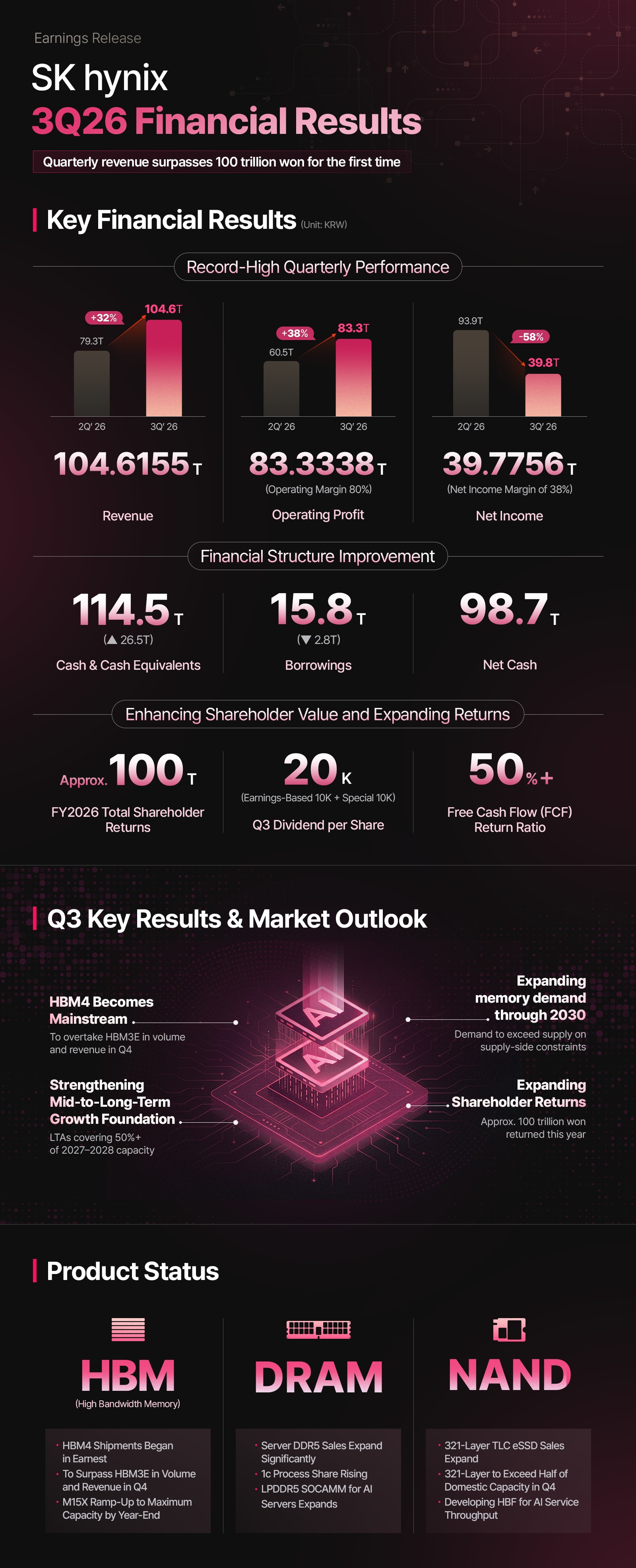
SK hynix had a stellar quarter – the financial report for Q3 reports revenues of KRW 104.6 trillion. This is the first time that the quarterly sales have gone above the KRW 100 trillion mark.
Better still, the company has margins that we can all be envious of – operating profit was KRW 83.3 trillion and net profit was KRW 39.8 trillion. This is an operating margin of 80% and a net margin of 38%.
The company reports cash and cash equivalents of KRW 114.5 trillion at the end of Q3, up KRW 26.5 trillion compared to the previous quarter. Meanwhile, borrowings decreased to KRW 15.8 trillion, down KRW 2.8 trillion. Net cash increased to KRW 98.7 trillion. At the bottom you’ll find an infographic with more details on the company’s financials.
It shouldn’t surprise you to hear that sales of pricey HBM4 memory for servers have expanded. Speaking of, SK hynix expects that next quarter HBM4 will overtake HBM3E in volume and revenue and become its mainstream product.

That said, sales of server DDR5 RAM also expanded significantly. Demand for LPDDR5 SOCAMM for AI servers is growing too. SK’s new fab, dubbed M15X, is expected to ramp up to full capacity by the end of the year. That should be 55,000-60,000 wafers per month of 1b DRAM chips. Meanwhile, the share of the next-gen 1c DRAM (which is used in the company’s LPDDR6) is rising.
Switching over to NAND flash, SK hynix reports that sales of 321-layer TLC chips for embedded SSDs are growing and it expects that production of these 321-layer chips will account for more than half of its domestic production capacity by the end of the year. The company is also developing HBF, High Bandwidth Flash, for AI servers. It’s similar to HBM but intended for longer-term storage than RAM, allowing AI models to stream in data that doesn’t otherwise fit in RAM.
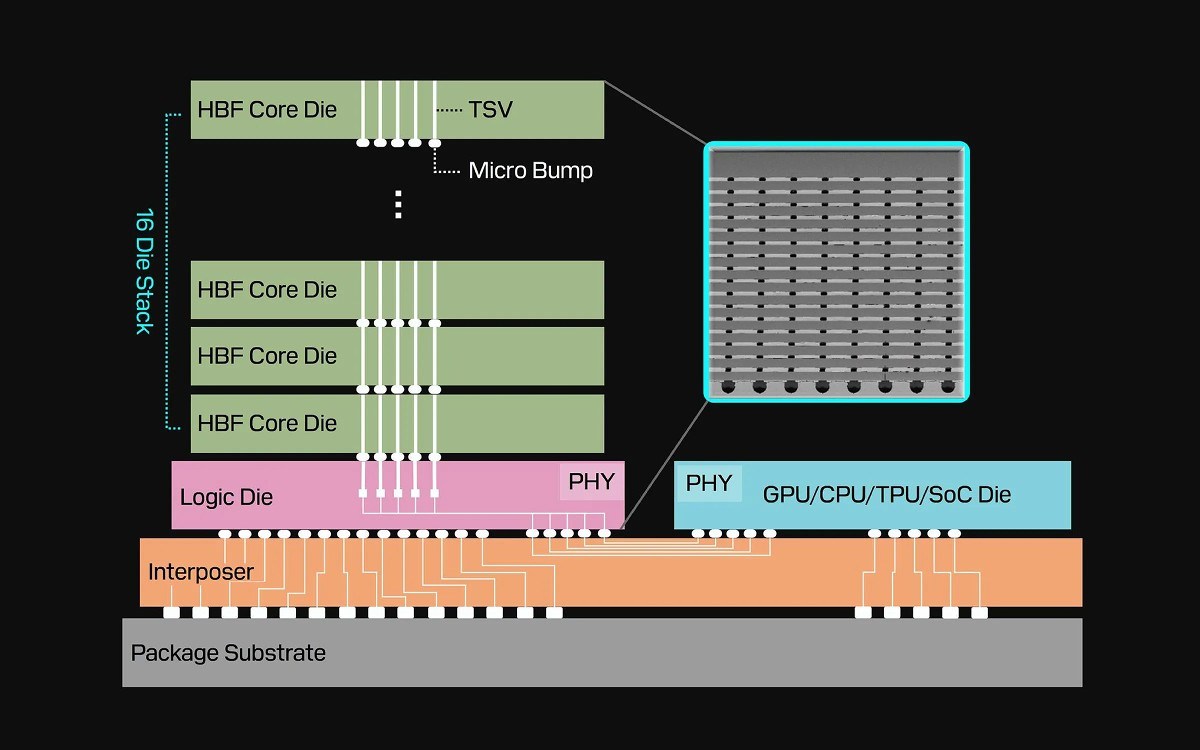 High Bandwidth Flash, HBF (image source)
The financial results press release contains a warning – the memory supply shortage will persist through 2030. The company plans to build more production capacity faster, but it will still take time to catch up. In the short term, enterprise and personal AI is expected to make up the bulk of the demand. In the mid-to-long term, AI for autonomous driving and robotics will also drive demand.
Based on a Counterpoint Research report from September, SK hynix was the second-largest DRAM maker globally by revenue with a 25% share compared to 38% for Samsung (#1) and 24% for Micron (#3). All three companies supply LPDDR and NAND memory to Apple – as do most other smartphone companies, including even Samsung.
SK hynix CEO Kwak Noh-Jung addressed the decision to cancel its plans for a Solidigm IPO: “The IPO was intended to raise external capital for the expansion of Solidigm’s production facilities, and thereby to lighten our own investment burden and broaden our capacity for shareholder returns. However, after carefully considering recent financial market conditions and other factors, we concluded that proceeding at this time would not be the best way to achieve the originally anticipated outcome. We have therefore discontinued our review.”