
.jpg) 2 hours ago
3
2 hours ago
3
There's a huge amount of clean energy locked away in ocean waves, if only we could find a way to harness more of it. A new study explains how a gyroscope sitting on the surface of the water could achieve notable increases in efficiency.
The study, by Takahito Iida of the Department of Naval Architecture and Ocean Engineering at the University of Osaka in Japan, is based on theoretical modeling of a gyroscopic wave energy converter (GWEC).
Such a GWEC would be a floating body with a spinning flywheel mounted inside, connected to a generator, able to produce electricity with the toss and turn of the waves – even as those waves changed in force and direction.
These GWEC devices have previously been tested as ways of unlocking wave energy, but have struggled to reach practical levels of efficiency because of the variability of wave patterns from day to day. This new research suggests that GWECs have the potential to perform much better if they're implemented in the right way.
"Wave energy devices often struggle because ocean conditions are constantly changing," says Iida. "However, a gyroscopic system can be controlled in a way that maintains high energy absorption, even as wave frequencies vary."
The key innovation outlined here is the use of linear wave theory to calculate the interactions between waves, the gyroscope, and the floating structure it sits inside. From there, Iida was able to calculate the optimum setup configuration for such a machine.
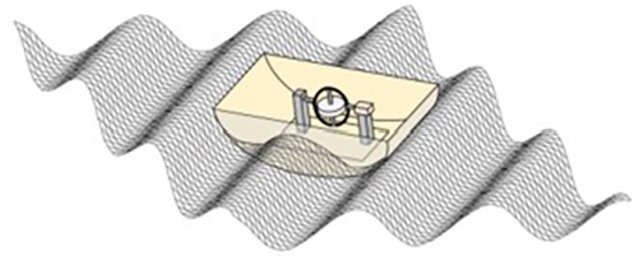 The basic setup for the modeling. (Iida, J. Fluid Mech., 2026)
By fine-tuning the rotational speed of the spinning flywheel and the resistance of the generator inside the gyroscope to match wave conditions, these devices should be able to hit a maximum of 50 percent efficiency – converting up to half of a wave's energy into electricity in theory.
"This efficiency limit is a fundamental constraint in wave energy theory," says Iida. "What is exciting is that we now know that it can be reached across broadband frequencies, not just at a single resonant condition."
In other words, a gyroscope's precession – the way outside forces nudge a spinning object – can be tuned to stay close to the 50 percent efficiency level even as wave conditions change.
Although this particular study didn't involve any real-world testing out on the water, computer simulations were also used to double-check the working and to examine a multitude of wave frequencies and wavelengths, and how a gyroscope might react.
These simulations matched up with the earlier math, but waves are incredibly complex and hard to simulate using equations, so there are some limitations to the calculations.
When Iida modeled the gyroscope's performance in lopsided and uneven waves, more like those in the ocean, he found that the device became less efficient in larger waves, though it could still extract a decent amount of power in certain conditions.

As well as using mostly idealized wave conditions, these calculations don't take into account the power cost of actually running the gyroscope on the ocean waves. This is very much a first step in trying to assess the viability of this type of wave power capture.
However, even with those limitations in mind, the study offers real encouragement that gyroscopes do have potential in this field. Iida also notes that other machine designs, ones that are asymmetrical, could potentially go beyond that 50 percent efficiency ceiling – though that remains to be seen.
Related: Earth's Energy Imbalance Has Doubled in 2 Decades, Study Warns
The next step is to do some testing of the physics that's been theorized here, and that's already being planned. In the not-too-distant future, floating gyroscopes could be making significant contributions to our planet's green energy balance.
"In future work, model tests will be conducted to validate the proposed theory," writes Iida in his published paper. "Moreover, we will explore optimal control strategies that take causality and nonlinear responses of the GWEC into account."
The research has been published in the Journal of Fluid Mechanics.
 English (US)