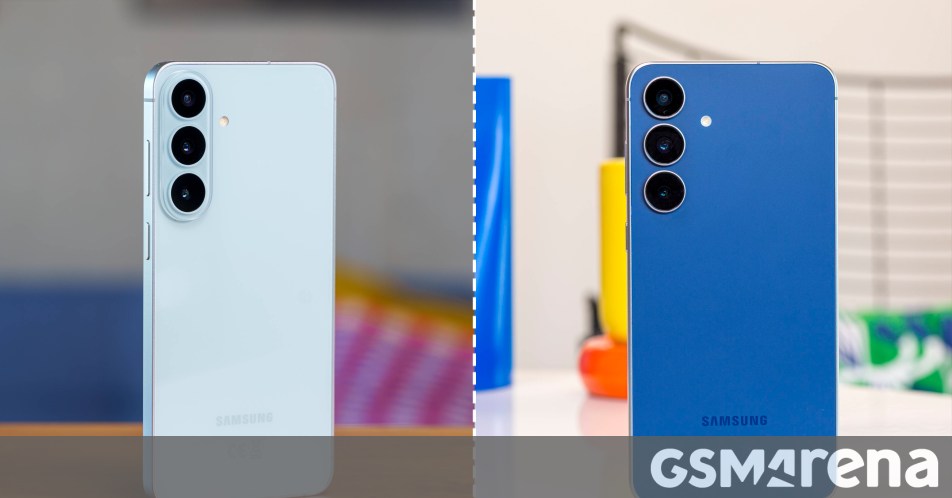
The Fan Edition of the latest Galaxy S series is out, but before you pull the trigger on the Samsung Galaxy S26 FE, why not consider the Samsung Galaxy S25 FE instead. It gets you a lot of the way there at a more reasonable starting price, which is exactly the FE series spirit. After all, the memory chip prices forced Samsung to launch the S26 FE at a higher price point and without changing almost anything in terms of hardware too.
The newer Galaxy S26 FE is pretty close to last year's Galaxy S25 FE, except for the chipset, of course. And one would wonder, what are you getting for the extra €50/$100? Let's find out!
Table of Contents:
For starters, you can compare the complete specs sheets or directly continue with our editor's assessment in the following text.
Size comparison
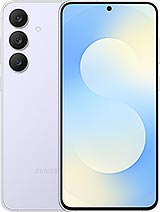
The newer Galaxy S26 FE is virtually identical to the Galaxy S25 FE when it comes to dimensions, weight and design. The newer Galaxy is negligibly wider and taller, and adds 3 grams to the overall weight. Not the kind of difference you will feel in the real world.
There's also no change in the build materials - both devices have Gorilla Glass Victus+ glass sheets on the front and back, while the side frame is "Enhanced Armor Aluminum," which is Samsung's own aluminum alloy used for its flagship phones.
What's new here is the colors. The new S26 FE comes in three colors - Blueberry, Graphite and Pistachio. The older Galaxy had four color options - Icyblue, Jetblack, Navy and White. We doubt that colors will be the deciding factor, but it's perhaps still important to note.
Display comparison
The two Galaxy Fan Editions share the same 6.7-inch OLED display with the same feature set. Our brightness tests confirm our suspicion that Samsung has ported the older screen directly to the new S26 FE.
Not that there's anything wrong with that, as the panel checks all the boxes for a flagship-level display.
Battery life
Here's where it gets interesting, though. Despite the lack of upgrades in the battery department, the newer Galaxy S26 FE turns out to be more efficient than its predecessor. Since the display and battery remain unchanged, the jump in endurance must be due to the newer Exynos 2500 SoC.
The Galaxy S26 FE's higher Active Use Score is solely thanks to the strong uptick in web browsing and video streaming.
Charging speed
The two handsets support up to 45W fast wired charging over Power Delivery with the correct PPS profile charger, but Samsung promises a marginal update in the charging curve, allowing slightly faster charging than before. Our tests corroborate those claims, to some extent.
The Galaxy S26 FE is 4 percentage points faster to the 15 minute checkpoint and 6 percentage points faster at the 30-minute mark, but only 2 minutes faster to the finish line at 100% charge. In other words - no meaningful change in the charging speed.
Speaker test
Unsurprisingly, Samsung didn't swap out the speakers for newer ones. The Galaxy S26 FE seemingly uses the same stereo loudspeaker setup as its predecessor with near-identical tuning, too. The only marginal difference is loudness, as the older model is a tad louder.
Performance
The Galaxy S26 FE runs on Samsung's last year's flagship Exynos 2500 chipset, while the Galaxy S25 FE gets the Exynos 2400 from the year 2024. The newer SoC is touted as more powerful and more energy efficient, which our endurance and performance tests confirm.
No change in the offered memory configurations, though, as both come with 8 GB RAM and 128 GB internal storage as standard. But you can also get them with 256 GB and 512 GB internal storage.
Benchmark performance
In the standard benchmark tests, the Exynos 2500 inside the S26 FE outperforms the Exynos 2400-powered S25 FE by about 16% in the CPU runs and by almost 25% in the GPU-focused 3DMark Wild Life test. The S26 FE also showed better sustained performance in our regular CPU and GPU stress tests.
Even though the performance difference is measurable, it may go unnoticed if you are not really into gaming.
Both phones ship with 7 years of major OS upgrades, but since the Galaxy S25 FE launched last year, its support will end a year earlier. Also, Samsung removed the wired DeX support on the newer model and no longer has DisplayPort output. This is quite the bummer for people used to wired DeX. Wireless DeX is here to stay, at least.
Camera comparison
The Galaxy S26 FE comes with the same camera system as last year's model - not just in terms of sensors and resolutions, but the exact same hardware (which was barely an upgrade over the S24 FE before it).
The main camera uses the in-house GN3 sensor that has a 50MP resolution and a 1/1.56" optical format. The telephoto is based on a relatively tiny 1/4.4" sensor with just 8MP resolution, though it will get you 12MP images. The ultrawide uses a fixed-focus lens, as does the selfie camera, and both feature 12MP sensors.
The camera samples (both photo and video) have been taken on separate occasions with the two phones.
Image quality
Daylight
Both phones capture pretty great photos with their main cameras at 1x - not quite top-tier results, but not half bad either. The new model just might be a little bit more restrained with the sharpening and can possibly render the detail a little finer, but it's not a huge difference. Both have lively color output and no problems with dynamic range.








Daylight comparison, main camera (1x): Galaxy S26 FE • Galaxy S25 FE
The 2x zoom results from both phones are solid. The S26 FE does seem to be somewhat more noticeably ahead here, though the old model is still not bad for the class.








Daylight comparison, main camera (2x): Galaxy S26 FE • Galaxy S25 FE
The telephotos are about on par as well - it's perhaps the one comparison so far that makes it the hardest to spot a difference. Maybe the S26 FE does a little better with noise reduction, though the S25 FE is only a little bit grainier. In any case, the photos are better than you'd expect from an 8MP to 12MP upscale job.








Daylight samples, telephoto camera (3x): Galaxy S26 FE • Galaxy S25 FE
We could also try and convince ourselves the S26 FE's ultrawide is a bit of an improvement over the S25 FE's, but whatever advantages we can find are neither substantial enough, nor really all that consistent. It's essentially a toss-up.








Daylight comparison, ultrawide camera (0.6x): Galaxy S26 FE • Galaxy S25 FE
Low light
A lot may have changed in the lighting of some of our low-light scenes, but little has changed in the way the Galaxy FE behaves in the dark - the S26 FE and the S25 FE capture similar levels of detail, tend to leave quite a bit of grain the images, and are not particularly keen on using Night mode if left to their own devices. The S25 FE does tend to be a bit more contrasty in its output, next to a pretty washed out S26 FE, so in a way the old model can be seen as a little better.








Low-light comparison, main camera (1x): Galaxy S26 FE • Galaxy S25 FE
Night mode cleans up the noise and dials up the sharpening on both phones, and the difference is more pronounced on the S26 FE. We wouldn't say it makes the new model take the lead though. It's probably a semi-curious observation that we weren't able to get the phone to apply night mode processing on the fourth scene - that's consistency for you right there.






Low-light comparison, main camera (1x), Night mode: Galaxy S26 FE • Galaxy S25 FE
Both phones turn very noisy and can be quite soft in areas with low-contrast detail. The S26 FE may be a little sharper in general, but it's hard to call it a winner with results like these.








Low-light comparison, main camera (2x): Galaxy S26 FE • Galaxy S25 FE
The S25 FE's Night mode results at 2x are actually more to our liking than the S26 FE's - the sharpening is more subtle on the older model.





Low-light comparison, main camera (2x), Night mode: Galaxy S26 FE • Galaxy S25 FE
The telephoto shots in full auto are pretty hard to look at from either phone, though the combination of softness and noise is a little less bad on the S25 FE. Again, not really high praise this.








Low-light samples, telephoto camera (3x): Galaxy S26 FE • Galaxy S25 FE
Night mode almost does wonders on both telephotos and it's clearly the way to go after dark. That said, the S25 FE is again a little better here, we reckon - the S26 FE conjures up these weird mesh patterns that can be irksome.






Low-light samples, telephoto camera (3x), Night mode: Galaxy S26 FE • Galaxy S25 FE
There's a glimmer of hope for the S26 FE in the ultrawide shots which do tend to be sharper than the S25 FE in full auto mode - consistently so. Not that they're particularly great in isolation, though.








Low-light comparison, ultrawide camera (0.6x): Galaxy S26 FE • Galaxy S25 FE
Things do get closer to a tie if you choose to shoot in Night mode, which you probably should on both phones, and in that case the S26 FE's advantage fades.






Low-light comparison, ultrawide camera (0.6x), Night mode: Galaxy S26 FE • Galaxy S25 FE
Selfies
When it comes to selfies, both phones are more or less on the same level, and you'd be getting pretty great images no matter which one you chose.




Selfies comparison: Galaxy S26 FE • Galaxy S25 FE
Video quality
Below we have a few framegrabs from the videos taken by the two phones at each focal length so it's easier to compare to one another.
The video recording capabilities of the two phones are more or less identical as well, with the main cameras maxing out at 4K60 (or 8K30, if you're into that), the ultrawide and the telephoto capped at 4K30, and the selfie camera also reaching 4K60.
Video quality is roughly similar between the two phones in bright daylight, though the S26 FE does have a bit of an advantage in sharpness at pretty much all zoom levels - it's most noticeable at 2x (where the S26 FE is surprisingly good) and 3x, but it's also got better definition at 1x and on the ultrawide as well. Is it significant enough to actually be a selling point? We're not entirely sure.




Daylight video screengrabs, Galaxy S26 FE: 0.6x • 1x • 2x • 3x




Daylight video screengrabs, Galaxy S25 FE: 0.6x • 1x • 2x • 3x
At night, the S25 FE's more contrasty take is more to our liking, and it also manages to look sharper at 1x. Neither ultrawide and neither telephoto are particularly great at night, but they all produce broadly usable results, though we just might still prefer the old model's more contrasty take on reality.




Low-light video screengrabs, Galaxy S26 FE: 0.6x • 1x • 2x • 3x




Low-light video screengrabs, Galaxy S25 FE: 0.6x • 1x • 2x • 3x
Verdict
As you can see, the updates on the Galaxy S26 FE are far and few between, but the chipset does make a difference. Not only is it faster, it also delivers an upgrade is the battery endurance, as the S26 FE has a particularly strong showing in our web browsing and video playback tests.
But the rest remains largely unchanged. And the exclusion of wired DeX and DisplayPort video out support don't help build a stronger case for the S26 FE.
So is the newer model worth it? Well, the answer in Europe is most probably "yes" because the price gap isn't big to begin with. For about €50 more, you get the newer model, unless the missing wired DeX support is a deal-breaker to you. On the other hand, the $100 gap in the US arguably makes the S25 FE the better deal.
- The longer web browsing and video streaming runtimes.
- The year longer OS support.
- The slightly more powerful chipset.
Get the Samsung Galaxy S26 FE for:
- The roughly the same user experience at a lower price.
- The wired DeX support and DisplayPort video out.