
.jpg) 1 hour ago
3
1 hour ago
3
Article content
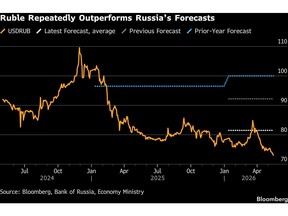
(Bloomberg) — Russia’s ruble has muscled its way to become the world’s best performer against the dollar so far this quarter, buoyed by a surge in foreign currency receipts from oil sales following the outbreak of war in the Middle East.

THIS CONTENT IS RESERVED FOR SUBSCRIBERS ONLY
Subscribe now to read the latest news in your city and across Canada.
- Exclusive articles from Barbara Shecter, Joe O'Connor, Gabriel Friedman, and others.
- Daily content from Financial Times, the world's leading global business publication.
- Unlimited online access to read articles from Financial Post, National Post and 15 news sites across Canada with one account.
- National Post ePaper, an electronic replica of the print edition to view on any device, share and comment on.
- Daily puzzles, including the New York Times Crossword.
SUBSCRIBE TO UNLOCK MORE ARTICLES
Subscribe now to read the latest news in your city and across Canada.
- Exclusive articles from Barbara Shecter, Joe O'Connor, Gabriel Friedman and others.
- Daily content from Financial Times, the world's leading global business publication.
- Unlimited online access to read articles from Financial Post, National Post and 15 news sites across Canada with one account.
- National Post ePaper, an electronic replica of the print edition to view on any device, share and comment on.
- Daily puzzles, including the New York Times Crossword.
REGISTER / SIGN IN TO UNLOCK MORE ARTICLES
Create an account or sign in to continue with your reading experience.
- Access articles from across Canada with one account.
- Share your thoughts and join the conversation in the comments.
- Enjoy additional articles per month.
- Get email updates from your favourite authors.
THIS ARTICLE IS FREE TO READ REGISTER TO UNLOCK.
Create an account or sign in to continue with your reading experience.
- Access articles from across Canada with one account
- Share your thoughts and join the conversation in the comments
- Enjoy additional articles per month
- Get email updates from your favourite authors
Sign In or Create an Account
or
Article content
The ruble has advanced roughly 12% since the start of April to 72.6 per dollar, the strongest level since February 2023, according to data compiled by Bloomberg. For a second straight year, the currency is diverging from official and market forecasts that projected a depreciation, leading some analysts to view it as overvalued relative to the current economic conditions.
Article content
Article content
Article content
The ruble’s strength is increasingly looking like an embedded feature of Russia’s current economy, a product of both sanctions-driven imbalances in its financial market and tight monetary policy to offset massive government spending on President Vladimir Putin’s war in Ukraine. While the appreciating currency helps ease inflationary pressure, it’s also squeezing exporters’ earnings and budget revenue.
Article content
By signing up you consent to receive the above newsletter from Postmedia Network Inc.
Article content
“If the Russian economy eventually moves away from a wartime footing, the ruble will also return to more normal levels,” said Iskander Lutsko, a Dubai-based senior portfolio manager at Istar Capital. “Right now, conditions are ideal for further strengthening.”
Article content
Economy Minister Maxim Reshetnikov said last month that the ruble may remain stronger “than many would like” in the coming years under the current economic model, which has limited capital outflows.
Article content
Demand for foreign currency remains subdued amid high local interest rates and weak imports, nearly 60% of which are now paid for in rubles as Russia has continued to adapt to sanctions imposed after the February 2022 full-scale invasion of Ukraine.
Article content
Article content
At the same time, inflows of foreign tender — which had begun to fade after Washington tightened sanctions on Russian oil last year — have surged following a rally in energy prices and an easing of US restrictions in response to disrupted shipping through the Strait of Hormuz.
Article content
Net foreign-currency sales by Russia’s largest exporters tripled in April to $7.3 billion after the average price of Urals crude rose to $77 a barrel in March from $44.6 a month earlier, according to central bank data. Urals averaged $94.9 a barrel in April, contributing to additional hard-currency income this month, the Bank of Russia said.
Article content
Under Russia’s fiscal rule, oil revenue generated above a $59-a-barrel threshold is used to buy foreign currency for the National Wellbeing Fund, which is tapped to support the budget when crude prices fall. The mechanism typically helps smooth ruble volatility caused by swings in commodity markets, but current purchases are insufficient to offset the surge in foreign currency.
Article content
In May, Russia resumed purchases of foreign currency and gold for the fund for the first time since June last year, allocating 110 billion rubles ($1.5 billion), though the amount is dwarfed by exporters’ foreign-currency sales.
 English (US)