
.jpg) 1 hour ago
3
1 hour ago
3
Article content
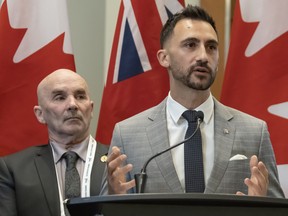
Eight provinces and two territories have signed a memorandum of understanding (MOU) to build cross-country electricity transmission infrastructure, Ontario Minister of Energy and Mines, Stephen Lecce, announced Wednesday.

THIS CONTENT IS RESERVED FOR SUBSCRIBERS ONLY
Subscribe now to read the latest news in your city and across Canada.
- Exclusive articles from Barbara Shecter, Joe O'Connor, Gabriel Friedman, and others.
- Daily content from Financial Times, the world's leading global business publication.
- Unlimited online access to read articles from Financial Post, National Post and 15 news sites across Canada with one account.
- National Post ePaper, an electronic replica of the print edition to view on any device, share and comment on.
- Daily puzzles, including the New York Times Crossword.
SUBSCRIBE TO UNLOCK MORE ARTICLES
Subscribe now to read the latest news in your city and across Canada.
- Exclusive articles from Barbara Shecter, Joe O'Connor, Gabriel Friedman and others.
- Daily content from Financial Times, the world's leading global business publication.
- Unlimited online access to read articles from Financial Post, National Post and 15 news sites across Canada with one account.
- National Post ePaper, an electronic replica of the print edition to view on any device, share and comment on.
- Daily puzzles, including the New York Times Crossword.
REGISTER / SIGN IN TO UNLOCK MORE ARTICLES
Create an account or sign in to continue with your reading experience.
- Access articles from across Canada with one account.
- Share your thoughts and join the conversation in the comments.
- Enjoy additional articles per month.
- Get email updates from your favourite authors.
THIS ARTICLE IS FREE TO READ REGISTER TO UNLOCK.
Create an account or sign in to continue with your reading experience.
- Access articles from across Canada with one account
- Share your thoughts and join the conversation in the comments
- Enjoy additional articles per month
- Get email updates from your favourite authors
Sign In or Create an Account
or
Article content
Speaking at a press conference in Toronto, Lecce said Canada currently has “13 islands” of grids, making the country less energy independent.
Article content
Article content
Article content
“We know this country’s grid was built for a different era, fragmented and disconnected, built really with a north-south orientation, overwhelmingly, where the power is much easier to flow north-south into the U.S. instead of flowing to each other as Canadians,” Lecce said.
Article content
By signing up you consent to receive the above newsletter from Postmedia Network Inc.
Article content
The MOU aims to build national infrastructure and intertie projects that connect the provinces’ and territories’ energy grids, he said, and to develop “intentional policy” to expand electricity trade within Canada before selling power to the U.S. or abroad.
Article content
Ontario, British Columbia, Alberta, Saskatchewan, Manitoba, New Brunswick, Yukon, Prince Edward Island, Nova Scotia and the Northwest Territories have signed on to the agreement.
Article content
Joking that the weather in Ontario feels “balmy” compared to back home, Yukon Minister of Energy, Mines and Resources, Ted Laking, said his province used more than 90 per cent of its available electricity capacity in December when temperatures dipped as low as minus 50 degrees Celsius for more than a week.
Article content
“When it gets that cold, industrial customers like mines must disconnect from the grid to ensure that we have enough electricity to meet the needs of Yukon’s residents,” Laking said. “I share this to underline the importance of today’s agreement. In Canada’s north, energy security is not a theoretical risk. It is a real and serious vulnerability.”
Article content
Article content
New Brunswick Deputy Premier and Minister of Energy René Legacy said his province is the “backstop” for energy in Atlantic Canada and already has transmission interties with Nova Scotia and Prince Edward Island. However, scale is a problem for the region.
Article content
Article content
“A kilometre of transmission line costs the same, whether you have 400,000 rate payers or you have four million, so we need to work in partnership,” Legacy said.
Article content
Lecce said the agreement will also advocate for financial support from the federal government to build transmission corridors and for Ottawa to create a national strategy for a “pan-Canadian grid” that connects east-west and north-south.
Article content
When asked by a reporter why Quebec did not sign the agreement, Lecce said the province’s government has “expressed support” for the policy but wants to emphasize that resources fall under provincial jurisdiction.
Article content
“We’ll respect that they’ll sign when they’re ready, but we do believe we’re in a much better place where Quebec supports the concept of the federal government and the provinces work together to reduce costs and maximize benefits for their ratepayers,” Lecce said.
Article content
With the agreement in place, he said the provinces can get to work on building a strategy that includes costs and timelines.
Article content
“We’ve got a problem, we’ve agreed to the problem definition, we agreed to a mechanism to fix it,” said Lecce. “The next step now is for the system planners to go off, build the strategy, figure out the intertie connections.”
Article content
 English (US)