
.jpg) 1 hour ago
2
1 hour ago
2
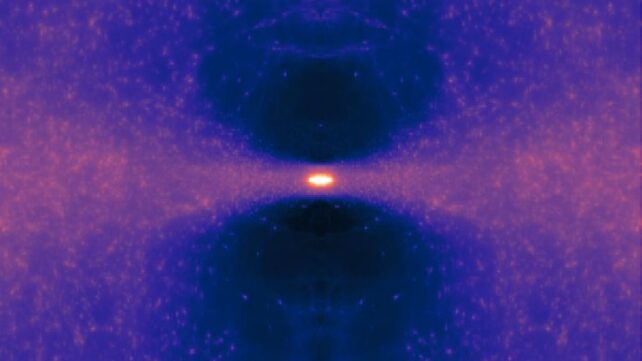 A simulation of the cosmic sheet as seen from the side, with voids above and below. (Wempe et al., Nat. Astron., 2026)
The Milky Way isn't just drifting through a giant void in space untethered, but is embedded in a sheet of dark matter like a blueberry in a pancake, new research suggests.
An analysis of how galaxies move through nearby space maps the gravitational pull of mass we cannot see – cold dark matter – suggesting that our local corner of the Universe may have more structure than we previously assumed.
The work from a team led by astronomer Ewoud Wempe of the University of Groningen in the Netherlands may help explain three odd features of the local Universe that astronomers have puzzled over: the Local Sheet, the Local Void, and the quiet Hubble flow.
"Modeling efforts have long struggled to reproduce the quiet Hubble flow around the Local Group," writes the team in their published paper.
"The observations are reconcilable within ΛCDM [the Lambda cold dark matter model of the evolution of the Universe], but only if mass is strongly concentrated in a plane out to 10 megaparsecs, with the surface density rising away from the Local Group and with deep voids above and below."
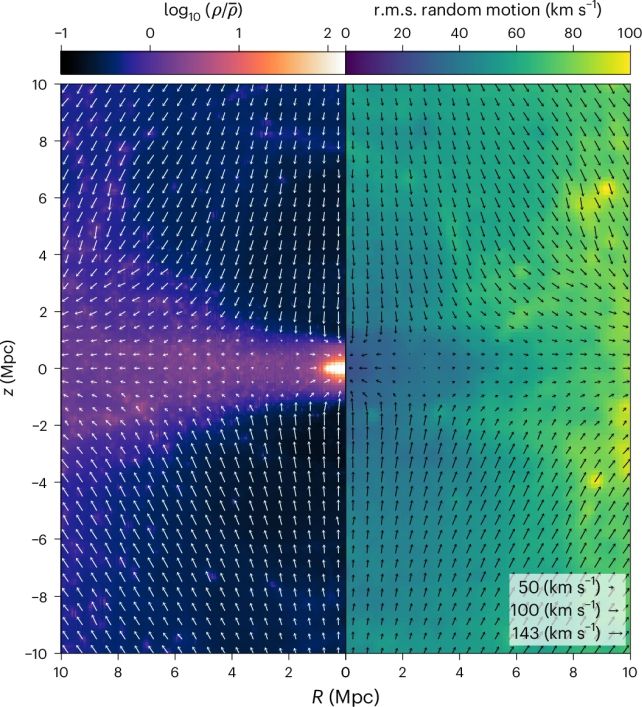 A diagram of the peculiar velocities in local space. (Wempe et al., Nat. Astron., 2026)
The Local Sheet is the structure in which the Local Group of galaxies is embedded, a curiously flat, plane-like arrangement of the Milky Way, Andromeda (our nearest major galaxy), and their neighboring galaxies.
Next to the Local Sheet is the Local Void, a strangely underpopulated pocket of space, from which galaxies appear to recede. The Local Group's velocity away from the Local Void has been described as "peculiar".
Finally, the quiet Hubble flow is the mysteriously smooth, regular expansion of the Universe within the local volume, which is difficult to reconcile with the masses of the Milky Way and Andromeda, which should be large enough to throw a gravitational kink into the flow.
To interrogate these mysteries, Wempe and his colleagues turned to the motions of 31 relatively isolated galaxies in local space, collected over several decades in large-scale surveys. The researchers chose these galaxies because their isolation makes them more reliable tracers of local expansion.
With this data in hand, the researchers ran simulations starting in the early Universe, using a mass distribution based on the cosmic microwave background – an echoing signal of the Big Bang. They hoped to reproduce the motions of these galaxies, as well as those of the Milky Way and Andromeda.
The team found that the simulation reproduced the observations only if certain conditions were met: namely, that the mass around us is arranged in a sheet-like architecture, with voids above and below.

If this is the case, it provides a very tidy explanation for the Local Sheet, the Local Void, and the quiet Hubble flow.
Astronomers have already established that the distribution and density of dark matter in the Universe are reflected in the distribution of galaxies. An underlying sheet of dark matter, therefore, would be reflected in the arrangement of galaxies – the Local Sheet.
It naturally follows that the gravitational attraction of the sheet would pull matter out of adjacent space, so voids on either side would be a natural consequence.
Finally, the geometry of the sheet would reduce the gravitational pull inward towards the Local Group, allowing the outer galaxies to expand more smoothly – thus the quiet Hubble flow.
Related: Behold, The First Direct Images of The Cosmic Web in The Dark Reaches of The Universe
What makes this even tidier is that we don't need new, exotic astrophysics to explain it. We know sheets exist in the cosmic web, and the possible processes that created them are the subject of multiple papers.
The existence of the sheet is not the most exciting part – it's that the dynamics of the galaxies in our local pocket of the Universe require it, based on these new simulations, and that it fits with existing physics, models, and theories.
"We are exploring all possible local configurations of the early universe that ultimately could lead to the Local Group," Wempe says. "It is great that we now have a model that is consistent with the current cosmological model on the one hand, and with the dynamics of our local environment on the other."
The research has been published in Nature Astronomy.
 English (US)