
.jpg) 1 hour ago
3
1 hour ago
3
Article content
An Ontario startup aims to speed up new drug discoveries for diseases such as Alzheimer’s through quantum sensors that map protein building blocks.

THIS CONTENT IS RESERVED FOR SUBSCRIBERS ONLY
Subscribe now to read the latest news in your city and across Canada.
- Exclusive articles from Barbara Shecter, Joe O'Connor, Gabriel Friedman, and others.
- Daily content from Financial Times, the world's leading global business publication.
- Unlimited online access to read articles from Financial Post, National Post and 15 news sites across Canada with one account.
- National Post ePaper, an electronic replica of the print edition to view on any device, share and comment on.
- Daily puzzles, including the New York Times Crossword.
SUBSCRIBE TO UNLOCK MORE ARTICLES
Subscribe now to read the latest news in your city and across Canada.
- Exclusive articles from Barbara Shecter, Joe O'Connor, Gabriel Friedman and others.
- Daily content from Financial Times, the world's leading global business publication.
- Unlimited online access to read articles from Financial Post, National Post and 15 news sites across Canada with one account.
- National Post ePaper, an electronic replica of the print edition to view on any device, share and comment on.
- Daily puzzles, including the New York Times Crossword.
REGISTER / SIGN IN TO UNLOCK MORE ARTICLES
Create an account or sign in to continue with your reading experience.
- Access articles from across Canada with one account.
- Share your thoughts and join the conversation in the comments.
- Enjoy additional articles per month.
- Get email updates from your favourite authors.
THIS ARTICLE IS FREE TO READ REGISTER TO UNLOCK.
Create an account or sign in to continue with your reading experience.
- Access articles from across Canada with one account
- Share your thoughts and join the conversation in the comments
- Enjoy additional articles per month
- Get email updates from your favourite authors
Sign In or Create an Account
or
Article content
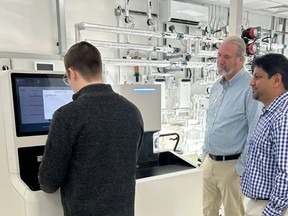
Founded by biomedical researchers and drug developers at the University of Waterloo in 2013, High Q Technologies is developing a quantum sensor called the electron paramagnetic resonance (EPR) spectrometer to map moving protein structures with extreme precision.
Article content
Article content
Article content
Their EPR device, named Fathom, aims to accelerate drug discovery for neurodegenerative diseases such as Alzheimer’s by years. According to the company, the device could slash the resources typically required in the stages of drug testing.
Article content
By signing up you consent to receive the above newsletter from Postmedia Network Inc.
Article content
“Proteins, like most biological structures, are flexible,” said Don Carkner, managing director at High Q. “When proteins interact with other molecules, they flex, twist and reconfigure as part of their function. In general, drugs work by affecting such motion.”
Article content
He added, “ Traditional … techniques tend to be sensitive to a protein’s most common configuration, and so sometimes struggle to resolve the full range of motion. EPR is able to detect all configurations at once.”
Article content
“Drug discovery is increasingly focused on understanding how proteins behave in motion,” said Carkner. “With Fathom, quantum-enabled EPR spectroscopy provides a way to study these dynamic systems.”
Article content
EPR can also be used as a screening tool to ensure that samples are ideally prepared before being measured by traditional equipment, which could lower development costs while positively impacting the pipeline, according to High Q.
Article content
Article content
The company recently partnered with Shirely N.Y.-based Creative Biostructure, a contract research organization, expanding access to High Q’s quantum technology for pharmaceutical research on a global scale.
Article content
Article content
“Creative Biostructure has a large existing client base, with over 3,000 customers in 60 countries and regions, including numerous large pharma and high-profile academic institutions,” the company said in a press release about the collaboration.
Article content
Creative Biostructure will provide scientific consultation, experimental design support and workflow guidance for organizations implementing High Q’s Fathom EPR spectroscopy platform, according to the press release.
Article content
The company’s stated mission to advance domestic biotechnology capabilities is backed by the government of Canada, Waterloo venture capital firm Quantum Valley Investments and the University of Waterloo’s Transformative Quantum Technologies accelerator.
Article content
In 2018, $6.5 million was awarded to the company through the federal Strategic Innovation Fund to support the development of quantum-enabled sensor technology.
 English (US)