
.jpg) 1 hour ago
2
1 hour ago
2
Article content
(Bloomberg) — Oil resumed gains — paring a steep drop from Monday — on concern that other nations may be drawn into the Middle East war.

THIS CONTENT IS RESERVED FOR SUBSCRIBERS ONLY
Subscribe now to read the latest news in your city and across Canada.
- Exclusive articles from Barbara Shecter, Joe O'Connor, Gabriel Friedman, and others.
- Daily content from Financial Times, the world's leading global business publication.
- Unlimited online access to read articles from Financial Post, National Post and 15 news sites across Canada with one account.
- National Post ePaper, an electronic replica of the print edition to view on any device, share and comment on.
- Daily puzzles, including the New York Times Crossword.
SUBSCRIBE TO UNLOCK MORE ARTICLES
Subscribe now to read the latest news in your city and across Canada.
- Exclusive articles from Barbara Shecter, Joe O'Connor, Gabriel Friedman and others.
- Daily content from Financial Times, the world's leading global business publication.
- Unlimited online access to read articles from Financial Post, National Post and 15 news sites across Canada with one account.
- National Post ePaper, an electronic replica of the print edition to view on any device, share and comment on.
- Daily puzzles, including the New York Times Crossword.
REGISTER / SIGN IN TO UNLOCK MORE ARTICLES
Create an account or sign in to continue with your reading experience.
- Access articles from across Canada with one account.
- Share your thoughts and join the conversation in the comments.
- Enjoy additional articles per month.
- Get email updates from your favourite authors.
THIS ARTICLE IS FREE TO READ REGISTER TO UNLOCK.
Create an account or sign in to continue with your reading experience.
- Access articles from across Canada with one account
- Share your thoughts and join the conversation in the comments
- Enjoy additional articles per month
- Get email updates from your favourite authors
Sign In or Create an Account
or
Article content
Brent climbed toward $104 a barrel, after plunging by 11% on Monday as President Donald Trump delayed a threat to strike Iran’s energy infrastructure for five days, claiming there were talks with Tehran. Iran denied negotiations were taking place, while Israel kept up attacks. US crude benchmark West Texas Intermediate advanced about 4%.
Article content
Article content
Article content
US allies in the Persian Gulf were inching toward contributing to the fight, the Wall Street Journal reported. Among them, Saudi Crown Prince Mohammed bin Salman is now eager to re-establish deterrence and is close to a decision to join the attacks, the newspaper said, citing people familiar with the situation.
Article content
By signing up you consent to receive the above newsletter from Postmedia Network Inc.
Article content
“If Gulf states were to join the conflict, it would represent a significant escalation,” said Linh Tran, a market analyst at XS.com. “The market remains highly sensitive to incoming headlines.”
Article content
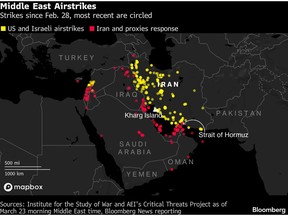
Brent has risen more than 40% this month on concern the hostilities between the US, Israel and Iran that have rocked the Middle East will trigger a global energy crunch, boosting inflation. The war has stymied transit through the Strait of Hormuz, forcing Persian Gulf producers to cut millions of barrels of daily oil output. Petroleum products such as diesel and jet fuel have rallied even harder than crude, squeezing consumers and rattling governments.
Article content
The fall-out continued to spread. In South America, Chile is set to raise fuel prices as much as half, while in Asia, Japan ordered a review of its entire supply chain for oil-related products. Elsewhere, Thailand hiked diesel, China’s biggest oil refiner said it would prioritize local supplies, and the Philippines warned grounding planes due to a jet-fuel shortage was a “distinct possibility.”
Article content
Article content
“If this shock lasts longer, this extreme tightness that’s now concentrated in Middle East and Asia would spread,” Goldman Sachs Group Inc. Co-Head of Global Commodities Research Daan Struyven told Bloomberg TV. Eventually, demand destruction would be required to rebalance supply, he said.
Article content
Iranian Deputy Speaker of Parliament Ali Nikzad said the Strait of Hormuz would not be returned to its previous state, and there would be no negotiations with Washington, the semi-official Fars news agency reported.
Article content
Tehran is reviewing correspondence it received from the US via mediators, CBS reported, citing a senior foreign ministry official. Meanwhile, gas facilities were hit in Isfahan, central Iran, the Fars news agency reported.
Article content
“It is unclear how far back-channel talks have progressed or if the IRGC is in any mood to settle at this stage when they remain in firm control of the Strait of Hormuz,” RBC Capital Markets LLC analysts including Helima Croft said in a note, referring to the Islamic Revolutionary Guard Corps. “Ships, not sound bites, will likely be what ultimately matters for physical markets.”
 English (US)