
.jpg) 1 hour ago
1
1 hour ago
1
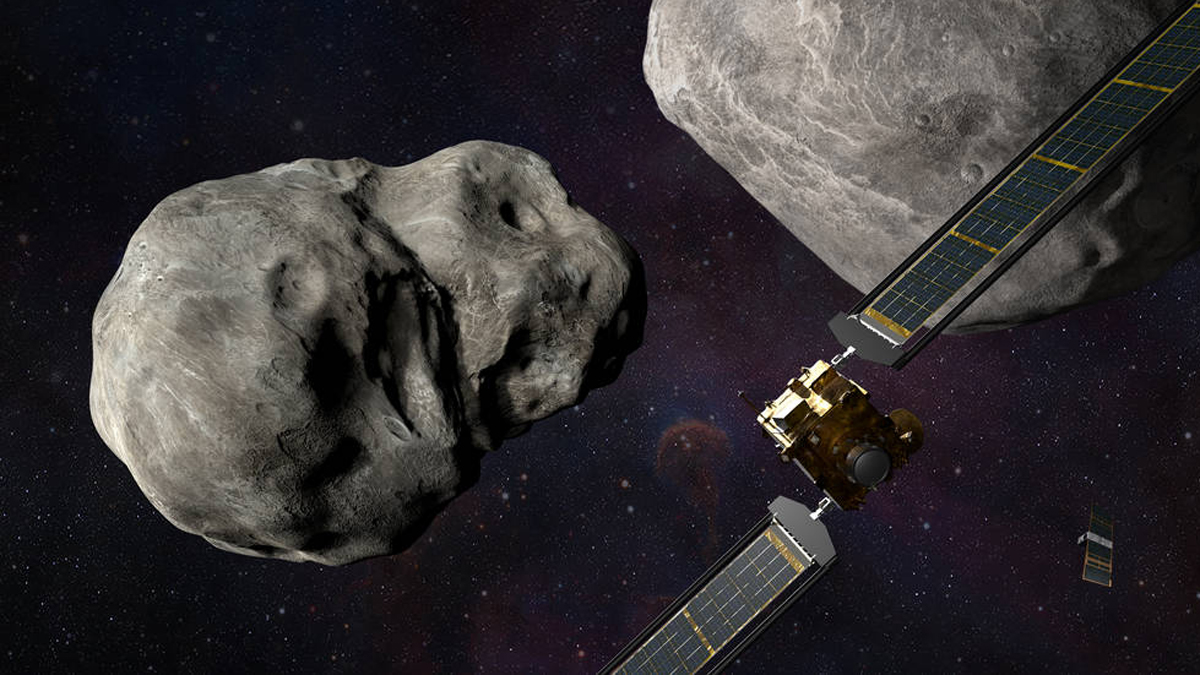
In 2022, NASA's Double Asteroid Redirection Test (DART) mission deliberately slammed into the asteroid Dimorphos, which orbits a larger asteroid named Didymos. Now, scientists have confirmed that not only did DART alter Dimorphos' orbit around its binary companion, but it also altered the whole binary system's orbit around the sun.
"The change in the binary system's orbital speed was about 11.7 microns per second, or 1.7 inches per hour," said Rahil Makadia of the University of Illinois Urbana-Champaign in a statement. "Over time, such a small change in an asteroid's motion can make the difference between a hazardous object hitting or missing our planet."
The objective of DART was to see whether a kinetic impactor — in this case, the DART spacecraft — could deflect an asteroid and prove that if a similarly sized asteroid were on a collision course with Earth, we could knock it out of the way.
Article continues below
The Didymos–Dimorphos double asteroid system was a safe place to practice this. Didymos is the larger asteroid, about 2,788 feet (850 meters) across, and the smaller 560-foot (170-meter) asteroid Dimorphos orbits around Didymos. Because astronomers had previously measured Dimorphos' orbital period and radius precisely, any deflection caused by the impact would be clear to measure as well. Plus, because Dimorphos is gravitationally bound to Didymos, the DART impact could not inadvertently knock it towards Earth.
The DART impact took place on September 26, 2022, with the spacecraft impacting at 4 miles (6.6 kilometers) per second. It knocked Dimorphos enough that its orbital period around Didymos shortened from 11 hours and 55 minutes to 11 hours and 23 minutes. Prior to impact, the aim had been to shove Dimorphos such that its orbital period reduced by a minimum of just 73 seconds, meaning the mission was a tremendous success.
New analysis of the data, led by Makadia and Steve Chesley of NASA's Jet Propulsion Laboratory (JPL), has shown that DART's effort to push Dimorphos received a helping hand from the cloud of debris, called ejecta, that it sprayed into space as it excavated a fresh new crater.
As this ejecta cloud raced away from Dimorphos, it also carried away momentum. And, as momentum is always conserved, this gave Dimorphos an added push. Scientists call this extra push the "momentum enhancement factor," and in the case of Dimorphos and the DART impact, the momentum enhancement factor had a value of two. This means that the loss of the ejecta doubled the thrust imparted on Dimorphos by the initial DART impact.
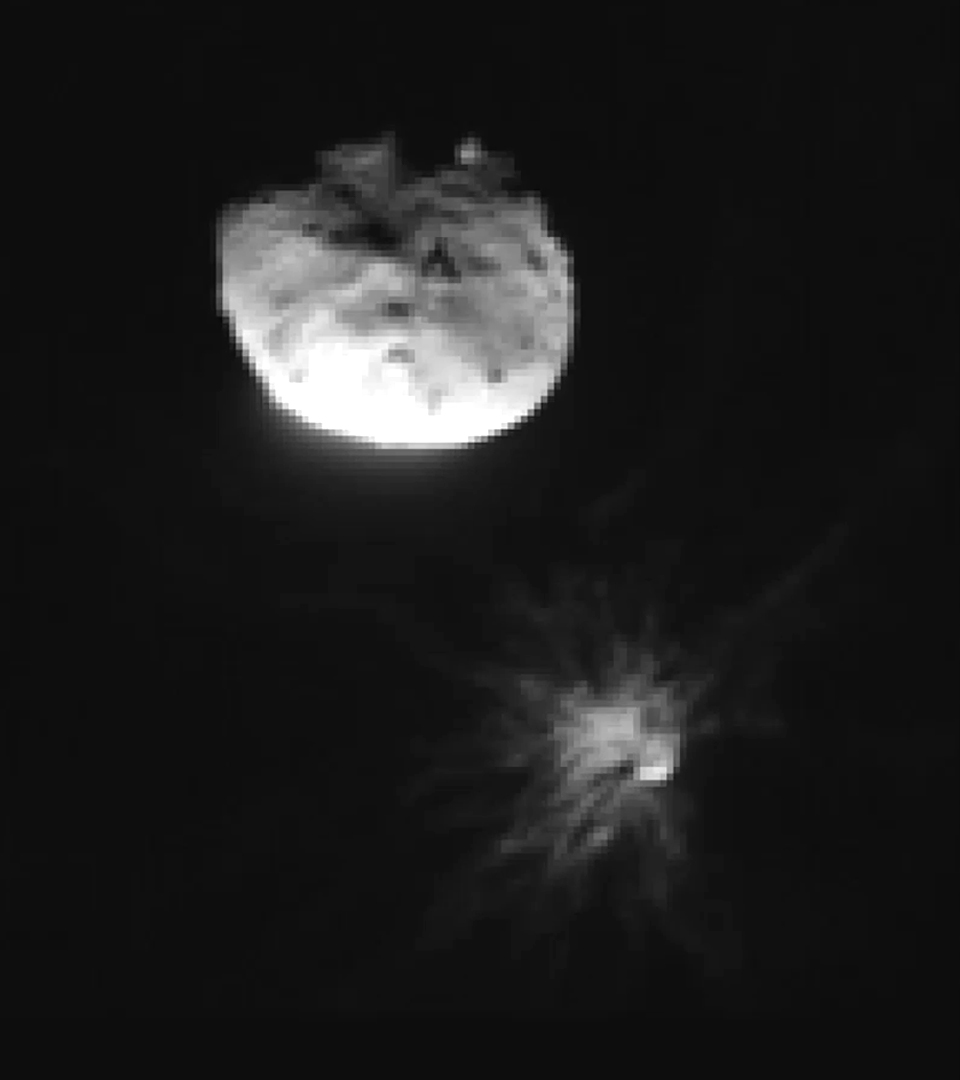
Because Dimorphos and Didymos are connected by the invisible ties of gravity, this extra push pulled both Dimorphos and Didymos off course in their orbit around the sun, changing their orbital period by 0.15 seconds.
This may not sound much, but as Makadia alludes to, it would be sufficient to push a hazardous asteroid away from Earth (so long as the asteroid is discovered in time).
To this end, NASA intends to launch a new space telescope called the Near-Earth Object (NEO) Surveyor sometime after September 2027. NEO Surveyor's mission will be to find as many of the remaining undiscovered asteroids close to Earth's orbital path as it can.
Determining the change in Didymos and Dimorphos' orbit around the sun was a labor of love, particularly for the 49 amateur astronomers who traveled to the ends of the Earth looking for stellar occultations.
A stellar occultation is when an object passes in front of a star from our point of view. When an asteroid occults a star, we can learn about the asteroid's shape, size, position and trajectory.
Stellar occultations are, alas, difficult to observe — they can only be seen from random narrow tracks across the surface of the Earth. However, thanks to the amateur astronomers who made journeys across the globe between October 2022 and March 2025 to witness 22 stellar occultations by the Didymos–Dimorphos system, Makadia and Chesley's team were able to calculate the change in the binary system's orbit around the sun.
"When combined with years of existing ground-based observations, these stellar occultation observations became key in helping us calculate how DART had changed Didymos' orbit," said Chesley. "This work is highly weather dependent and often requires travel to remote regions with no guarantee of success. This result would not have been possible without the dedication of dozens of volunteer occultation observers around the world."
Based on the orbital changes, it was also possible to calculate the densities of the two asteroids. Didymos has a density of 2,600 kilograms per cubic meter, while Dimorphos is less dense than thought, at 1,540 kg per cubic meter/, which makes it something of a loosely held together rubble pile. This supports the hypothesis that Dimorphos formed from material that was once upon a time spun-off from Didymos.
These latest findings from the DART mission were published on March 6 in the journal Science Advances.
 English (US)