
.jpg) 1 hour ago
2
1 hour ago
2
Article content
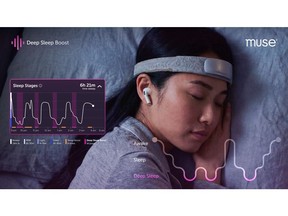
EEG-timed sound cues designed to support the brain’s most restorative sleep

THIS CONTENT IS RESERVED FOR SUBSCRIBERS ONLY
Subscribe now to read the latest news in your city and across Canada.
- Exclusive articles from Barbara Shecter, Joe O'Connor, Gabriel Friedman, and others.
- Daily content from Financial Times, the world's leading global business publication.
- Unlimited online access to read articles from Financial Post, National Post and 15 news sites across Canada with one account.
- National Post ePaper, an electronic replica of the print edition to view on any device, share and comment on.
- Daily puzzles, including the New York Times Crossword.
SUBSCRIBE TO UNLOCK MORE ARTICLES
Subscribe now to read the latest news in your city and across Canada.
- Exclusive articles from Barbara Shecter, Joe O'Connor, Gabriel Friedman and others.
- Daily content from Financial Times, the world's leading global business publication.
- Unlimited online access to read articles from Financial Post, National Post and 15 news sites across Canada with one account.
- National Post ePaper, an electronic replica of the print edition to view on any device, share and comment on.
- Daily puzzles, including the New York Times Crossword.
REGISTER / SIGN IN TO UNLOCK MORE ARTICLES
Create an account or sign in to continue with your reading experience.
- Access articles from across Canada with one account.
- Share your thoughts and join the conversation in the comments.
- Enjoy additional articles per month.
- Get email updates from your favourite authors.
THIS ARTICLE IS FREE TO READ REGISTER TO UNLOCK.
Create an account or sign in to continue with your reading experience.
- Access articles from across Canada with one account
- Share your thoughts and join the conversation in the comments
- Enjoy additional articles per month
- Get email updates from your favourite authors
Sign In or Create an Account
or
Article content
TORONTO — Muse today announced Deep Sleep Boost (DSB), a new sleep feature designed to help users sustain deeper, more stable slow-wave sleep. Powered by Muse S Athena, Deep Sleep Boost delivers targeted slow-wave sleep support using AI-driven neural signal models trained on large-scale EEG data. These models enable precise detection of slow-wave sleep and real-time timing of acoustic stimulation, addressing the brain’s most restorative sleep stage—closely linked to physical recovery, memory consolidation, and long-term brain health.
Article content
Article content
Article content
Article content
Many adults spend enough time in bed but still wake up unrefreshed. The issue is often not sleep duration, but insufficient depth. Deep Sleep Boost is designed to strengthen and stabilize deep sleep using EEG-guided, phase-timed sound cues, helping users wake feeling more restored and clear-headed.
Article content
By signing up you consent to receive the above newsletter from Postmedia Network Inc.
Article content
“Helping people fall asleep is important, but sleep quality is what ultimately drives recovery,” said Chris Aimone, Chief Innovation Officer and Co-Founder of Muse. “Over the past several years, we’ve made sustained advances in EEG-based sleep modeling, combining improved signal processing, machine learning, and large-scale training data to better understand not just when deep sleep occurs, but how it’s structured. Deep Sleep Boost builds on that foundation, using adaptive, real-time brain models to precisely time sound cues and support deeper, more continuous slow-wave sleep rather than simply adding more minutes.”
Article content
Translating sleep science into real-world results
Article content
Article content
that precisely timed acoustic stimulation during slow-wave sleep can meaningfully strengthen deep sleep. In one randomized trial, phase-locked sound cues increased slow-wave activity by nearly 50% and improved overnight memory retention by about 20%.
Article content
In a pilot study involving people with Alzheimer’s disease, nightly acoustic stimulation was associated with an approximately 60% increase in time spent in deep, slow-wave sleep.
Article content
Deep Sleep Boost translates this validated sleep science into a feature designed for consistent, real-world use at home. In beta testing, Deep Sleep Boost delivered measurable improvements in the structure of deep sleep itself, an aspect of sleep quality that matters more than simply increasing the total minutes spent in deep sleep:
Article content
- Users experienced ~24% longer slow-wave trains, meaning sustained sequences of deep sleep brainwaves, and ~42% more slow-wave trains per minute during deep sleep.
- Together, these effects resulted in ~76% more slow waves occurring within organized trains, reflecting deeper, more continuous sleep rhythms rather than fragmented deep sleep counted simply as minutes asleep.
Article content
How Deep Sleep Boost works
Article content
Muse S Athena, the world’s first consumer wearable to combine EEG and fNIRS, continuously monitors brain activity overnight. When slow-wave sleep is detected, Deep Sleep Boost delivers whisper-quiet, EEG & AI timed pink-noise synchronized to the brain’s slow oscillations to reinforce and stabilize deep sleep without waking the user.
Article content
Article content
A built-in Sleep-Safe Design automatically pauses stimulation if signs of disruption are detected. Users can customize intensity and timing preferences, with premium users able to layer Deep Sleep Boost alongside other sound tools.
Article content
Supporting the full sleep cycle
Article content
Muse’s ability to deliver effective sleep interventions is built on years of EEG-guided sleep support already in use by consumers. Muse directly measures real-time brain activity during sleep, offering advanced sleep tracking powered by validated EEG-based AI models trained on longitudinal, real-world brain data.
Article content
Deep Sleep Boost complements Muse’s broader Sleep, by Design toolkit, including:
Article content
- Sleep Assist helps users fall and stay asleep using EEG-guided acoustic cues with users reporting falling asleep 55% faster.
- Deep Sleep Boost supports sustained slow-wave sleep by delivering EEG-timed acoustic stimulation with beta users experiencing ~76% more organized slow-wave activity reflecting deeper, more continuous deep sleep.
- Smart Alarm, launching in 2026, uses EEG-informed timing to wake users during lighter sleep phases, helping reduce morning grogginess.
- Muse’s AI Coach: Enso shares clear explanations and guidance based on their sleep data to better understand nightly patterns over time.
Article content
Together, these features are designed to help users fall asleep faster, sleep deeper, and wake clearer, using real-time brain data throughout the night.
Article content
Availability
Article content
Deep Sleep Boost is available now for iOS and Android users included with every Muse S Athena at no additional cost. For more information, visit www.choosemuse.com. Samples and media interviews available upon request.
Article content
About Muse by Interaxon Inc.
Article content
Muse is pioneering brain health through its industry-leading mEEG platform, built on advanced AI algorithms. Muse spearheads decentralized research initiatives focused on enhancing mental health, optimizing sleep, and advancing cognitive performance through innovative neurotechnology. Muse’s AI-driven tools empower researchers, developers, and consumers worldwide, and are underpinned by 200+ third-party-led studies from institutions including the Mayo Clinic, MIT, and Harvard. Muse has collected and decoded over 1 billion minutes of brain data to-date. Muse is headquartered in Toronto, Canada.
Article content
References
Article content
Ngo HV, et al. Auditory Closed-Loop Stimulation of the Sleep Slow Oscillation Enhances Memory.Neuron, 2013.
Article content
Papalambros NA, et al. Acoustic Enhancement of Slow-Wave Activity during Sleep in Alzheimer’s Disease.Journal of Clinical Sleep Medicine, 2023.
Article content
Sleep Advances (2025). Advances in EEG-based sleep staging algorithms for wearable neurotechnology. *Muse has demonstrated approximately 86% agreement with polysomnography, compared to about 75% for wrist- and ring-based wearables.
Article content
Article content
Article content
Article content
View source version on businesswire.com:
Article content
Article content

Article content
Contacts
Article content
Press Contact
Article content
Article content
Max Borges Agency
Article content
Article content
Article content
Article content
 English (US)