
.jpg) 7 hours ago
2
7 hours ago
2
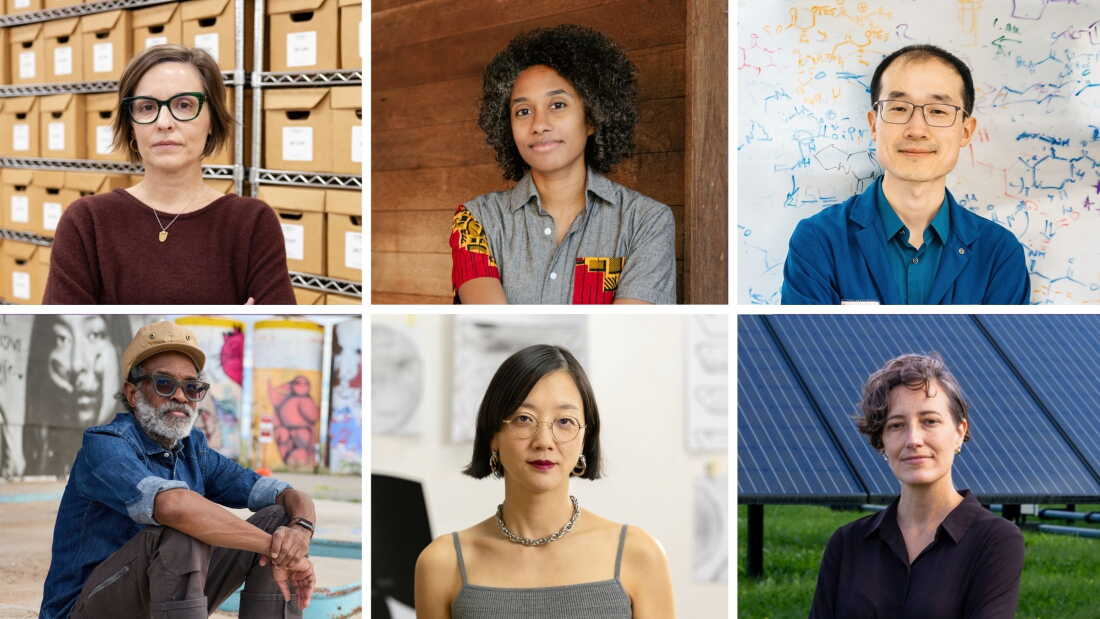
Clockwise from top left: forensic anthropologist Kate Spradley, labor economist and economic historian Ellora Derenoncourt, organic chemist Song Lin, sociologist and energy policy researcher Holly Jean Buck, artist Christine Sun Kim and public artist Chip Thomas. John D. and Catherine T. MacArthur Foundation hide caption
toggle caption
John D. and Catherine T. MacArthur Foundation
A historian who studies racial wage gaps, a saxophonist whose live performances include a chef cooking meals onstage and a forensic anthropologist who repatriates the remains of migrants who perished along the Texas-Mexico border — they are all among the latest recipients of the MacArthur Foundation's no-strings-attached, $800,000 fellowship grants.
As usual, this year's winners come from a wide range of professional disciplines. But they converge in their interests in sometimes unexpected ways. For example, visual and sound artist Christine Sun Kim, philosopher and cognitive scientist Felipe De Brigard and novelist Bryan Washington all explore human connection and healing — from radically different creative standpoints.
Here are the 20 individuals whom the foundation's network of scouts selected as recipients of the prestigious fellowships, popularly known as "genius grants."
Fellows seeking solutions for climate change
Holly Jean Buck: The University of Buffalo sociologist centers on ethical and political questions around climate change policy. For example, in her 2019 book After Geoengineering, Buck argues that carbon removal systems must be designed to serve local communities and the public interest rather than corporate profit.
Kaiyu Guan: The University of Illinois Urbana-Champaign climate scientist brings together satellite data and machine learning to figure out how to boost food productivity while at the same time reducing environmental impacts. Among other achievements, Guan has created digital platforms that simulate how crops might respond to future weather patterns, water availability and land management practices.

Marika Holland: Based at the National Center for Atmospheric Research in Boulder, Colo., the climate scientist works to predict the complex interactions between polar sea ice and global climate dynamics. For example, Holland demonstrated that as sea ice thins past critical thresholds, exposed ocean water and surface melt absorb more solar radiation, accelerating ice loss and triggering rapid polar warming.
Fellows rewriting American history and economics
Elizabeth Ellis: The Princeton University historian's scholarship of Indigenous sovereignty and commercial relationships shifts the usual focus away from large Native confederations to reveal how smaller Indigenous groups actively shaped early American history. For instance, Ellis' 2022 book, The Great Power of Small Nations: Indigenous Diplomacy in the Gulf South, explores how such groups in the Lower Mississippi Valley interacted with early European settlers.

Ellora Derenoncourt: The Princeton University labor economist and economic historian studies the historical drivers underpinning the racial wealth gap in the United States. Her groundbreaking work on the 1966 extension of the Fair Labor Standards Act shows that extending minimum wage protections to previously excluded, Black-dominated sectors such as agriculture, service industries and domestic work radically decreased the Black-white earnings gap during the late 1960s and early 1970s.
Ariel Ron: The Southern Methodist University historian's research into 19th century farming practices challenges longstanding narratives about a purely industrial, capitalist North versus an agrarian, slave-holding South. For example, his 2020 book Grassroots Leviathan: Agricultural Reform and the Rural North in the Slaveholding Republic demonstrates that Northern family farms were a powerful political and economic force rather than a mere backdrop to industrialization.
Fellows confronting political violence, memory and justice

Maaza Mengiste: The novelist and Wesleyan University English professor's fiction blends deep historical research with the sometimes competing perspectives of multiple characters to explore the individual and societal harms of conflict. For example, her 2019 novel The Shadow King focuses on the little-known history of Ethiopian women who took up arms against fascist Italian forces during and after the Second Italo-Ethiopian War, which started in 1935.

Vincent Valdez: The Texas-based visual artist, who divides his time between Houston and San Antonio, subverts classical European painting traditions to depict everyday working-class people, particularly from Chicano communities. For the installation El Chavez Ravine, created in collaboration with American musician Ry Cooder, the artist painted a 1950s ice cream truck with scenes of Mexican American displacement in Los Angeles as the Dodger Stadium was built.
Rodney McMillian: The visual artist and University of California, Los Angeles professor works with sculpture, painting, video and installation to highlight systemic inequality, institutional violence and historical erasure — focusing on the American South. A recent series on paper pairs painted sunsets with quotations from historical housing records to highlight the legacy of discriminatory housing practices.

Kate Spradley: The Texas State University forensic anthropologist works to identify and repatriate the remains of migrants who have perished along the Texas-Mexico border. In 2013, Spradley founded Operation Identification (OpID). The humanitarian and forensic research initiative combines forensic science, cross-border DNA databases and humanitarian partnerships to return remains to family members.
Fellows creating new pathways for human health
Liangfang Zhang: The University of California, San Diego chemical and biological engineer is a pioneer in the field of biomimetic nanomedicine — in other words, the creation of "stealth" drug delivery systems. Zhang's groundbreaking method of cloaking synthetic nanoparticles with natural cell membranes delivers drugs and neutralizes toxins without being rejected by the immune system.
Song Lin: The Stanford University organic chemist's research, among other achievements, has advanced the organic electrosynthesis process, using clean electricity rather than toxic chemical reagents to craft custom molecules for new drugs, as well as materials like polymers. Lin is a pioneer in demonstrating how simple electrical currents — even from a couple of AA batteries — can replace expensive, toxic heavy metals to synthesize complex molecules for medicine.
Vincenzo Vitelli: The University of Chicago physicist's work bridges theoretical physics with the mathematical field of topology to model how forces and movement flow through living tissues and active cells. For instance, by studying how biological tissues respond to physical stress, Vitelli's theories help describe tissue growth and wound healing. This understanding offers insights into how organs maintain shape or how diseases like cancer alter the elasticity of cells.
Fellows transforming how we communicate, perceive and heal
Christine Sun Kim: Born deaf, the Berlin, Germany-based sound and visual artist uses charcoal drawings, musical notation, performance and video art to reframe sound as a visual and tactile medium rather than an exclusively auditory one. Kim's large-scale charcoal drawings combine musical symbols like dynamics, staves and rests with American Sign Language grammar to make the nuances of ASL visible to non-signers, building a bridge between linguistic worlds.
Felipe De Brigard: The Duke University philosopher and cognitive scientist explores the flexibility of the human memory. His projects, including fieldwork with victims of political violence in Colombia, provide frameworks for how individuals and communities can process and heal from historical trauma.

Bryan Washington: The Tokyo, Japan-based novelist's spare, intimate fiction redefines how modern relationships — especially among queer men of color and their families — are built, strained and repaired. In works like Lot, Memorial and Family Meal, the healing often happens at the dinner table in quiet scenes that expose the complex, messy reality of modern relationships alongside moments of beauty and humor.
Layli Long Soldier: The Santa Fe, New Mexico-based poet pulls apart official legal documents to expose how words can be used as instruments of state violence. For example, in her 2017 collection Whereas, Long Soldier contrasts the bureaucratic language of documents like the 2009 U.S. Congressional Resolution of Apology to Native Americans with Lakota cultural teachings and personal prose to highlight how formal governmental apologies can mask ongoing systemic harm and historical erasure.
Fellows redefining performance and public space
Trajal Harrell: The Zürich, Switzerland-based dancer and choreographer melds dance styles, artists and cultures. For example, Harrell's performance series Twenty Looks or Paris Is Burning at The Judson Church merges the Harlem ballroom scene's voguing tradition with avant-garde postmodern dance.
Chip Thomas: At 69, the visual artist, based in Flagstaff, Ariz., is the oldest MacArthur award recipient in 2026. Thomas' work as a primary care physician for 36 years on the Navajo Nation informs his artistic endeavors. For instance, Thomas "corrected" billboards on the Navajo reservation by turning the slogan "Welcome to Pepsi Country" into "Welcome to Diabetes Country" to highlight the impacts of American capitalism on the landscape and community.

Immanuel Wilkins: The 29-year-old New York-based saxophonist and composer is the youngest person on the MacArthur roster this year. He transforms traditional concert venues into multisensory spaces. For instance, while performing his Blues Blood album live, he played alongside a chef cooking meals onstage, filling out the musical composition with the sounds of knives chopping, water boiling and oil frying in a pan.
Note: The MacArthur Foundation is among NPR's financial supporters.
 English (US)