
.jpg) 1 hour ago
3
1 hour ago
3
In the quest to find ways to help us live at a healthier level for a longer period of time, researchers are turning to existing drugs for clues.
Medicines that are available for purchase are already approved for people to use, and it can be quicker and cheaper to repurpose them for longevity and aging studies than to try to discover and test entirely new medical compounds.
Finding medications that might affect biological aging or lifespan is still a challenge though, as there are a lot of pharmaceuticals out there.
To try and narrow down the search, a team from Northeastern University and Harvard Medical School has come up with a new framework for identifying promising candidates.
Their framework, described in a new study in Nature Aging, works by matching drugs to clusters of genes and proteins that are connected to hallmarks of aging: those changes in the body that build up over time, like cells having less energy to work with.
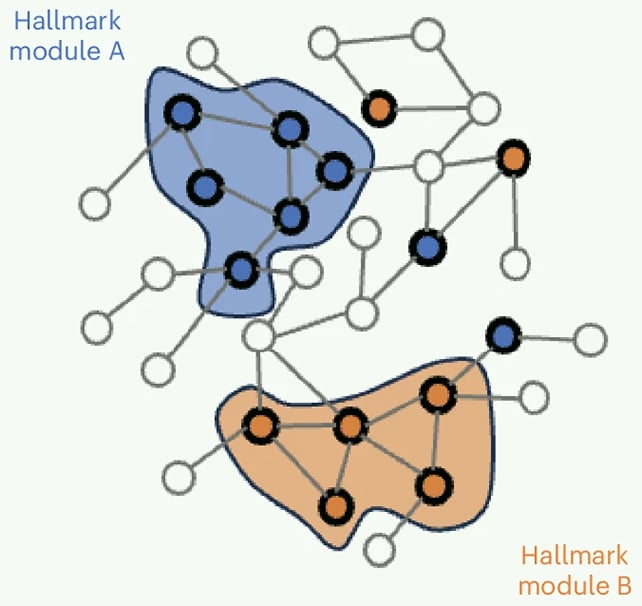 The researchers found genes related to aging hallmarks were clustered together on a map of protein interactions. (Gross et al., Nat. Aging, 2026)
One of the drug candidates identified by this new process is oxymetazoline. It's available over-the-counter as a nasal spray for congestion (branded as Afrin or Sinex), as eye drops for eye redness, or as a topical cream for facial redness caused by rosacea.
It hasn't previously been linked to longevity research, but through the new method, the study team discovered that it can improve cell-to-cell communication – something else that naturally wears down as we get older, impairing numerous biological functions.
"Ultimately, our findings underscore the potential of leveraging the extensive hallmark-associated genetic evidence to identify drug-repurposing candidates for healthy longevity," write the researchers in their published paper.
The research process started by collecting information on 1,250 genes already associated with one or more hallmarks of aging.
The genes were then mapped out on the human interactome, an existing database of the proteins produced by genes, and how they interact with each other – in more than half a million different ways.
This protein mapping revealed that genes related to aging all clustered around specific interactome areas, grouping around the various aging hallmarks. By looking at where these clusters overlap, researchers can identify drugs that may work on several hallmarks.
"The challenge is figuring out which drugs are worth testing." – network scientist Albert-László Barabási
"If the genes were spread randomly, there is no way for a drug to specifically affect it because it's spread all over," says network scientist Bnaya Gross from Northeastern University.
"[Our] discovery is that aging genes are located in very specific areas, a very specific neighborhood, allowing you to find drugs that affect this neighborhood."
The next step was taking this information and then finding existing drugs that would influence these genes and proteins, from a list of 6,442 medications already in a recognized pharmaceutical database.
Another metric was introduced at this stage, to gauge not just which drugs hit which genes, but also whether they accelerated or slowed down aging processes.

That led the team to oxymetazoline, as well as other promising candidates such as aspirin (which is already being investigated for its anti-aging properties).
"This study does not provide a cure for aging, nor does it prove that any specific drug will extend human life," says network scientist Albert-László Barabási, from Northeastern University.
"It offers a roadmap… toward actionable interventions that can be tested in cells, animals and eventually humans."
There are of course multiple contributors to aging and age-related disease, and it's likely that anti-aging treatments aimed at boosting lifespan and health are going to have to target several of them simultaneously.
With innovative approaches like this, that robustly identify which drugs might be most useful and why at the same time, we should be able to get closer to developing treatments that can genuinely slow the passage of biological time.
Related: Study Reveals The Age You Hit The 'Tipping Point' Into Frailty
"As someone whose hair turned gray years ago, I share the universal wish that there might one day be a pill that slows aspects of aging," says Barabási.
"The challenge is figuring out which drugs are worth testing."
The research has been published in Nature Aging.
This article was fact-checked by Rachel Garner and edited by Peter Dockrill. While we pride ourselves on our process, we are only human. If you spot a mistake, please let us know.
 English (US)