
.jpg) 3 hours ago
3
3 hours ago
3
There's something wrong with the center of the Milky Way.
For decades, astronomers have puzzled over a vast population of antimatter particles, or positrons, that collide with electrons to annihilate in flashes of gamma rays around the center of our galaxy.
The problem is that known astrophysical sources cannot account for how many positrons the Milky Way appears to produce – and now a pair of physicists has reported evidence that could make that problem worse.
According to a new paper by Thomas Siegert of the Julius Maximilian University of Würzburg in Germany and Hiroki Yoneda of Kyoto University in Japan, the gamma-ray signature of matter-antimatter annihilation may have been detected outside the Milky Way for the first time.
At least one location suggests that some positrons may be escaping far beyond the Milky Way's disk before annihilating.
If true, that could mean the Milky Way is producing significantly more antimatter than previous estimates indicated.
"This would be the first detection of extragalactic positron annihilation," Siegert told ScienceAlert.
"That in itself would mean that the positron content of the Milky Way is much larger than what is currently observed 'inside'."
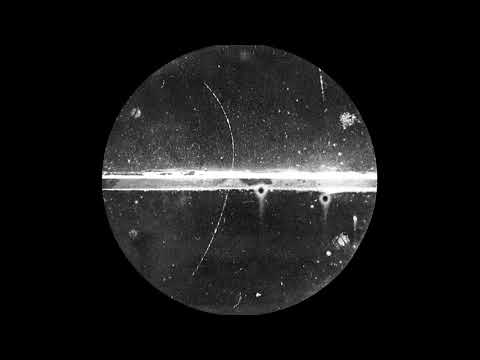
Positrons are the antimatter counterpart of electrons – they carry the same mass and spin, but the opposite electric charge. When a positron and an electron meet, they mutually annihilate each other in a puff of gamma rays that has a characteristic energy of 511 kiloelectronvolts.
Astronomers have been mapping this emission across the Milky Way for decades to identify the galaxy's positron annihilation hotspots – but with those hotspots has come a perplexing puzzle. There appear to be far more positrons annihilating than known astrophysical sources can comfortably explain.
Even after accounting for positrons produced by radioactive isotopes forged in stellar explosions, black holes, neutron stars, and other energetic objects, the observed annihilation signal still cannot be fully explained.
The European Space Agency's INTEGRAL space telescope spent more than 20 years observing the gamma-ray sky, from 2002 to the mission's end in 2025.
Siegert and Yoneda were analyzing the complete INTEGRAL dataset to compile the most detailed maps of the Milky Way's 511 keV emission yet when they noticed something odd.
"We tried to figure out what could go wrong here," Siegert explained.
"For example, we split up the dataset into 3-year intervals, then compared the resulting images to each other, then constructed images as a cumulative dataset, incorporating 3 years, then 6, then 9, etc.
"The signals were always there and then appeared to be more significant with more time. This is not something you'd expect from an instrumental background systematic."
The most compelling signal appeared to come from Complex C, a vast cloud of hydrogen gas falling toward the Milky Way disk.
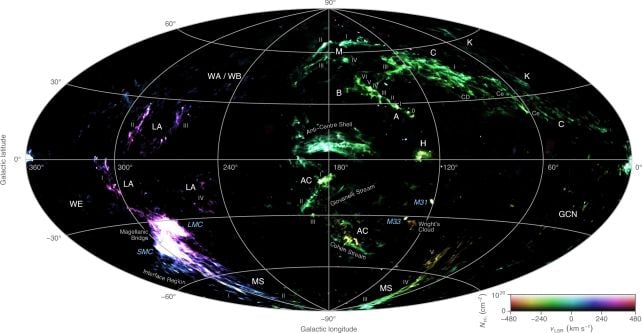 A map of high-velocity clouds in the Milky Way. Complex C is in the upper right quadrant. (Westmeier, MNRAS, 2018)
Another tentative signal was detected from the Magellanic Stream, a ribbon of gas that trails behind the Large and Small Magellanic Clouds as they orbit the Milky Way.
Neither region is expected to produce many positrons on its own, which suggests that the particles might have traveled there before annihilating. The authors argue the particles may have escaped the Milky Way itself – but that introduces a new puzzle.
"For positrons to annihilate efficiently, they need to be very slow. The typical idea of antimatter that is just violently destroying matter everywhere is not the case in space. So, if the positrons need to be slow to annihilate, they would never manage to escape the Milky Way," Siegert explained.
"That means there is a fraction of positrons at higher energies that escape the Milky Way to slow down in the gas of the Magellanic Stream. That escape was basically unexpected."
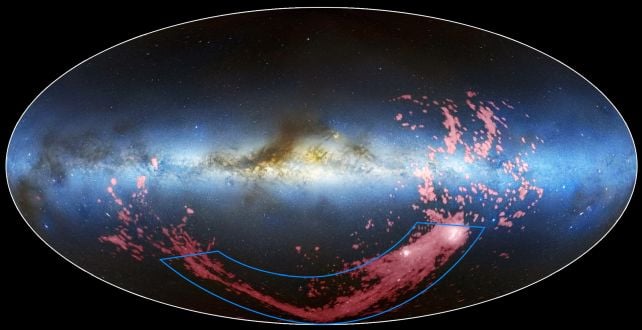 The Magellanic Stream. (David L. Nidever et al., NRAO/AUI/NSF and Mellinger, LAB Survey, Parkes Observatory, Westerbork Observatory, and Arecibo Observatory)
If that interpretation of the data is correct, then it may have just deepened one of the longest-running antimatter mysteries.
Astronomers estimate how many positrons the Milky Way produces by observing where they annihilate. If some positrons escape the Galaxy before slowing down and annihilating, that suggests that the galaxy's positron production is significantly higher than current estimates.
Siegert and Yoneda estimate that the Milky Way might be producing 100 tredecillion positrons per second, which is 2-3 times higher than other estimates.

"The propagation is indeed an interesting issue here, but I would say that the origin of positrons that are seen to annihilate is then even weirder," Siegert said.
"We have the problem of explaining the sheer number of positrons in the Milky Way. If it turns out to be even more, we are running out of conventional astrophysical sources to explain them."
The detections still carry a reasonable degree of uncertainty. The strongest signal reached 4 sigma, which means there's a roughly one-in-15,000 chance it emerged from a statistical fluctuation. Physics requires a certainty of 5 sigma to claim a discovery.
Siegert is confident that a real annihilation signal exists, but says future observations will be needed to determine whether the strength of the signal has been measured correctly.
Related: Major Antimatter Discovery May Help Solve Mystery of Existence
Future observations using NASA's Compton Spectrometer and Imager (COSI), due to launch in 2027, should be able to determine whether these faint annihilation signals – which Siegert and Yoneda call "tantalizing hints" – are genuine and help trace where the Milky Way's positrons are born.
If confirmed, the findings would deepen one of astronomy's oldest antimatter mysteries, pushing conventional astrophysical explanations closer to their limits.
"At some point, we would need to introduce unconventional dark matter models to get this number of positrons, such as light dark matter particles," Siegert said.
The research has been published in Astronomy & Astrophysics.
This article was fact-checked by Clare Watson and edited by Rebecca Dyer. While we pride ourselves on our process, we are only human. If you spot a mistake, please let us know.
 English (US)